

On-site Refueling

On-site fueling provides simplicity, convenience and cost-effective productivity with your next project.

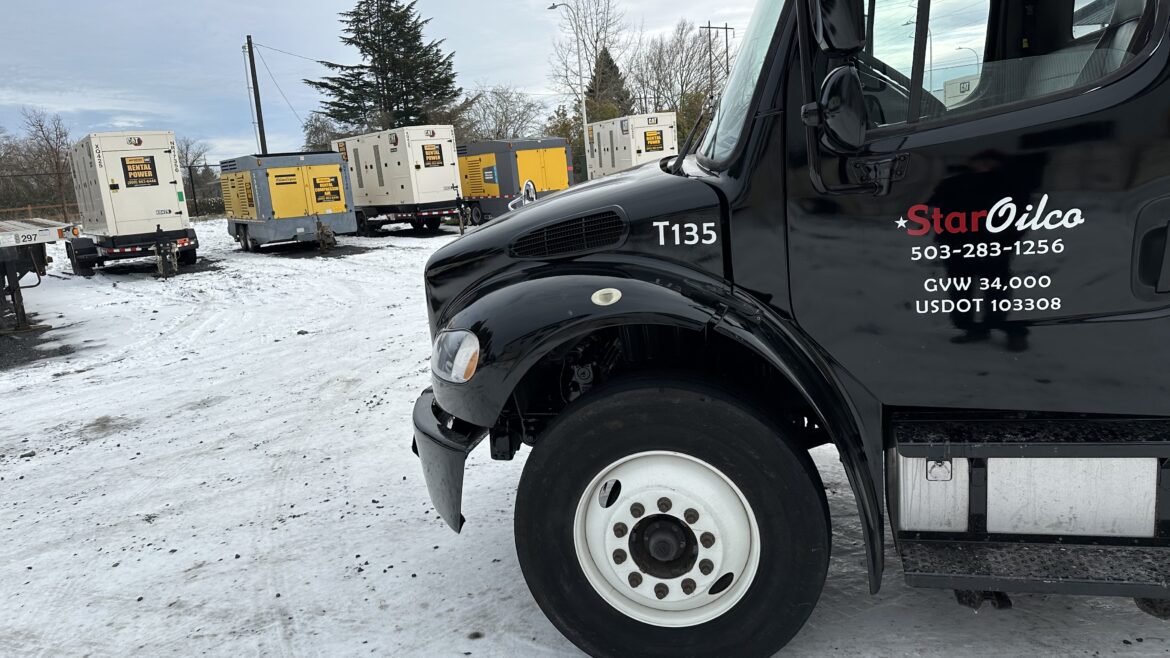
Star Oilco truck refueling off-road diesel at a job site in Portland OR
Every Question We Have Been Asked About Renewable Diesel 1024 768 Star Oilco

Every Question We Have Been Asked About Renewable Diesel

Renewable Diesel Frequently Asked Questions (FAQ)

Every Question we have been asked about Renewable Diesel

What is renewable diesel?

Renewable diesel is a synthetic diesel fuel, known for it’s lower CO2 characteristics, typically seeing purity and real world performance response superior to petroleum diesel fuel.  Renewable diesel is a next generation hydrocarbon diesel biofuel made by either the Fischer-Tropsch or Hydrogenation processes.
Hydrogenated renewable diesel is made by taking fats, oils, and greases by use of a hydro-treater.  The biomass based oil or fat is cracked and reformed in the presence of hydrogen and  catalyst forming a hydrocarbon diesel molecule.

Fischer-Tropsch renewable diesel is used by converting any btu dense feedstock (wood waste, woody biomass, municipal garbage, coal, and an endless list of low value waste products into syngas, then converting this into a wax that is reformed into hydrocarbon diesel.

Is it true that Renewable Diesel reduces CO2 emissions by more than half?

It depends on the feedstock and processes that determine the fuel pathway.  But for the most part it is safe to presume that if you use a R99 Renewable Diesel product in Oregon that it will have a lower than 50CI which would cut the CO2 emissions in half versus an equivalent gallon of gasoline used.  Sometimes Renewable Diesel can be blended with fossil fuel diesel as well as biodiesel.  Star Oilco currently presumes 99% renewable diesel is the fuel being used when describing Renewable Diesel and “cutting emissions in half” as a claim, backed up by the scientific data associated with the Oregon Clean Fuels Program and its pathways.

According to the Oregon Clean Fuels Program list of pathways for Renewable Diesel approved to be sold in Oregon shows the lowest CO2 value to be 16.36 CI and the highest to be 65CI.  Most, nearly all, of the Renewable Diesel pathways in Oregon are below 50% reduction in CO2 emissions associated with the fuel.  You can see these by reviewing the downloadable spreadsheet of “Fuel Pathways – Carbon Intensity Values” available on the left hand side of the Oregon Clean Fuels Program website under the heading “Participating Facilities” as an easy sharable link is not available.

To learn more about this please see the Oregon Department of Environmental Quality’s Clean Fuels Program page where CO2 emission pathways are disclosed for renewable fuels distributed in Oregon.  The system used to measure CO2 emissions and reduction is a modified Oregon “GREET” model.  GREET stands for Greenhouse gas, Regulated Emissions, and Energy Use in Technology. The GREET scientific system to review CO2 emissions was developed by the US Department of Energy and similar systems are used by California and Washington in their Low Carbon Fuel Standards as well.

Is HVO or Hydrogenated Vegetable Oil the same as Renewable Diesel?

Yes.  HVO is either R100 or R99 renewable diesel. The reason you will hear the phrase HVO or Hydrogenated Vegetable Oil instaed of renewable diesel is that the regulations and various incentives for renewable diesel have restrictions.  If renewable diesel is used in stationary power generation it is treated differently for the various subsidies and incentives.  The regulations on fuels for vehicles and equipment differ compared to utility scale power generation.  For this reason the power generation industry will refer to renewable diesel as “HVO” to denote it’s end use.

Is Sustainable Aviation Fuel or “SAF” the same as Renewable Diesel?

No.  Sustainable Aviation Fuel or “SAF” is a Jet A specification or a Number 1 diesel fuel. A Number 1 diesel fuel can be mixed with Number 2 without impacting it’s specification requirements.  Number 1 though cannot be mixed with Number 2 diesel weights and stay in specification.  It is a lighter end than Number 2 diesel meaning it has a different specific gravity weight of the fuel.   So in short SAF can be used as Renewable Diesel but has a much higher standard to meet than is required for Renewable Diesel. Therefore the products are very different based on this need for quality assurance to meet the aviation jet fuel specification.

There is a huge demand for Sustainable Aviation Fuel and many of the current Renewable Diesel plants in operation are upgrading their technology to make SAF.  It is expected that in the hydrotreating processes to make renewable diesel and SAF, the Jet A fuel specification is a harder one to produce.  So as the refining of SAF increases we will expect to see subgrade SAF (product made to be SAF that does not meet the standard) be moved to the Renewable Diesel market.  We will not see Renewable Diesel being used in jets though.

Can Renewable Diesel be used as Heating Oil?

Yes.  Renewable Diesel is a synthetic hydrocarbon diesel fuel.  It can be used interchangeably with petroleum diesel products of similar grade. Heating Oil is typically number 2 diesel which is the same specification as Dyed R99 Renewable Diesel (or blends of Renewable Diesel with petroleum diesel).   Star Oilco now offers R99 Heating Oil delivered in the Portland metro region area of Oregon.

Most modern oil heat appliances use a Becket Burner.  For more on heating fuel compatibility with oil furnaces and oil burning appliance please see “Alternative Fuels and Becket Burners” for more information.

Why do people use renewable diesel over petroleum diesel?

Fleet managers operating R99 Renewable Diesel report a lower mechanical cost of operation using the fuel.  Beyond the immediate benefit of R99 cutting CO2 emissions by half or more, fleets experience performance benefits from the fuel.  The big savings are seen the the performance of Tier 4 Emission systems on modern diesel seeing far less wear of the Diesel Particulate Filter system as well as far fewer regenerations of the system.  Additionally Renewable Diesel is a very clean and dry diesel fuel improving the storage stability, field operation, and general predictability of the fuel’s performance.

How do I know Renewable Diesel is being sold at a retail location?

Renewable Diesel is a hydrocarbon diesel that meets the specification for petroleum diesel known as ASTM D975 specification.  This means currently R99 can be readily blended and sold with petroleum diesel without a disclosure.  The US Federal Trade Commission and local state Weights and Measures have rules for retail pump labeling.  Blend percentages of biomass based diesel must be labeled especially if being advertised.  As R99 Renewable Diesel has a higher value and is sought out by many consumers though usually it is disclosed.  The pump labeling for R99 Renewable Diesel typically looks like the below.

R99 Renewable Diesel fuel dispenser label

What is renewable diesel made of?

Renewable diesel can be made from a host of things, usually a low value waste product. The most common feedstock used currently is waste vegetable oil, wastes from animal rendering, and other biologically derived oils. Processes using bio-oils are following a Hydrogenation process to turn low value waste oils into high value diesel and jet fuel.

Chevron Renewable Energy Group and Diamond Green Diesel (Diamond Green is in a joint venture with Valero) are the largest producer of renewable diesel with their REG Ultra Clean Diesel product in the United States. Neste is the largest producer of renewable diesel internationally, with its “Neste My” product.  being the two largest producers of low CO2 bio-oil derived renewable diesel fuels.

Major petroleum refiners have also turned around existing petroleum refineries into Renewable Diesel Refineries to produce this in demand low CO2 fuel. HF Sinclair , Marathon, Phillips 66, and Montana Renewables. There are quite a few newer Renewable Diesel projects planned and in progress around the United States as well as in the Pacific Northwest.

Other refiners of renewable diesel (on a much smaller scale of production) are using a Fischer-Tropsch process with wood waste, sorted higher grade municipal garbage, and other high btu value carbon based waste products.  Many expect this to technology to be the future of all diesel and jet fuel refining turning refuse into fungible low carbon fuel.

What is renewable hydrocarbon diesel?

Renewable hydrocarbon diesel is a synthetic diesel fuel made from non-petroleum feedstocks like vegetable oil, animal fats, municipal waste, agricultural biomass, and woody biomass. It is characterized by having a low CO2 and renewable resource for its feedstock and is made without crude petroleum, coal, or natural gas as a direct feedstock input in the refining process.

How do they make renewable diesel?

Renewable diesel is made by several processes. If you are buying renewable diesel, it is probably from a Hydrogenation process used by Renewable Energy Group and Neste for their products. Other smaller volume producers are using a Fischer-Tropsch process or Fast Pyrolysis. Both processes involve taking energy dense molecules, cracking those molecules under heat and pressure, then reforming them in the presence of a catalyst and added hydrogen, which forms a renewable diesel molecule.

Is renewable diesel a lower carbon fuel compared to petroleum diesel?

Yes, to this point all renewable diesel made from renewable feedstocks have appeared to be a lower CO2 fuel compared to petroleum diesels. The California Air Research Board in particular has done research on this in depth.

The low CO2 lifecycle emissions of Renewable Diesel also is tracked closely and supervised by California’s Low Carbon Fuel Standard, Washington’s Low Carbon Fuel Standard, and Oregon’s Clean Fuels Program. The highest value markets for low CO2 fuels in the United States are California and Oregon, which both have mechanisms that track and price the CO2 intensity of diesel fuels as well as the sustainable lower CO2 substitutes and blend-stocks that can go in those diesels. They track, rate, and determine the carbon intensity of the fuels providing a neutral and scientifically defensible number for CO2 reduction.

Is renewable diesel available in Oregon?

Renewable diesel is readily available for delivery from Star Oilco throughout the Pacific Northwest via 10,000 gallon volumes of bulk delivery.   Star Oilco is also offering bulk delivery of any size and mobile onsite fueling service within 100 miles of the Portland, Oregon market.

Star Oilco has R99 Renewable Diesel available with a Star Oilco CFN Cardlock card in Portland, Oregon.

What is the difference between biodiesel and renewable diesel?

Biodiesel and renewable diesel are very different fuels made with very different processes. In a nutshell, biodiesel is made with a simple chemical reaction that turns vegetable and animal fats into fuel. Renewable diesel is made from far more complicated process where vegetable and animal fats (as well as other feedstocks) are cracked on a molecular level and built back into synthetic diesel fuel.

What is the difference between renewable diesel and Sustainable Aviation Fuel?

The difference between the fuels is the specific gravity and general specification for what the fuel is used for. Jet fuel, or Sustainable Aviation Fuel, and on-road diesel fuel are different fuels and therefore have different specifications. Renewable diesel is typically referring to a #2 diesel specification for on road diesel use.

Sustainable Aviation Fuel or “SAF” is typically referring to “Jet A” or “JP8” jet fuel specification for fuel. This is a #1 diesel range fuel with use and handling requirements that are far more stringent than for on-road or off-road diesel fuels. Renewable jet fuel can be used as a kerosene or #1 diesel fuel but renewable diesel cannot be used as a jet fuel.

Where do I buy renewable diesel in Oregon or Washington?

Renewable Diesel is currently available for bulk delivery and mobile onsite fueling. It will soon be offered at commercial cardlock in the Portland area. It is being sold as R99 and as Ultra Clean Diesel, which is a mixture of biodiesel, renewable diesel, and petroleum diesel.

What is R99?

R99 stands for 99% renewable diesel and 1% petroleum diesel.  Federal rules over alternative diesel fuels made fuels requires that manufacturers of non-petroleum derived diesel fuels must blend a minimum 1% petroleum with the fuel to generate a Renewable Industry Number or “RIN” under the US Federal Renewable Fuel Standard. Additionally there are other incentives that require a “blender of record” to receive these tax credits.

Is renewable diesel being made in Oregon?

As of Spring 2022, renewable diesel is not being manufactured in Oregon. There is a major projects underway, Next Renewable Fuels in Port Westward, Oregon.

What is renewable diesel made from?

Renewable diesel can be made from many energy dense carbon based material.  By volume of produced product sold in the United States, vegetable oils and animal fat-based wastes are the most common feedstock. Woody biomass, agricultural wastes, and sorted municipal wastes are also sources for renewable diesel production.

Is renewable diesel made from palm oil?

Palm oil can be used as a feedstock for renewable diesel. There are producers who use palm oil as a feedstock. In the United States, feedstocks and carbon intensity are tracked closely under both Oregon and California’s fuel programs.  You can determine if a supplier is using palm oil as a feedstock through these regulated pathways.

How much does renewable diesel cost?

This is a tough question to answer given there are several markets intersecting.  From the feedstocks to the market demand for the finished product as well as both California and Oregon’s Clean Fuel Standards which place a price on the CO2 intensity of the fuel which reduces the cost of the fuel if consumed in Oregon and California.

It has consistently been trending between the same cost and over $1 a gallon higher than petroleum diesel depending on the state, you buy renewable diesel in. In California, renewable diesel is very close to petroleum diesel depending on the value of CO2 credits for lower-carbon fuels. In Oregon, it has consistently been between $.05 to $.80 a gallon higher than diesel also depending on the value of CO2 abatement associated with the fuel and what these carbon credits are trading for.

When petroleum diesel costs are high Renewable Diesel tends to be more competitive with petroleum diesel.  When petroleum diesel is below $3 a gallon the cost of Renewable Diesel by comparison is usually higher unless CO2 credits are in higher than normal demand for Clean Fuels Program demands.

Can you mix petroleum diesel and renewable diesel?

Yes. Renewable diesel and petroleum diesel can be blended in any mixture without worry. They are drop-in substitutes for each other in your fleet’s use.  Renewable Diesel is a drop-in fuel. It is a hydrocarbon diesel that will work mixed with diesel or biodiesel blends of petroleum diesel.

Green fuel nozzle representing renewable diesel with Star Oilco logo - serving Oregon and Washington fleets.

Learn more about renewable diesel and how it can benefit your operations. Contact us today.

Contact Form

  • This field is for validation purposes and should be left unchanged.
Star Oilco fuel tanker truck delivering diesel to refrigeration unit during icy winter conditions
Do you need Refrigerated Trailer fuel? We fuel reefers automatically. 1024 768 Star Oilco

Do you need Refrigerated Trailer fuel? We fuel reefers automatically.

Refrigerated Trailer Fueling Service.

Dyed Diesel delivered to your trailer.

Need to keep your refrigerated trailer running during the summer heat in the Pacific Northwest? When temperatures rise, having a reliable reefer trailer is more important than ever to protect your inventory. That’s where Star Oilco comes in. Our team provides fast, dependable refrigerated trailer fuel delivery in Portland, Salem, Vancouver, and nearby areas. We’ll keep your cold storage trailers fueled and your goods safe, so you can focus on your business, not the weather.

Keep your refrigerated trailer running with our automatic keep full program.

Reefer trailer fuel service

Refrigerated trailers, often also called “reefers” in trucking.  These are popular in grocers, food processors, and many other industries. Reefers expand refrigerated inventory for grocers during the food rush of the holidays, and Star Oilco is ready to keep your inventory cold.

Star Oilco is the Portland area’s leading refueler of refrigerated trailers. We’re ready to help you expand your on hand inventory by supplying dyed diesel for your refrigerated trucks. We have the industry’s lowest price for service, a flat fee of $65 for service on an automatic keep full schedule. We’ll keep your inventory the right temperature this holiday season! Our trucks are ready and on the road driving past your location. This program is designed specifically in response to grocers and food processors needing a partner to simplify their refrigeration needs during their busiest time of year.

We make it one less thing to worry about.

How often should you fuel your refrigeration trailer?

Reefer Trailers typically can run for two days without a refuel if opened only once or twice a day.  Three days if you go a weekend without opening the trailer if fueled on Friday.  If you have staff leaving the door open regularly expect to need fuel daily.

Refrigerated trailer fueling. Keep full program.

Call for service. The first step is to open an account or run the service on a credit card, fleet card, or other payment method used by your business. 

Star Oilco can provide either Ultra Low Sulfer B5 Diesel, or low CO2 R99 Renewable Diesel to your reefer. All fuels are dyed and for off-road use to avoid the expensive taxes associated with using clear diesel from a gas station pump. All of our dyed diesel is treated with Hydrotex PowerKleen Premium Diesel. This additive guarantees long-term storage stability and improves performance at time of combustion.

A refrigerated trailer typically burns between 10 and 15 gallons a day in the Portland area during the winter. In our experience, fuel burns faster if the door is continually opened. Some customers are able to get by with service twice a week. Given this experience, we usually recommend a refill schedule of three days a week. This ensures you have no downtime or worry with the refrigerated trailer.

Customers on automatic keep full schedule receive emergency response services for fuel theft at no additional charge. We will be there for you to make running your business that much easier.

Also remember if you are storing a trailer onsite for back up or overflow purposes you will want to prepare the fuel in the tank for long term storage. Star Oilco’s fuel additives ensure the storage and make sure your refrigerated trailer fires when you need it to.

To set up Refrigerated Trailer Refueling Service call or email our office.

We are ready to keep you full.

Construction equipment fuel delivery service

Message us below if you want to get a call back from our Dispatch about setting up service or call 503-283-1256 for immediate service.

Contact Form

  • This field is for validation purposes and should be left unchanged.
greenhouse gas emissions reduction graphic by Star Oilco
Why diesel fuel in Oregon may go up in 2025 940 788 Star Oilco

Why diesel fuel in Oregon may go up in 2025

What are the market forces impacting diesel in Oregon for 2025?

There are some big changes coming for diesel fuel in Oregon and it is not widely reported. The biggest likely change being a smaller supply of renewable diesel in the first quarter of 2025.  Renewable Diesel is expected to see a shorter supply than in recent years as imports drop off with the removal of subsidies.

Oregon is going to see several major market forces impacting the wholesale, as well as retail cost of diesel to those that buy it.   To list them simply, the following events will converge on New Years Eve:
The end of the $1 a gallon US Blenders Tax Credit (BTC) subsidy on biodiesel and renewable diesel.
– The subsidy replacing the BTC, the Producers Tax Credit (PTC), blocks imported biofuels such as Neste Renewable Diesel.
– Oregon is relaunching its Climate Protection Program which will cap the market allowance for fossil fuels.
Portland has a Renewable Fuels Program that requires the blending of Biodiesel and Renewable Diesel under a 60% reduction in CO2 emissions from petroleum diesel (biofuels sold in Portland must be below a 40CI under Oregon’s Clean Fuels Program).
California has mandates for Renewable Diesel in many uses raising the cost of R99 renewable diesel throughout the US.

These forces will raise the cost of fossil fuel diesel, renewable diesel and biodiesel while at the same time Oregon and Portland are requiring the use of these biofuels.  This will mean a higher retail and wholesale price inside Oregon compared to the rest of the United States. We cover the details of these trends below in depth.

THE OREGON CLIMATE PROTECTION PROGRAM

The biggest change impacting the price for on-road diesel is the return of Oregon’s Climate Protection Program (CPP). The program’s more common name is Cap and Invest, in fuel pricing it is referred to as “Cap at the Rack” as its allowance requirements are priced on a gallon of fossil fuel.  The program caps the total fossil fuel allowed to be sold inside Oregon. Then, revenue generated from selling the allowances to import CO2 contributing fossil fuels into the state, is invested to reduce future needs for these fuels.  In 2025, this program will return and fuel importers into the state of Oregon will have to capture the cost of reducing their CO2 emissions under this program.

Oregon previously had a “Cap and Invest” program limiting the total market share allowed for petroleum diesel fuels.  This created a higher cost for diesel fuels refined from petroleum compared to renewable diesel and biodiesel. This program was stopped by an Oregon court decision in 2023. The Oregon Department of Environmental Quality (DEQ) just finished and published the new rules for this program correcting the issues the court had with the program.

The way the Oregon Cap and Invest works on the market is similar to musical chairs. If you imagine the market for diesel is limited just like seats in musical chairs, every year they will take a few of the fossil fuel chairs away.  That means that anyone maintaining their existing customer gallons or trying to grow their volumes must meet this demand with renewable diesel, biodiesel or some other fuel.  The limited market for fossil fuels is represented by “Allowances” provided by the Oregon DEQ.  If a fuel seller cannot reduce their fossil fuel dependency, they need to buy a CPP Allowance in an Oregon DEQ curated market for them.

The value of these CPP Allowances is actually charged on each gallon of fuel sold by the regulated parties.  It is commonly called “Cap at the Rack” and can range in cost from nothing to over $.50 a gallon depending on how hard it is to meet the need of the program.  The biggest impact on the Cap at the Rack cost is how much renewable diesel or biodiesel is being used by those selling fuel.   Prior to the stoppage of Oregon’s CPP program, the Cap at the Rack cost usually ran around $.05 to $.30 a gallon.  It is expected we will see a return to this cost starting January 1st, 2025.  OPIS reports have an adjusted and non-adjusted option to capture the cost of this program.

The way the CPP program is designed is that if a fuel seller brings in a lower CO2 fuel like renewable diesel or biodiesel into the state of Oregon those gallons do not count towards the fossil fuel market cap.  So a R99 seller has no CPP Allowance obligations for those gallons.  A B20 biodiesel blender, as well, picks up 20% more gallons available to sell as those biodiesel gallons do not count against their CPP Allowances.  This facet of the CPP is why the market of renewable diesel in particular is a big deal for diesel prices.

The intent of Oregon is for consumers, fleets, farmers, municipalities, and industry in Oregon to grow their energy needs, they will need to use more low carbon energy.  If this energy use is a fleet running over 32,000 GVW this will mean low CO2 biomass based diesel fuels.   At the same time, the CPP program is kick-starting back into existence, the world of these biofuels is seeing some major market changes.

OREGON CLEAN FUELS PROGRAM

Oregon has another program to reduce the CO2 of the liquid fuels sold inside the state.  This program is additional and works in conjunction with the CPP.  It is the Clean Fuels Program (CFP) and is extremely similar to the California Low Carbon Fuel Standard (LCFS).  This program creates a market for Carbon Credits that are traded and required by fuel importers into Oregon.  OPIS also shows this program’s cost per gallon on their reporters.

Where the Climate Protection Program is like musical chairs with market share as the allowed market for fossil fuel shrinks year over year, the Clean Fuels Program is like a coupon required with sales of fossil fuel.  The major importers of fossil fuels into Oregon must show they are blending lower CO2 biofuels by presenting CO2 credit generated under the CFP program.  Users of fuel inside Oregon also see a benefit for bringing in low CO2 fuels when the market needs the credits so that voluntary users of high blend biofuels like R99, B99, B20 or E85 (85% ethanol) get financial support via a reduced final cost per gallon if using those fuels.

The reason we see renewable diesel in Oregon compared to the rest of the United States is because of this program.  This value of a Carbon Credit is usually taken to buy down the competitive price of these biofuels.  The concept is that if a fuel importer is bringing low CO2 fuels into Oregon, the reduction in CO2 these fuels represent can generate a CO2 credit.  That credit being sold on an open market to help reduce the cost of a low CO2 fuel compared to a fossil fuel.  The market for these credits is banked and has been building for years. Currently, the CO2 value is low as there are plenty of credits.

If the market availability of renewable diesel and biodiesel is dropping, the value of these credits should be rising.  The overall market will be bearing this cost though consumers will likely never see it.  In effect these regulatory market impacts of less renewable diesel in Oregon will mean a higher Carbon Credit price under the CFP program.  That will help lower the blended or delivered costs of B99 biodiesel and R99 renewable diesel hitting the end consumer.

RENEWABLE DIESEL AND BIODIESEL SUPPLY IN OREGON

Biodiesel and renewable diesel are called “Biomass Based Diesel” as a respective class of biofuels.  Where fossil fuel diesel is made from crude petroleum, biomass based diesels are diesel fuels made by several technologies from biomass feedstocks. The most widely used feedstock being fats, oils, and greases from virgin vegetable seed oils (soy and canola) or waste streams like recycled deep fryer oils, meat processors rendering fats, recovered trap greases, and many other sources of fat waste streams.

The 2025 Oregon Fuels Forecast for Oregon predicts a 199+ million gallon need for R99

The Oregon Department of Administrative Services Office of Economic Analysis produces a Clean Fuels Forecast which describes the size of the market need in Oregon.  In 2023, Oregon used 133.3 million gallons of R99 inside the state. The fossil fuel diesel used in 2023 was 577.6  million gallons by comparison.  So R99 and B99 blended with those gallons is a substantial 26% of the diesel burned in Oregon by the most recent total data.  The forecast for 2024 Renewable Diesel is 46.6 million gallons of R99, which appears to be exceeded by quite a bit.

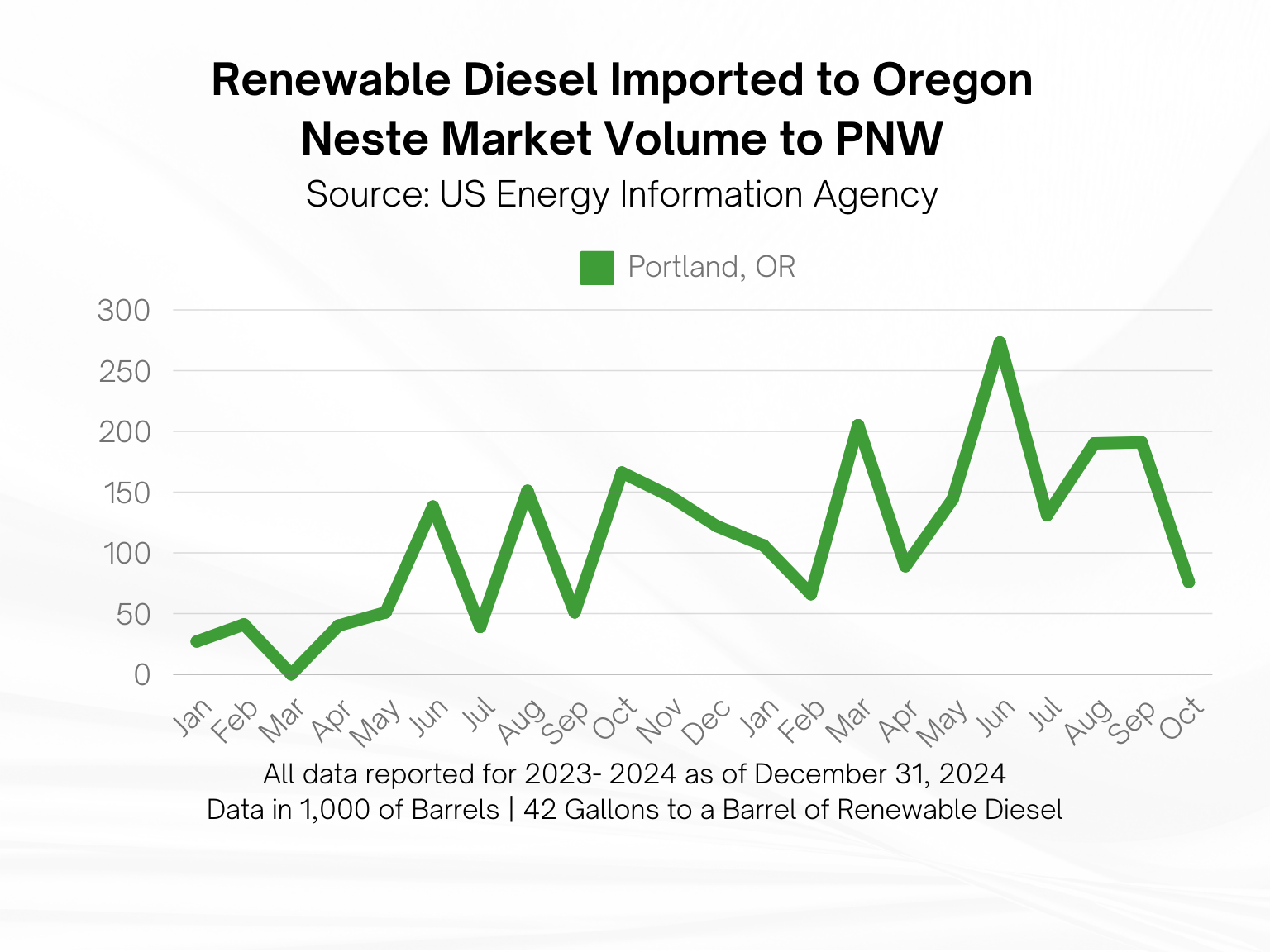
We do not have total consumption numbers for 2024 yet, but we do know thanks to the US Energy Information Agency, that imported R99 from Neste Singapore by itself through October was roughly 62 million gallons rounding up.  The Oregon Clean Fuels Forecast expects 199.5 million gallons of renewable diesel in 2025.  As the program ramps up with this expectation, the imports of previous years will be far less competitive without subsidies.  This means the price of renewable diesel will be higher, unless US production scales to not only fill this market void but also add tens of millions of gallons into the state.

Of that 133.3 million gallons of R99 used in 2023 in Oregon, a third, more than 40 million gallons of it was imported Neste Renewable Diesel.  973,000 barrels of renewable diesel was shipped from Singapore to Oregon that year.  Other renewable diesel refiners such as Diamond Green, HF Sinclair, Marathon, Montana Renewables, Phillips 66 and Chevron also had R99 product sold into Oregon.  Regardless of the expansion of US domestic Renewable Diesel production in recent years, the Neste product no longer receiving subsidies will have a real impact to maintain these 133+ million gallons of R99 inside Oregon.

This same projection reports that Oregon’s B99 Biodiesel use inside the state in 2023 was 78.8 million gallons.  With a projection of Biodiesel to rise 83.8 million gallons in 2025.  Given these market needs, Star Oilco predicts R99 to be expensive compared to petroleum diesel. Biodiesel will be more competitive given the available product and no substantial change in suppliers.  Biodiesel will also need to be used to replace R99 gallons under the CO2 reduction programs of Oregon. Due to these market forces Star Oilco has contracts for supply at reasonable prices for our existing customers.

R99 is mandated in certain diesel uses in California by the California Air Resource Board (CARB) which make for an inelastic price.  Diesel equipment operators in California will have to buy R99 at any price.  This will raise the prices we in Oregon can expect to see renewable diesel at.  The other low CO2 diesel fuel biodiesel will not be impacted by CARB the same way and we can expect to see B20 become more widely sold because of its more competitive price.

Biodiesel has a much more widely used market development around the US, especially in over-the-road trucking.  The plants that make biodiesel also tend to be co-located, owned in collaboration with feedstock producers, and integrated within the Soy industry that produces the feedstock.  Expect that biodiesel will continue to be more competitive with diesel than renewable diesel if price is the concern.

It is worth mentioning that the CARB mandates for R99 use in California will have impact to set the price for renewable diesel in other states.  If the market demand mandated by CARB continues and the market is short, the price can be expected to rise to meet this demand.  So unsubsidized imported R99 will likely continue to flow into California and other states but it will be at a full cost to make up the subsidy.  This will likely mean that incremental gallons of R99 needed to meet the market growth projected in Oregon will be at a premium over Oregon diesel to match California’s diesel market.

US BLENDERS TAX CREDIT EXPIRATION IMPACTING OREGON

The biggest unknown on how expensive diesel will be for Oregonians relates to Federal biofuel policy.  For the last twenty years the US Government has had an on-again/off-again subsidy on biodiesel and more recently renewable diesel.  There have been years the subsidy was not renewed which informs us of what probably will happen with prices on biodiesel.  Renewable diesel though is a stickier market.  The reaction of R99 renewable diesel prices in California, Washington and Oregon market is the big question and it comes down to an issue of production.  Two big issues at play are how much renewable diesel will these states continue to see from Neste’s Singapore plant and how much new US production for renewable diesel comes online to feed the market need.

The Blenders Tax Credit will be replaced with the Producers Tax Credit

The Blenders Tax Credit expired December 31st.  There are those that hope that in January the new Congress will take up an extension of this but most experts in the industry do not expect and are not betting an extension will not occur.  Meanwhile there is subsidy regime named the “Clean Fuels Production Credit” or the slang term preferred by industry the Producers Tax Credit (PTC) which ranges from $.20 a gallon to $.80 a gallon depending on how low CO2 the fuel as well as some labor practices.  The PTC also bars imported renewable diesel and biodiesels from getting any money at import.  Approximately more than 40,000,000 gallons a month of renewable diesel flows from Neste Singapore to the west coast, this will have a huge impact on Oregon.  For those accustomed to that fuel at the same price as fossil fuel diesel, the expiration of this subsidy will raise our prices for those demanding R99 renewable diesel which was already in short supply prior to this change.

There is also another wrinkle in the subsidy policy of the US with this.  The subsidy on Sustainable Aviation Fuel (SAF), basically renewable diesel meeting the Jet A fuel specification, is still in place for imported product for another year.  Europe also has some significant incentives and mandates for SAF.  Renewable diesel refiners, both domestic as well as foreign have a huge financial incentive to make renewable jet fuel over renewable diesel. This reality probably means that if a gallon of fuel can go to a jet fuel market over a transportation market it will.

So the market forces for renewable diesel in particular probably means less R99 available nationwide in the US.  While that is happening, the state of California has mandated that all off road equipment run R99 Renewable Diesel.  So regardless of what the price of this fuel is, California will have to use it in huge volumes.  Markets being what they are, for high volume fleets demanding R99 they can expect the R99 price in Oregon will track the price paid in California.  There will be exceptions of contract relationships for supply of R99 as well as retail brands moving renewable diesel blends to meet their strategic CPP requirements.  This will definitely mean anyone wanting R99 will want to line up a contractual supply agreement or can expect a higher price than in 2024.

THE FEDERAL RFS AND RINS

It should also be mentioned that the US EPA has a Renewable Fuel Standard of its own. It is a completely different regulatory system compared to the Portland RFS.  This program requires gasoline refiners as well as importers to use so much biofuel in their sales inside the United States.  Federally refiners and importers must prove they blended specifically assigned amounts of ethanol, and biomass based diesel fuels.

This program attaches a Renewable Industry Number (RIN) on every gallon of biofuel sold in the US.  As there are many unobligated users of this biofuel in the US those blending their own biodiesel, renewable diesel and ethanol generate RINs that can be sold to the refiners and importers of gasoline inside the US.

The RIN value has been low compared to historic values for biomass based diesels.  As Biodiesel and Renewable Diesel generate the same type of RIN, the reduction in imported R99 might raise the value of these RINs.  This value increase for the Renewable Industry Number is expected to slightly off set the hard subsidy.  It will be a market based value so it can not be relied upon for lowering the cost of biofuels, but can be expected to help with price.

As more US produced renewable diesel is coming online, hopefully enough to replace the lost imported gallons before the busy summer diesel season, these RIN values may not have a major contribution to the wholesale price of R99.

CONCLUSION

We predict diesel prices to rise in Oregon compared to the US in the first quarter of 2025

Star Oilco’s team saw these market conditions coming during the summer of 2024.  We have locked in contractual supply of R99 renewable diesel for our existing customers and have additional supply for customers seeking R99 renewable diesel by Star Oilco owned cardlock sites, mobile onsite fueling or smaller volume bulk delivery.

Star Oilco expects a Cap at the Rack price from the Oregon CPP to be between $.10 and $.40 a gallon by the end of January depending on biofuel supply. With unofficial conversational predictions with several large fossil fuel refiners and brokers, there is an expectation of over $.25 a gallon as a Cap at the Rack price.  We think it will be higher than that with the removal of millions of gallons of R99 from Oregon’s market.  In the first quarter with the removal of imported R99 hitting the state we expect the Cap at the Rack price to start in the higher $.30 a gallon range where it left off when the program was ended by a court. As the low CO2 exempt renewable diesel gallons shrink in the first quarter a heavier reliance on fossil diesel will be required.

We expect quite a bit of biodiesel to be loaded up ahead of the $1 a gallon subsidy being ended on December 31st.  Renewable diesel will be in short supply due to disruptions in supply of imported product.  So first quarter R99 will be at a premium and B99 for blending with diesel will be a deal to be had as fossil fuel diesel prices rise.  Expect to see far more B10 and B20 offered in the market place as either a more common than not fuel at retail gas stations, truck stops, and most cardlock stations, especially in Portland.  Star Oilco will have options for our customers of either B20, R99, or R20 blends of diesel all complying with the City of Portland Renewable Fuel Standard inside the city.  Star Oilco’s Portland CFN and Pacific Pride locations will have both R99 and B20 hoses available for customers.

California will continue to demand any and all R99.  If the market is short R99 because of a removal of imported renewable diesel, the value of R99 in California will rise to justify foreign R99 to enter the market without a subsidy.  Star Oilco presumes that number will be between $.40 to $.80 a gallon.  If R99 in California is able to demand a premium, Oregon will have to pay that price for incremental gallons.  Oregon has a specific need for R99 and B99 for retail gasoline sellers to meet the Climate Protection Program (if you sell so much gasoline you must reduce your market share someplace and R99 diesel is the easiest way to do that).  Oregon retailers will be seeking to move a budgeted amount of renewable diesel and biodiesel to meet their fossil fuel allowance budgets under the CPP.  Each gallon beyond that will have to compete with California at a high price.

R99 will still be available but we expect incremental gallons to be at a premium.  Contractual gallons direct with a refiner of renewable diesel will have a consistent price that a business can manage fuel surcharges against diesel.  Outside of a contract for volumes, the wholesale rack price of R99 may vary wildly compared to a B5 ULSD fossil fuel diesel prices depending on how high diesel is going for are as well as the CPP and CFP values of a Carbon Credit and Cap at the Rack.

The big unknown to price is how one key importer of R99 will respond to the market without a subsidy.  It is the assumption of Star Oilco that California will continue to buy imported R99 without a subsidy for it’s off-road mandated market. If the economics of Neste are such, they can compete and open the floodgates of R99 and this could change.  This open flood of product is not expected especially given the economics of Sustainable Aviation Fuel which renewable diesel plants are expected to make more of in 2025.

The Oregon and Washington market will see a flow of new capacity of R99 for retailers mandated to reduce their fossil fuel volumes.  US production of R99 is expected to more than compensate by 2026, but 2025 will be a chasm to jump.  Chevron, HF Sinclair, Marathon, and Phillips 66 will be procuring and supplying US made biomass based diesel to the Pacific NW for their retail gas station needs.  We would expect to see R99 or blends of it sold at parity with branded diesel in the retail market in Oregon.

Commercial sellers of wholesale unbranded diesel will have a tougher time lining up R99 at a price in line with wholesale B5 or B20 ULSD.  No doubt with these higher prices we will be seeing an evolution of R20 (20% renewable diesel) as well as blends of biodiesel with renewable diesel available inside the City of Portland for it’s Renewable Fuel Standard as a premium fuel at a competitive price with diesel.

Star Oilco has R99 and R20 blends for commercial customers in the Portland, Oregon area.  We also have R99 available for Clark County Washington commercial and municipal fleets.  Star Oilco also has biodiesel blends and can support fleets seeking to succeed with it.  Call us if you would like to talk about your fuel supply in 2025.

If your fleet has an interest in a consistent and contractual supply of R99 renewable diesel or wants to develop a relationship that prioritizes a 20% of renewable diesel blended to meet Portland’s Renewable Fuel Standard compliance please feel free to reach out to Star Oilco.

Reach Out To Our Team

Our team of fuel experts would be happy to work with you and help you understand how this affects your operations

Excavator on construction site using off-road diesel
Diesel Loaner Tanks for Construction 683 1024 Star Oilco

Diesel Loaner Tanks for Construction

WE LOAN DIESEL TANKS FOR CONSTRUCTION PROJECTS

DYED OFF ROAD DIESEL FUELING SERVICE BY STAR OILCO

Wethose Fueling for Construction

If you need diesel, kerosene, gasoline, biodiesel, or renewable diesel in bulk or as a wet-hose fueling service, we are ready for your project.  We also deliver Diesel Exhaust Fluid on jobsites. We won’t let your generators go down.  Daily routes for diesel fueling in Portland, Oregon and Vancouver, Washington. 

Star Oilco serves the whole Portland metro area included the ex-burbs.  Our routes deliver to Salem, Oregon as well as Longview and Kelso, Washington.

Call and ask for our Dispatch to set up service today at 503-283-1256.

Off Road Dyed Diesel Delivery

All-dyed construction and generator fuel delivered by Star Oilco is premium diesel treated with Hydrotex PowerKleen. Star Oilco’s premium diesel is stabilized for long-term storage for the total up-time needs of construction fueling. There is an additional treatment of fuel microbiocide to kill and prevent growth of bacteria/algae in your diesel. Star Oilco can add Valvtect BioGuard to your fuel to stabilize your fuel for long term storage upon request as well.


Construction season is here.

Star Oilco still has loaner tanks immediately available for your job site, project or temporary fleet needs.  Make life easier and keep your team working hard. Get ahead of the rush and reserve your UL142 double wall loaner tank now.

Just let us know if you need a 12V pump (powered by your equipment’s battery) or a 110V plug in pump with your equipment set up.

Star Oilco has both 550 gallon and 275 gallon tanks with 110% containment meeting UL 142 for your next construction project.  Star Oilco can provide larger tanks if arranged with notice beforehand.  Larger tanks available for longer term project if needed.  We also provide remote tank monitoring on these tanks. These tanks meet fire code in Oregon and Washington for construction refueling and provide temporary storage of fuel on an ever-changing construction job site. Oregon and Washington fire code allow temporary double wall tanks for construction projects where an active permit has been pulled and needs diesel to complete.

Ultra Low Sulfur Diesel is 15 PPM
Please also remember that ultra low sulfur diesel (ULSD) is the standard of off-road dyed fuel now as well. New off-road equipment will need ultra low sulfur diesel given the modern emission systems required.  This is a recent change.

If you are renting newer equipment, it will have a need for ULSD and Diesel Exhaust Fluid (DEF). You will need to ensure that any fuel on a jobsite running newer equipment with diesel after treatment is ultra low sulfur diesel fuel. If you are operating your own tanks as you receive newer equipment, you will want to flush the fuel to make sure you get all the higher sulfur fuels out of it. All equipment from Star Oilco is drained as well as flushed prior to deliver as part of our set up.

If you are a contractor, project manager, or need a temporary tank for on-site fuel, we can help. In cases where you need an auxiliary tank, transfer fuel tank, an emergency back-up fuel supply, or even a long-term rented loaner tank for specialized equipment, Star Oilco can solve problems for you. For long-term projects, we can also work to get cardlock and other novel tracking solutions to secure your on-site fuel needs. Give us a call, we are here to help.

Kick the Can Card

Call our Dispatch at 503-283-1256 or tell us what you need in the following Contact Form.

We have loaner tanks immediately available. Open an account and get started today.


Aerial view of a city skyline at sunrise with lush green trees in the foreground
On Site Refueling in Oregon 1024 664 Star Oilco

On Site Refueling in Oregon

6 reasons to use Wet-Hose diesel and gasoline fleet fueling in Portland, Oregon.

The best strategic decision to reduce needless driver hours and keep your fleet on the route without excuses.

Mobile Onsite Fleet Fueling Service for diesel and gasoline available in Oregon and Washington.

If some days you have more work than drivers…  Wet Hose Fleet Fueling is your solution!


There is a reason that fueling on-site and after hours is the preferred fueling method of growing fleets in the Pacific Northwest.  The fleet refueling solution that solves the complex problem of dispatching in a world short of drivers and facing unpredictable traffic. Mobile Onsite refueling or “Wet Hose” fueling is a solution that will push more money to your bottom line and reduce stress on your drivers.  Star Oilco can also merge our mobile onsite refueling service with our national Fleet Card system to give you one bill and easy reports for your fuel tax reporting by license plate and equipment number.

 One bill for On Site Fueling and Fleet Cards, labor saving in town and low prices over the road. 

Make your IFTA and PUC’s fuel reporting simple.

Secured fleet fueling while over the road.  Simple labor saving fueling in your yard.  Track equipment by license plate and equipment number on one invoice.

Reefer trailer fuel service

  6 Reasons to Use Wet Hose or Mobile Onsite Refueling

On Site refueling or “Wet Hosing” is a preferred method for fueling these days. Fleets of all sizes prefer getting their fleet fueling delivered after hours in their yard. The reasons are numerous but at the top of the list, labor is the driving force behind it.

Shaving off even fifteen minutes of labor–which is one of the two highest costs for most fleets, right after diesel–can have a huge payback to the bottom line.

If your fleet is consistently on overtime or short that one extra hour of legal driver time, picking up fifteen to thirty minutes per truck a few times a month can be a huge opportunity. If your drivers always seem to be bleeding into overtime or missed stops, you want on-site fueling.

Streamlining their route without a consideration for fuel will pay back rapidly. With a simple change in what a driver has to consider at the start and finish of their day, efficiencies are immediately seen with wet hose fueling. Most of all, this is seen if you are pulling your drivers out of the productivity killing vortex that is truckstops. Truckstops may show a good diesel price but they are making it up when your drivers wait in line inside the store while on the clock.

Call Star Oilco if you have questions and want to examine the payback value of Wet Hose Refueling compared against your current vendor for diesel. You might be surprised how much it will save you in time, money and management effort.

Six reasons why you should consider wet-hose diesel fueling:

  1. Driver Time – The most valuable resource your fleet owns.

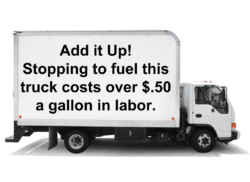
    • Truck drivers are a limited resource and they cost more than you can usually measure in money alone. Without calculating the lost productivity of your truck, you are paying over $10 each time your drivers stop for fuel. The out of route stopping, refueling, and getting back on the road time could be half hour of lost time. As the average fill up we see is under 50 gallons, fueling your own trucks will cost you $.20 to $.50 a gallon in labor costs alone.
  2. One More Stop – Picking up productivity in your fleet.

    • Getting drivers on the road and without a reason to be out of route pays back dividends. If you pay productivity bonuses, your most productive drivers will thank you as well. Even in fleets where pay is by stop, not based on hourly wages, the ability those few times a year when drivers are so busy they are bumping up against DOT work rules, they will thank you for the convenience of being ready to go the start of each shift and not having to worry about that one more stop on the way back to base. A few extra stops a year is often worth thousands of dollars to your bottom line–more than a cost of a tank of diesel.
  3. Control Fuel Taxes – Track your taxes without chasing paper receipts.

    • Pay the right taxes. We have audited and seen where mobile on-site refueling pays back thousands of dollars in savings. Typically from just this often unnoticed needless expense alone. In Oregon many small towns have add-on taxes of their own that hide out in your fuel bill. Portland, Oregon’s diesel tax is a $.10 a gallon (or more for weight mile). Regardless, you can avoid these taxes and nail down a totally known cost of fuel.
  4. Control Your Type of Fuel – Ensure you are getting Premium Diesel, Dyed Diesel, or B20 Biodiesel.

    • If you are trying to guarantee the highest performance in your fleet the quality of your diesel matters. To guarantee you receive Premium Diesel, ensure one point of responsibility for the diesel fueling of your equipment.
    • Easily track what fuel went where for tax purposes. Wethose fueling provides the gallons moved by piece of equipment, license plate, and even VIN if that’s what you want it tracked by. Make fuel tax reporting easy and consolidated.
    • If you are working to guarantee a low CO2 footprint for sustainability reasons. Wethose fueling services are a great way to simplify that effort. Commercial prices for B20 Biodiesel are often more competitive than retailers selling the fuel as premium product as well. Additionally, with a single fuel vendor you can track back the source of the fuel for CO2 or other footprint analysis. Know what your impacts are.
  5. Easily integrates with cardlock and other fleet cards onto one bill.

    • If you have a major hub with a critical mass of trucks in town, wet-hosing yPride Advantage Sample Cardour fleet can pay back rapidly. Even if the majority of your fleet is over the road and out of town, on-site refueling can be a money saving proposition. You can also integrate it seamlessly with a Pacific Pride, CFN, Fuelman, Voyager or other fleet card program as well. Star Oil can provide a Pacific Pride or Fuelman card that will work over the road consolidating all your fuel into one bill. Star can also accept Fuelman, Comdata, WEX or Voyager and bill those fleet cards directly with onsite refueling. If your fleet uses one of these national fleet cards, call us to move to wet hosing. We bill directly to the card and license plate of each one of your trucks. (For further reading on corporate fleet card security features please read our article on Upgrade your Fleet Card’s Security Features.)
  6. Cost Plus Diesel – Budget to know every day you are getting a good wholesale rate for your fleet.

    • Star Oilco can connect your fleet to an agreed and easily verifiable cost plus supply agreements. Be it OPIS Average or Low Rack Plus agreements, we can guarantee you have a good wholesale price of fuel.  You can also use B20 Biodiesel or Renewable Diesel fuels at a discount price to reduce your fleet’s emissions if that is a priority for you.  Onsite refueling will provide a simplified fleet management experience for both your drivers and your Accounts Payable department. Call us if you want to talk about what this can do for your business. ( For further reading on the benefits of premium diesel and a wholesale partner for diesel, read our article on What is the benefit of Premium Diesel versus untreated diesel?)

Contact Star Oilco with any questions you may have about Wet Hose Fueling your fleet.  

We are here to serve you and make Mobile Onsite Fueling simple.

Contact Form

  • This field is for validation purposes and should be left unchanged.

For more on Fleet Fueling Best Practices read these other Star Oilco articles:

Upgrade your Fleet Card’s Security Features

The difference between Portland, Oregon Diesel and the rest of Oregon.

Seven ways to stop fuel theft before it happens.

Eliminate Fuel Theft and Save Money

Close-up of a diesel fuel droplet creating ripples in a golden liquid
What is the benefit of Premium Diesel versus normal diesel? 1024 769 Star Oilco

What is the benefit of Premium Diesel versus normal diesel?

Premium Diesel delivered in Oregon and Washington with every gallon of Star Oilco diesel.

Are you clogging filters, seeing corrosion, suffering repeated DPF regens, or fighting biological growth in your tank?

Premium Diesel improves engine performance and reduces DPF regens.

Premium Diesel with routine tank maintenance is the solution to your problem.

Premium diesel provides real benefits to the long term maintenance cost of any diesel fleet.

Hydrotex PowerKleen Premium Diesel has a higher cetane, an aggressive detergent for cleaning injectors and tanks, pushes water out of the fuel keeping it dry while traveling down your fuel rail, as well as stabilizes the fuel to ensure it does not begin to grow algae or other biological problems in your tank.

Hydrotex PowerKleen Premium Diesel has plenty of benefit for a very small additional cost.  The most profound and not highlighted is the effect on long term storage of tanks and what your bulk storage tank bottoms look like long term. Namely that the corrosion inhibitors, moisture demulsifiers and stability benefits of Premium Diesel will pay back dividends for your entire fleet.  As time passes the bottom of your tank begins to age and collect anything that might fall out of solution.  Premium diesel will significantly reduce these danger particles that can get into your fleet’s fuel system.  Premium diesel not only improves the active daily performance of your fleet, it also prevents the long term problems that build up in fuel storage.

A first hand extreme example.  Recently we have seen where a customers sprinklers put a huge quantity of water in their storage tank and the additive kept that fuel bright, clean and not growing fuel algae.  Upon sending the sample to the lab of course water content was higher than you want, but that fuel was in great shape considering this extreme failure of fuel quality assurance. Controlling and preventing for the unforeseen is worth the effort.  What might have been a disaster costing tens of thousands in down equipment was an oddity we were able to fix for them in a few hours.  All because additive fuel kept that fuel within specification even in the most extreme of scenarios.


To read more about Hydrotex PowerKleen Premium Diesel and more in depth research on the benefits of premium diesel:  Hydrotex PowerKleen Premium Diesel Brochure.

Backup Generator Fuel Portland

If you have a commercial fleet and want to have Star Oilco sample and test your fuel for quality assurance please do not hesitate to ask. We are here to help.

Tank Testing Form

  • This field is for validation purposes and should be left unchanged.
Star Oilco diesel fuel truck servicing portable generators on a snowy Portland job site
Do You Need a Diesel Loaner Tank? 1024 768 Star Oilco

Do You Need a Diesel Loaner Tank?

Did you know that Oregon allows temporary diesel tanks onsite for construction projects?

Order off-road diesel for your next construction project in the Portland, Oregon area and Star Oil will loan you a tank with your fuel purchase.

We also have routes to Longview, Washington and Salem, Oregon.

Wethose Fueling for Construction

Take the headache out of fueling your construction project with a temporary tank on the jobsite.

Star Oilco’s goal as a bulk diesel provider is to keep things simple. Make them easy, predictable, and also get the best price for our customers. We love serving construction sites with our mobile, onsite wet-hose service. But we notice sometimes construction projects can sometimes be tricky to fuel.

Planning your project around fuel is not what anyone wants to do. We make it easy by planning for regular stops at a regular time married with bulk equipment to get your price under control.

Generator Fueling Service

Star Oil provides full-service diesel construction fueling, including DEF.

Make sure your diesel generators, light sets, water pumps, air movers, and other project critical equipment are topped off with diesel and DEF.

It can be difficult to keep a construction site fueled with the stops and starts of projects. The coordination required to keep everything moving full speed while adjusting for the unexpected down times caused by subs, permitting, or weather, can be overwhelming. To “keep things simple,” which is our company motto, we know that locating a bulk diesel fuel tank on your jobsite can simplify your project’s fueling complexity. This provides you with a few days worth of fuel when you need it, while also lowering your cost of fuel.

We find that our customers benefit from lower prices and increased up time by placing a temporary bulk diesel tank in their project’s yard. Call Star Oilco for bulk fuel delivery and ask us about our ability to place a tank on your jobsite in the greater Portland ,Oregon or Vancouver, Washington area.

On-demand fueling service available upon request.

Diesel Tank Rental

Star Oilco provides you with single wall 275 gallon and 550 gallon tanks with 110% containment for your short-term construction product at no cost. 550 gallon UL142 Fuel Cubes are also available for longer-term projects or projects requiring the ability to crane a tank. Bigger tanks and card control options are available, too. Whatever your tank need is, we’ll find solutions and make construction fueling easy.

For more information call 503-283-1256, email Dispatch@StarOilco.net or let us know below.


Contact Form

  • This field is for validation purposes and should be left unchanged.


Star Oilco also can provide fleet cards and wet-hose fueling service for your next project.

Star Oilco’s 6 Reasons to Use Wet Hose Fueling

Star Oilco’s 7 Ways to Stop Fuel Theft Before it Happens

Prepaid and Preset Fuel Cards for Your Small Business 

How to Eliminate Fuel Theft an Save Money

Close-up abstract image of diesel fuel with suspended droplets and fluid motion
About Diesel Fuel 1024 512 Star Oilco

About Diesel Fuel

Bulk Diesel Fuel Frequently Asked Questions

Ultra Low Sulfur Diesel is 15 PPMDyed Off-Road Diesel

Where your diesel comes from and what you need to know about ASTM Diesel Standards and ISO cleanliness code.

Where do Pacific Northwest vendors get their fuel?

In the Pacific Northwest, diesel is fungible. Everyone buys their fuel from each other in some way or another.  

This means that every refiner is typically expecting to mix their diesel and gasoline products. The real difference is in the care a vendor takes to filter the fuel, additize and continuously check their fuel quality. If you are buying at the absolute lowest price possible, know that there is an incentive to skip any added value of quality assurance.

Through its Pacific Operations unit, Kinder Morgan operates approximately 3,000 miles of refined products pipeline that serves Arizona, California, Nevada, New Mexico, Oregon, Washington and Texas. With roots dating back to 1956, it is the largest products pipeline in the Western U.S., transporting more than one million barrels per day of gasoline, jet fuel and diesel fuel to our customers. The company-owned terminals also provide additional services, such as liquid petroleum product storage and loading facilities for delivery trucks.

Diesel Fuels

In the United States, diesel fuel is controlled according the American Society for Testing and Materials Standard D975-97.  This standard describes a limited number of properties that diesel fuels must meet.  It should be noted that the requirements are all performance- based.  They do not mandate the composition of the fuel, only the specific performance related requirements demanded of a fuel for a diesel engine.  The requirements of D975 are described below. 

ASTM Specifications for Diesel Fuel Oils (D975)*

* You can go to the source of ASTM HERE if you have an interest in really getting in depth.

Diesel fuel is characterized in the United States by the ASTM standard D975.  This standard identifies five grades of diesel fuel. We are only going to talk about the two most popular commercially diesel fuel used — No 1 and No. 2 diesel. The ASTM D975 standard is made up of a series of different tests that check the characteristic ranges of a fuel to confirm it is adequate to operate in your equipment. In simple terms, they are checking for specific gravity, the vapor point (when it turns into a gas), the flash point (when it catches fire), the dirt content, water content (how much microscopic entrained water), and a host of other requirements diesel must meet in order to be legal to be sold for use in your engine.

Grade No. 1-D and Ultra-Low Sulfur 1-D: This is a light distillate fuel for applications requiring a higher volatility fuel to accommodate rapidly fluctuating loads and speeds, as in light trucks and buses. The specification for this grade of diesel fuel overlaps with kerosene and jet fuel, and all three are commonly produced from the same base stock. One major use for No. 1-D diesel fuel is to blend with No. 2-D during winter to provide improved cold flow properties.  Ultra Ultra-Low sulfur fuel is required for on-highway use with sulfur level < 0.05%. 

Grade No. 2-D and Ultra-Low Sulfur 2-D:  This is a middle- or mid-grade distillate fuel for applications that do not require a high volatility fuel. Typical applications include high-speed engines that operate for sustained periods at high load. Ultra-Low sulfur fuel is required for on-highway use with sulfur level < 0.05%.

RecologyDealing with Dirty Fuel and Today’s Tier 4 Engines

Water and dirt are the biggest concerns for fuel quality. Why? Because no matter how perfect fuel is refined, these two elements can find their way into fuel and crash its performance. Water and dirt often build up in tanks just from the temperature change between night and day, causing a bulk fuel tank to breathe. Condensation and dust can also find their way into a bulk storage tank. If not addressed, they build up and will cause mechanical failures.

Dirty fuel will cause premature parts failure in equipment of any age. But newer equipment has far tighter tolerances than what we saw in previous decades. Today’s new and improved Tier 4 rail injector engines are more efficient, they burn cleaner, and run better, they are more powerful than ever before. But there are things that make fuel quality more important than ever. Because of the extremely high pressures (upwards of 35,000psi at the injector tip), the possibility of damage from dirty wet fuel is more prevalent than ever. This damage is much more pronounced in newer equipment with High Pressure Common Rail (HPCR) fuel systems. Hard particulate is commonly referred to as “dirt,” but is in fact made up of a wide variety of materials found at job sites (coal, iron, salt, etc.), generated by fuel tanks and lines (rust, corrosion, etc.) and inside engines (carbonaceous materials and wear particles).

Frequent diesel fuel filter changes — as well as the expensive, and time consuming, task of cleaning diesel fuel tanks — have become acceptable periodic maintenance, instead of a warning signal, for diesel engine failure. Diesel fuel filter elements should last a thousand hours or more, and injectors should endure 15,000 hours. However, since diesel fuel is inherently unstable, solids begin to form and the accumulating tank sludge will eventually clog your diesel fuel filters, ruin your injectors and cause diesel engines to smoke.

Symptoms

  • Clogged and slimy filters
  • Dark, hazy fuel
  • Floating debris in tanks
  • Sludge build up in tanks
  • Loss of power and RPM
  • Excessive smoke
  • Corroded, pitted injectors
  • Foul odor

The solids that form as the result of the inherent instability of the diesel fuel and the debris formed in the natural process of fuel degradation will accumulate in the bottom of your fuel tank. The sludge will form a coating or “bio-film” on the walls and baffles of the fuel tank, plug your fuel filters, adversely impact combustion efficiency, produce dark smoke from the exhaust, form acids that degrade injectors and fuel pumps, and impact performance. Eventually, fouled diesel fuel will clog fuel lines and ruin your equipment.

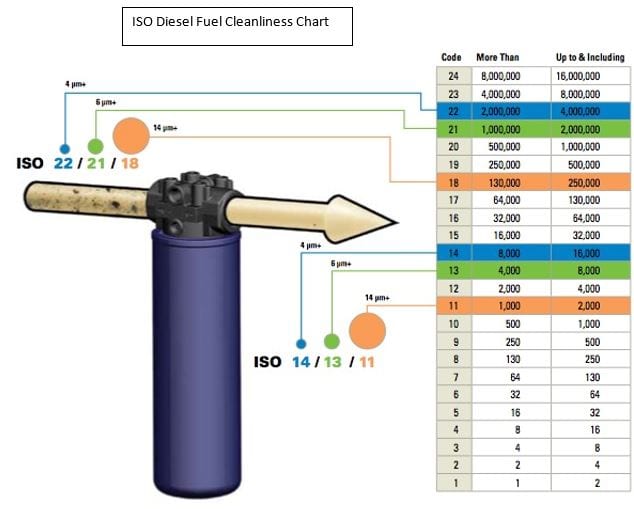
The Bigger Picture: ISO (International Standardization Organization)ISO Chart 1

In today’s world, the definition of what constitutes clean or dirty fuel is critically important and, as such, fuel cleanliness levels are now measured and reported according to the ISO Cleanliness Code 4406:1999. The International Organization for Standardization (ISO) created the cleanliness code to quantify particulate contamination levels per milliliter of fluid at three sizes: 4μ, 6μ, 14μ. Microns.

Fuel Cleanliness vs. Engine Technology

Fuel cleanliness levels using the ISO4406:1999 method were officially documented as a global standard only as recently as 1998 with the development of the Worldwide Fuels Charter (WWFC). Since its inception, the charter has established a minimum cleanliness level for each of the diesel fuels under various available categories around the world.

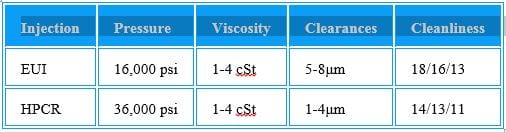
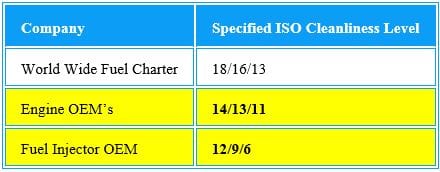
Most mainstream engine OEM’s now subscribe to these standards. Interestingly (and somewhat troubling to note), however, is that fuel cleanliness levels as specified by engine OEM’s and the WWFC have not changed since their inception in 1998, despite the enormous advances in fuel injection technology. This relationship is best represented in the previous table that identifies the advances in fuel injection systems and clearly highlights how OEM’s and the WWFC have not responded to reduce fuel cleanliness in accordance with advancements in technology.

Diesel Fuel Injection – Advancing Technologies & Cleanliness Levels

ISO Chart 4This table  identifies that, over time, fuel injector critical clearances have halved and fuel pressures have doubled, yet the level of fuel cleanliness being specified has not changed in accordance with such advancements. In fact, the same cleanliness levels specified in 2000 are still being used today despite these magnificent technological design advancements by engine manufacturers worldwide.

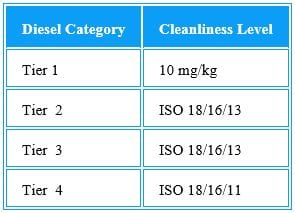
Leading fuel injector manufacturers around the world have clearly identified and communicated that they require ULSD fuels with ISO fuel cleanliness levels as low as ISO12/9/6 to maintain ultimate performance and reliability. It is here where we see an enormous mismatch in what the fuel injection OEM desires as a fuel cleanliness level, to what the engine OEM’s and the WWFC are advising the industry. The following table identifies the discrepancies in fuel cleanliness levels.

Diesel Cleanliness Levels

 ISO Chart 3                        


WWFC Diesel Category Fuel Cleanliness Standards                                                                                                      ISO Chart 5


Damage Caused by Hard Particulate

Hard particulates cause problems with moving parts in the fuel system. This can lead to starting problems, poor engine performance, idling issues and, potentially, complete engine failure. All too common, hard particulates damage engines.

The spray pattern generated by the HPCR injector is critical for proper combustion and overall fuel system performance. (1) sm-injector-with-red-light-Bosch

It must be extremely precise in terms of quantity, distribution and timing. Ball seat valves are sealed with balls that are only 1mm in diameter. A good seal is absolutely necessary for proper injection. Damage from erosive wear, such as shown below, will cause over fueling, leading to decreased fuel efficiency and eventually shut you down altogether.

hpcr injector damaged by hard particulate(3) high-pressure-fuel-system-wear

Pump performance can also be compromised by scoring and abrasive wear. These issues are magnified by tighter tolerances and extreme pressures in HPCR engines. In these circumstances, it is the smallest particles (1-5 microns in size) that cause the most damage, virtually sand blasting part surfaces.

Allowable Levels of Hard Particulate 

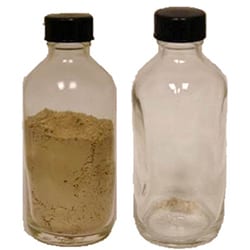
(4) dirt-in-vs-allowed-in-1000-gal-dieselIn some parts of the world, 10,000 gallons (38,000 liters) of “typical” diesel contains 1-1/2 lbs (700 grams) of hard particulate; this is 1000 times more than the 1/4 oz. (0.7 grams) per 10,000 gallons (38,000 liters) that is allowed by the cleanliness requirements of high pressure common rail fuel systems. In reality, there is no “OK” level of hard particulate. Injector manufacturers are very clear that damage caused by hard particulate reaching the engine is not a factory defect, but rather the result of dirty diesel that is not fit for use in HPCR fuel systems. At the end of the day, the end user is responsible for the fuel he puts into his equipment, and the consequences thereof.

How Dirt Enters Fuel

Dust and dirt are all around us, especially on job sites. Diesel fuel is fairly clean when it leaves the refinery but becomes contaminated each time it is transferred or stored. Below you will find some of the key contributors of fuel contamination:

Pipelines: Most pipelines are not new, and certainly not in pristine condition. Corrosion inhibitors are added at most refineries to help protect pipelines, but rust and other hard particulate is nevertheless picked up by the fuel that flows through them.

Barges and rail cars: How often are they drained and scrubbed out? What was in the last load? Where did it come from? How much of it was still in the tank when your load was picked up? How long was it in transit? Is the tank hermetically sealed? There are many opportunities for contaminants to make their way into the fuel.

Terminal tanks: Terminal tanks usually see a high rate of turnover, so there is not much time for the fuel to pick-up contamination from outside ingress. Has the tank ever received a “bad load” from a pipeline or a barge? Has larger dirt had a chance to settle on the bottom of the tank? How often has it been cleaned out? Was it just filled? Did the bottom get churned up in the process? How full was the tank when your fuel was loaded into the delivery truck? There are many variables that can affect fuel cleanliness.

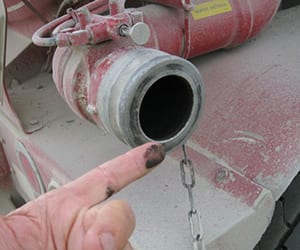
Delivery trucks: All the same issues that apply to stationary tanks also apply to tanker trucks, except that truck tanks never get a chance to settle. In addition, have you ever considered how much dirt gets into that tanker while it is delivering fuel to a customer, potentially a customer in an extremely dusty environment? As fuel flows out, air is sucked in to displace it. Is there anything protecting the inside of the tank from all the dust in the air? Generally not. Venting is typically completely unprotected, as seen in the image to the right.

Storage tanks: Onsite bulk storage tanks typically see less rapid turn-over than terminal tanks. In addition to those issues, yard and jobsite tanks can also develop serious problems with other sources of contamination, such as the ingress of dirt and water, condensation, rust, corrosion, microbial growth, glycerin fall-out and additive instability. Time and temperature become big factors affecting fuel quality.

Dispensing process: How far does your diesel need to travel between the bulk tank and the dispenser? The more pipe it runs though, the more potential there is for contamination. Are your dispenser nozzles kept clean? Are they ever dropped on the ground? Then what? What about the vehicles’ fuel tank inlets, are they clean? Think about the extremely tight tolerances in your fuel system, then take another look at housekeeping issues. You will see them through new eyes.

Onboard fuel tanks: Contamination continues even after the fuel is in the equipment. What has that tank seen in the past? Has it been left stagnant for long periods? What kind of protection is there on the equipment’s air intake vents? Heavy equipment does hard, dirty work.

Engines: Unfortunately, even if the fuel in your tank could be perfect, additional contamination is generated by the fuel system itself. Wear particles are created by mechanical friction. High heat and extreme pressure generated inside the modern engine, lead to coking and the creation of carbon products at the injector. Much of this internally-produced particulate is returned to the fuel tank, along with the unburned diesel.

The Bottom Line

No one gets special fuel, no one has better fuel, no one has cleaner fuel. Diesel fuel vendors get the same fuel, from the same pipeline, delivered to the same terminals. We all wait in the same lines with our tank trucks to get that same fuel. So ask yourself: Given that the fuel is the same, what sets one vendor apart from all the others? Star Oilco Premium Diesel fuel is treated with Hydrotex PowerKleen® additive running through Donaldson filtration systems.

Clean, dry, premium diesel

FURTHER READING ON DIESEL FUEL:

Read about Star Oilco’s approach to Fuel Quality Assurance: Star Oilco – Precision Fuel Management

Read about dealing with biological growth in your diesel tank: Bioguard Plus 6 biocide treatment for diesel

Get Chevron’s Technical Manual to Diesel Fuel (essentially an easy to read text book on diesel): Chevron’s Fuel Technical Review

Get a white paper from Donaldson Filtration on tier 4 engines and fuel cleanliness: Donaldson on Tier 4 Engine Fuel Contamination

Read more about Donaldson Desiccant Breathers for bulk diesel tanks: Why use a Donaldson Desiccant Breather for a bulk diesel storage tank.