

• 232 NE Middlefield Rd, Portland, OR 97211

Blog

Fueling Around Blog

Red fuel nozzle inserted into a blue vehicle at a fueling station
Oregon Cardlock Safety Training 1024 683 Star Oilco

Oregon Cardlock Safety Training

Consider using this Oregon Fire Marshall Training for your driver’s Cardlock or Fleet Card training.

 

Fueling your Car in Oregon


As anyone with a Pacific Pride, CFN, or Voyager gas card in Oregon knows, to use an un-staffed Cardlock location, the Oregon Fire Marshal requires safety training.

Typically, it is just reading and signing a form. Many fleets provide this form to their employees as a training piece for refueling safety. But if you’re training in a group, nothing beats a video to get everyone engaged.

The Oregon State Fire Marshal’s office has produced a training video to make it easier to on-board your team about using Cardlock fuel safely. This tool makes training those unfamiliar with cardlock a little easier and more professional.

If you have an Oregon fleet seeking to use Pacific Pride, CFN, or Voyager fuel cards for self-serve commercial fuel, this training is required annually by your company in Oregon state. This handy training video is great for training your new employees on Commercial Cardlock.

If you have questions about using Pacific Pride Fuel Cards or other 24/7/365 stand-alone Cardlock locations give Star Oilco a call. We can get you set up and your drivers out of fuel lines. Save money and reduce the risk of fuel theft with Star Oilco’s fleet card program.

For more on using Commercial Cardlock in Oregon please read other posts below:

STOP FUEL THEFT WITH PACIFIC PRIDE CARDS

HOW TO AUDIT YOUR CURRENT FUEL BILL

WHAT DOES A BUSINESS NEED TO USE PACIFIC PRIDE OR CFN IN OREGON

Leave us a message to set up a Star Oilco Fleet Card account.
Contact Form

  • This field is for validation purposes and should be left unchanged.
B99 Biodiesel for Fleets & Heavy Equipment 150 150 Star Oilco

B99 Biodiesel for Fleets & Heavy Equipment

Using B99 Biodiesel in a Tier 4 Heavy Duty Diesel

B99 Biodiesel reduces CO2 footprint of a 105,500 GVW truck and trailer by more than half at a lower cost than petroleum diesel.

What is B99 Biodiesel?

B99 Biodiesel is as pure of blend of Biodiesel you can get in the United States and still participate in the incentives associated with this alternative fuel.  B99 is the product received by petroleum refiners, terminals, and truck stops to blend with petroleum diesel.  Biodiesel is a renewable, clean-burning diesel replacement.  B99 Biodiesel is a common blendstock with petroleum diesel (being 99% biodiesel).  It can be presumed that nearly every major truck stop throughout the US is consistently using either a blend of 5%, 10% or 20% of biodiesel   The reason for this is both due to its price advantage against petroleum currently as well as Federal/State laws requiring it’s use.

Why Higher Blends of Biodiesel Matter?

Biodiesel is a low CO2, net energy positive fuel.  Depending on the feedstock Biodiesel is made from a CO2 reduction of 30% to 80%+ can be expected compared to petroleum diesel.  As the West Coast (Oregon, Washington and California) ramps up CO2 regulations that charge an additional cost for carbon emissions associated with petroleum diesel the financial case for Biodiesel becomes obvious.  Early adopters will see direct financial benefit.

B99 Biodiesel for Fleets & Heavy Equipment

Star Oilco has fielded the Optimus Technologies system on our 105,500 GVW truck and trailers.  Star Oilco began with a single Freighliner truck and trailer operating a Cummins ISX as a trial.  This truck’s typical route was approximately 305 miles round trip from Portland, Oregon to Grays Harbor, Washington.  This run is from Star Oilco in Portland, Oregon to the Grays Harbor REG Biodiesel plant and back to the Portland terminals for delivery of this product.    Over the last year and a half this truck has performed amazingly well, the only maintenance concern is swapping the fuel filters more regularly with every oil change.  Mileage and power difference are negligible as noticed by drivers or our Elog system.  On a few occasions a loss of power was experienced requiring an in between service fuel filter swap.

This field trial of the Optimus Technologies system Star Oilco has regularly saved between $15 and $75 a day when running this dedicated route, depending on the cost of B99 Biodiesel versus petroleum ultra low sulfur diesel.  Consistently the price of B99 Biodiesel has been below petroleum diesel in the Portland, Oregon market. This has been due to a combination (or is effected by) RIN values, a Blender’s Tax Credit on biodiesel, and Oregon’s Clean Fuels Program which also prices the CO2 reduction value of B99 Biodiesel.   We see this trend continuing as an assumed market reality for biodiesel.

What is the business case for our deploying B99 Biodiesel Optimus Tech upfit kits?

The systems increase the intelligence of our late model trucks with their very complicated Tier 3 and Tier 4 emissions systems.   The Optimus Kit enables two saddle tanks to operate with the duty cycle of the truck. One tank (which we will be running B5 ULSD or R99 through) is dedicated to fuel the particulate trap and SCR systems.  These systems have extremely tight tolerances and tend to choke on higher blends of biodiesel.  By dedicating a tank with a smart controlling system we reduce the maintenance and concern with these after treatment systems hopefully extending the maintenance cycle on these traps by years while reducing inconvenient efficiency killing regens.

The Optimus Kit also enables a modern diesel engine to run B99 Biodiesel.  It does this by controlling the temperature of the fuel in it’s dedicated saddle tank and routing B99 to the engine when the RPMs and operating temperatures are best for this fuel. Upon start up and shut down the Optimus Technology kit will flush the engine, fuel rail, and injectors with the petroleum/R99 tank ensuring easy start up and no cold weather effects.  The B99 saddle tank is temperature controlled as well to enable performance in extreme weather.  When operating under load the Optimus Kit will move to B99 as the fuel into the engine.  As B99 Biodiesel has a substantial reduction of emissions, particulate, and other compounds when combusted; this further reduces the impact of miles on a truck to the particulate trap and it’s service needs.

Beyond this maintenance experience, the performance and function of the system has been indistinguishable to our other trucks running the same route.

Biodiesel Mandates in the Pacific Northwest

Oregon and Washington have passed legislation which puts a price on the CO2 emissions associated with petroleum diesel.   These laws mean that petroleum fuel costs more than biofuels with a low CO2 footprint.  These laws are also added on top of other mandates and incentives for biofuels.  Biodiesel blends between 5% and 20% are common on the west coast at every gas station, cardlock, and truckstop.

How Can I Utilize B99 or B100 in My Own Fleet? 

Star Oilco uses The Vector System developed by Pittsburgh-based Optimus Technologies. The Vector System is the only EPA-compliant biodiesel engine system and upgrades any medium or heavy-duty engine to operate on 100% biodiesel. It can be installed in as little as 12 hours. Learn more about The Vector System by contacting Optimus Technologies here directly or by reaching out to Star Oilco locally. 


Contact Form

  • This field is for validation purposes and should be left unchanged.


For more on Biodiesel, Renewable Diesel or Low CO2 fuels please see these other Star Oilco articles:

Every Question Star Oilco has been asked about Biodiesel

Every Question Star Oilco has been asked about Renewable Diesel 

Do you have questions about Renewable Diesel in Oregon 

Wet Hose Fueling Service in Portland, Oregon

About Diesel Fuel 

Biodiesel Use and Handling Guide 

Green diesel nozzle filling off-road fuel tank labeled for ultra low sulfur diesel
Every Question About Off-Road Diesel 1024 768 Star Oilco

Every Question About Off-Road Diesel

Got questions about red dyed diesel? We have answers!

If you don’t find the answer you’re looking for related to red dyed diesel (or off-road diesel) reach out to us directly and we’d be happy to help answer your questions.

Red Diesel is off-road diesel, in the United States this fuel is denoted with a red dye. The dye marks this as fuel for off-road equipment and vehicles and as such it doesn’t have road fuel taxes included in the priceThis dye takes a great deal of clear fuel to dilute so it makes it very obvious if an on-road vehicle has been using off-road untaxed fuel. Tax authorities can and do check for vehicles using off-road red diesel in on-road vehicles. They do this by using a black light to spot any residual presence of dye in the fuel as well as at key places in the engine compartment.

On-road diesel is clear or slightly green. Refineries place a green dye into diesel fuel which is obvious if fuel is freshly dispensed into a bottle to observe its color. As fuel ages this dye fades to yellow or darker colors. Part of a visual observation to inspect diesel fuel quality is to check the fuel for a “bright” appearance with the slight green dye being a giveaway that the diesel is fresh and in good condition.

Nearly all diesel has dye in it. Typically when talking about dyed diesel, we’re referring to a red dye added to off-road diesel. Off-road diesel is normally used for heating oil, construction fueling, agricultural use, and other off-road equipment not used on the highway system where fuel taxes would be required by law.

comparison chart showing difference between off-road diesel and on-road diesel fuel in Portland OR

Why is diesel dyed?

Diesel is dyed in order to denote if it has paid road tax or not. On-road diesel in the United States usually has a light green tint to it. Off-road diesel has a red dye to denote it has not paid road taxes as required by all states and the Federal government.

What is off-road diesel?

Off-road diesel is diesel fuel dyed red to show it is untaxed and available only for off-road fuel uses such as construction fueling, equipment never used on a public road, agricultural use, heating oil, boiler fuel, and other non-taxed diesel fuel uses under state and Federal fuel tax law. In Oregon, with proper paperwork, some off-road uses can buy on-road fuel with the Oregon state tax exemption.

What is farm diesel?

Farm or diesel for agricultural use is off-road diesel that is not charged on-road fuel taxes. Agricultural use fuel is a tax-exempt use of diesel fuel. If diesel is burned on a farm and can be tracked for such, taxes can be avoided. Farms are allowed to receive clear diesel without road taxes charged on it in Oregon. Often it is dyed red to denote it is tax free. In Oregon, where P.U.C. for trucks over 26,000 GVW pay a weight mile tax instead of a per gallon state road tax, some farms will track their use of clear diesel so they can file for Federal road taxes on off-road usage.

Contact Us Today To Order Your Off-Road Diesel

Star Oilco technician testing off-road diesel fuel quality with a funnel and filter on-site in Portland OR

All diesel sold in the United States typically has some dye in it. On-road diesel usually has a slight green tint to it. This is a dye added by either the refiner or terminal provider with the fuel. Off road diesels are dyed red to denote that the fuel is untaxed and is for use in off-road purposes only.

Solvent Red 26 and Solvent Red 164 are the allowed dyes prescribed by the United States Internal Revenue Service for marking diesel as for un-taxed off-road use only.

Off-road diesel is classified as a Class II combustible liquid by the National Fire Code. A flammable fuel is one with a flash point below 100 degrees F. Diesel’s flash point is between 126 and 205 degrees F (typically assumed to be about 160 degrees F)That classifies it as a Class II combustible.

Fuel taxes charged is the big difference between the two fuels. All on-road diesel is clear or greenish in color to denote it is both ultra-low sulfur diesel and the on-road fuel taxes associated with using it to power a highway vehicle have been paid. Dyed fuel means that fuel taxes are not paid and that the fuel can not be used to power a vehicle on a public road.

It depends on the sulfur content of the fuel and the year/engineering of the truck.  If your dyed fuel is ultra low sulfur it is typically the exact fuel as on road diesel with an added injected red dye to denote it is untaxed for off road use only.

Red Dyed fuel can occasionally be low sulfur or high sulfur content.  That sulfur content will create real issues with a  post 2007 pick up or commercial diesel truck with a tier 3 or tier 4 emission system.  Most diesel in the US today including off-road diesel is ultra low sulfur (under 15 ppm sulfur). Low sulfur diesel is over 15 parts per million and can be as high as 500 ppm.  High sulfur diesel is over 500 ppm and can range in the thousands of parts per million.  That sulfur means far more soot and black smoke out of your tail pipe.  If you are “rolling coal” out of a modern diesel that’s bad for the truck as well as violates emissions laws in the US.  Similarly if you are using a 2007 or newer truck it will have very tight tolerances on the fuel injectors which can more easily coke up if running a higher sulfur or even dirtier specification diesel.  It is recommended to use ultra low sulfur fuel in all equipment.

It is illegal because diesel used for on-road use has taxes to pay for those roads. These taxes are charged at a federal, state, and municipal level depending on where you are at.  Off road diesel has a red dye injected into it at the time of loading the fuel delivery truck.  This loading of a fuel truck at a terminal is the point of taxation and tracking for diesel down stream in the economy.  If you see a fuel with a red dye, it is untaxed.  To use this in an on-road vehicle if you get caught can result in huge fines. In Oregon it could be as much as $10,000 a day for use of red dyed diesel in an on road use.  It is not uncommon for scale stops of commercial tanks to flashlight a saddle tank and check for any evidence of dye in fuel at a DOT scale stop.

Is off-road diesel or dyed diesel high sulfur diesel?

Dyed diesel (or off-road diesel) can be high sulfur fuel. High sulfur diesel is defined as diesel fuel with over 500 parts per million of sulfur content.

Is off-road diesel or dyed diesel ultra-low sulfur diesel?

Off-road and dyed diesel fuels can be ultra-low sulfur but are not guaranteed to be. There has been a consistent push to reduce sulfur in all fuels in the United States as led by EPA regulation. In recent years, EPA standards require off-road construction and agricultural equipment to have an emissions system that allow ultra-low sulfur to operate without major problems. So today’s off-road diesel being delivered is ultra-low sulfur. If you have a tank with old stored dyed red diesel fuel in it, you can assume it has a higher than ultra-low sulfur content.

What is dyed ULSD fuel?

Dyed ULSD fuel is ultra-low sulfur diesel with a red dye in it to denote that it is for off-road or untaxed purposes only. These purposes are typically for heating oil, construction fuel, agricultural fuel, generator fuel or other off-road uses. The “ULSD” is an acronym for ultra-low sulfur diesel.

Dyed diesel can be either #1 or #2 diesel. Both fuels require a red dye in them to confirm they are untaxed and cannot be used for on road fuels.

Dyed diesel and off-road diesel can be kerosene (which crosses as #1 diesel fuel), but not necessarily. Do not assume a dyed fuel is kerosene, which is a rarer fuel. Kerosene is different than #1 diesel for one characteristic: its confirmed ability to be absorbed and taken up by a wick. All kerosene is #1 dieselNot all #1 diesel fuels are kerosene. The same goes for dyed diesels and off-road fuels. All dyed kerosene is dyed and off-road diesel. Not all dyed fuel is kerosene.

Yes, dyed diesel and off-road diesel are stove oil. Typically a #1 stove oil or #2 stove oil, similar to diesel. Historically stove oils had a slightly different set of specification concerns which is why they were called “stove oils” versus diesel. When petroleum refineries distilled crude oils to get diesel range fuels, it was less exact than it is today with hydrocracking technology. Today with both oil refinery technologies and the EPA emission regulations, the number of distillate range fuel specifications is far more consolidated in order to ensure compliance with EPA and state rules. If your heating appliance is demanding stove oil, it typically needs a #1 stove oil or #1 kerosene product. This product is expected to produce less soot and therefore to work better in a pot stove type of application. The most modern stove oil appliance in the U.S. are Monitor and Toyostove thermostatically controlled direct vent heaters.

Depends on the year of your truck, and we assume you mean red dyed diesel fuelFirst, using dyed diesel, off road diesel, or heating oil in an on-road vehicle is against the lawIf you are caught in Oregon the fine can be as big as $10,000 and the State of Oregon does aggressively pursue this type of tax avoidanceBeyond the legal use of off-road fuelTypically on the west coast dyed diesel is ultra low sulfur diesel. Which means it will not cause maintenance issues if burned in your engine.  Dependent on the age of the dyed fuel, or if it is actually a heating oil, it might be high sulfur or low sulfur fuel. If you use that in a post 2007 engine with a particulate trap it will have serious maintenance issues if you use that fuel.

Yes, dyed diesel and off-road diesel are acceptably used as heating oil. Dyed diesel and off-road diesel these days are typically ultra-low sulfur diesel. Heating oil can be low sulfur or high sulfur in content under EPA and most state laws. So heating oil sometimes cannot be dyed diesel (when used for off-road equipment or agricultural use) but dyed/off-road diesel can always be used for heating oil and conform to the necessary specification required by heating oil furnaces.

Yes! But in today’s ultra-low sulfur market, most off-road diesel is below 15 parts per million. If your equipment requires ultra-low sulfur diesel, it is a good practice to confirm that is what fuel you are getting. Some low sulfur diesel (under 500 parts per million sulfur fuel) and high sulfur diesel (over 500 parts per million sulfur) is still in the marketplace used by heating oil, boiler systems, locomotive, and marine applications.

Off-road diesel gels at cold temperatures. At colder temperatures, wax crystals begin to form and fall out of the diesel, clogging filters and gelling up the fuel. Also, the water and naturally held-in diesel will ice up and obstruct filters. This phenomenon is called diesel gelling.

All diesel fuels will gel if it gets cold enough. Both a formation of wax crystals and ice forming in your fuel will obstruct filters and take your equipment down. Rule of thumb: with no treatment your diesel fuel should operate without any issues above 20 degrees Fahrenheit. Below 20 degrees Fahrenheit, you will want to ensure your vendor is treating the fuel for winter use to ensure it will operate down to -20 degrees FahrenheitIf you are facing temperatures below that, you will want to confirm with your vendor that they are testing that fuel to operate below -20 degrees Fahrenheit.

Why does the government require diesel be dyed red?

From a informational pamphlet from the US IRS on untaxed fuel: 

“The federal government requires dyeing of untaxed diesel fuel and kerosene for two reasons. To help reduce tax evasion by identifying fuel on which excise taxes have not been paid, and to help reduce air pollution by identifying fuel not suitable for use in highway vehicles.”

Does off-road diesel go bad?

Off-road and dyed diesel do age and can go bad. All diesel fuels adhering to ASTM specification should be safe for storage up to a year without additional treatment and testing. If you are storing diesel for long term use, it is a good best practice to treat the fuel with a biocide and oxidative stabilizer to ensure that the fuel stays within specification and nothing will begin to grow in your fuel tank. The biggest enemy of long term diesel storage is water and dirt entering the fuel through a tank vent. As temperatures change a tank will breath pulling in air and moisture from outside. Ensuring there is no water in the tank and that outside contaminants can’t get into a tank are how keep your fuel within specification.

Untreated, you can assume that diesel fuel is good for a year. If treated with a biocide to prevent biological growth from growing in the tank, you can expect diesel to be good for two to three years. After two to three years, diesel begins to show age as it loses its brightness when sampled. After three years you will want to sample and test the fuel to ensure it is within specification for reliable use.

Fuel taxes vary by state and sometimes even local municipality. With off-road diesel, usually the only taxes to consider are sales taxes on the fuel. In Oregon there are no taxes on dyed off-road fuel. In Washington state there are sales taxes for dyed-diesel charged on top of the sale price of the fuel. (NOTE: If you use clear diesel in Washington state there is no sales tax as the road tax is being charged.)  If you are curious for a more in depth answer Star Oilco has a full explanation of Oregon Diesel Taxes (a unique system in the United States for local fuel tax collection of trucks over 26,000 GVW).

Yes. If you are consuming dyed diesel and are not paying for the on-road fuel taxes in Washington state, the sales tax is charged. If you use clear fuel with road taxes attached to the fuel, the sales tax is not charged. For more on Washington fuel taxes see the Washington Department of Revenue. 

Your petroleum distributor has some small taxes (under $.01) attached to the fuel they buy at the wholesale terminal level. Those taxes being the U.S. EPA Superfund cleanup and the “LUST” or Leaking Underground Storage Tank cleanup fund. Beyond that, there are no taxes (Federal, state or local municipality) on fuel used for off-road diesel in Oregon state.

In Oregon you can buy clear fuel exempt of Oregon’s state road taxes. The qualifications for using clear diesel Oregon State tax exempt are the following: 

vehicles issued a valid ODOT Motor Carrier permit or pass (weight receipt) 

vehicles issued a valid Use Fuel User emblem by the ODOT Fuels Tax Group 

vehicles registered to a US government agency, Oregon state agency, Oregon county or city, and displays a valid Oregon “E” plate 

vehicles, or farm tractors/equipment only incidentally operated on the highway as defined in ORS 319.520 

vehicles or equipment that are unlicensed and/or used exclusively on privately owned property 

What happens if I use dyed diesel in an on-road vehicle?

If you get caught in Oregon, a $10,000 a day fine can be levied. We have seen fuel tax cheats get caught repeatedly so be aware Oregon is on the look out for any amount of dye in the saddle tank of an on-road vehicle. If the fuel you use is low sulfur or high sulfur fuel and your vehicle has a particulate trap, you will have maintenance issues with the emission system of your vehicle.

Only if that pickup is dedicated to an off-road use. If you plan to ever use that truck on a public road (even to cross a street), and dyed fuel is found in that vehicle, fines up to $10,000 per occurrence can (and are) levied by state regulators. If you have a closed facility or large farm and are not registering the vehicle for on-road use (so the pickup must not leave the site), you can use off-road diesel as the vehicle’s fuel. If you have license plates and it’s permitted for on-road use, any regulator spotting dyed fuel in that truck will presume it is an on-road pickup.

Typically when checking for illegal use of dyed fuel, regulators will sample from the tank or spin the fuel filter and observe for obvious dyed fuel. If the fuel is clear (or even slightly pink) and they suspect dyed fuel was used in the vehicle, they can apply a special black light that will glow an obvious color denoting dyed fuel had been in contact with the vehicle. They will shine that light on the filter, fuel tanks, and various parts in the engine compartment that would have come into contact with the fuel. If those areas denote even a mild trace of the red-dye used in off-road diesel, they will cite the vehicle operator. There are kits sold online for filtering dye out of fuel to remove the colorThose kits will not remove enough dye to avoid detection by these lights.

Off road diesel is dyed red to show that the on-road fuel taxes are not paid or that it is a tax-free fuelThe Federal Government and State Government’s have fuel taxes for on-road fuel usage to help pay for the roads we all drive onIf you are using diesel for a non-road equipment, machinery, or heating/boiler applications the fuel taxes are exempt and the fuel is dyed to ensure it’s tax free status is immediately seenRegulators in a road side or site level inspection can also shine a black light on specific places in a vehicles system to denote if dyed fuel is being used in violation of the law as well.

In the Pacific Northwest at the current moment? Usually nothing. Heating oil is dyed diesel. Most petroleum distributors are selling the mainstream dyed diesel specification for use as heating oil in order to lower the overall cost of the fuel. There are different ASTM specifications for heating oil and dyed diesel dependent on the state you buy it in. Heating oil’s specification has wider tolerances than diesel specifications as furnaces and boilers can handle dirtier, lower quality fuels than off-road equipment with a particulate trap. Heating oil is always a diesel fuel, but sometimes dyed diesel for off-road equipment has a different specification than heating oil. For example, in Oregon a 5% biodiesel or 5% renewable diesel mandate exists for any dyed diesel fuel used in off-road equipment. This biofuel mandate exempts heating oil and boilers. So heating oil can be biodiesel free but off-road diesel for equipment cannot.

Get Your Off-Road Diesel Delivered Today

Star Oilco truck refueling off-road diesel at a job site in Portland OR

Can refrigerated trailers or “reefers” use dyed diesel even if they are attached to a truck moving it on the highway?

Yes, refrigerated trailers are off-road equipment. The diesel fueled refrigeration trailer is off-road equipment as its engine is not powering something actually driving down the road. These trailers can use any ultra-low sulfur diesel fuel (dyed or clear). If using on-road clear fuel in a refrigerated trailer, if you track and keep proof of the on-road fuel being used in the off-road piece of equipment, you can file for those fuel taxes back. Proof is required though so consult with your CPA or accountant.

The first step is to set up an account with Star Oilco. It’s easy to pay through a simple credit application or by placing a credit card on the account. Oregon and Washington are highly regulated when it comes to fuels such as diesel. We need to account for who is ordering and getting fuel (yes, Oregon even checks sometimes as the DEQ tracks every gallon of diesel moving into the state). Determine if you want a loaner tank onsite or a keep-full service plan. Star Oilco will deliver bulk or wet hose fuel your job site on a regular schedule. We are here to make it as easy as possible for you to focus on your project, not fueling. Let us know what you want: we will keep it simple and make it easy for you.

If you are storing off-road or dyed diesel for longer than six months you will want to make sure it is stabalized. Star Oilco recommends Valvtect Plus Six as the fuel additive you want to useOur recommended fuel additive is a fuel microbiocide with stability additives made for diesel long term storageThis kills and prevents the growth of biological “hum-bugs” in your tankBacteria, yeast, and algae can grow in your fuel tank. Usually in a small amount of water that collects in the bottom of the fuel storage tank (be it the bulk tank you  fuel out of or the saddle tank on your equipment).

There are several ways to do this.  What you will want to do varies based on how much water and what it is in.  If you are dealing with a large bulk fuel tank you want to definitely pump the tank bottom to get the water out.  If you are seeing extreme biological activity (Hum-Bug growing in your tank) you want to do a kill dose treatment on that tank. It might not be a bad idea to also spend a few thousand dollars to have a professional tank cleaning company come in and manually clean the tank prior to adding the kill dose to kill anything growing in your tankIf it’s the tank on your equipment usually the best route is to drain the tank, flush the tank, and also put a kill dose of  a fuel microbiocide to make sure nothing continues to growIf you want to talk to someone feel free to call Star Oilco, you do not need to be our customer for us to walk through some solutions you can do yourself. 

There are a very few rural gas stations that provide this fuel.  Some Pacific Pride or CFN cardlock locations also have pump available for this fuel.  The easiest way to acquire this fuel is through a fuel company.  Star Oilco is one such company that can deliver dyed diesel for it’s customers, or provide cardlock cards for its customers.

Contact Us Today To Get Your Off-Road Diesel Delivered To Your Location

  • This field is for validation purposes and should be left unchanged.
Two Pacific Pride fuel cards on a country road background
Rules for Getting a Pacific Pride or CFN Card in Oregon 512 440 Star Oilco

Rules for Getting a Pacific Pride or CFN Card in Oregon

What are the rules for getting a Pacific Pride and CFN Cardlock Card in Oregon?

Star Oilco is a proud independent Franchisee of Pacific Pride

Pacific Pride fueling is a wholesale cost plus way to buy fuel.  With the crazy market conditions getting 24 hour access to fuel has a renewed appeal to both individuals as well as businesses.  Today the price difference between retail gas stations and wholesale prices at CFN and Pacific Pride sites in part of the state of Oregon provides a huge price value for small businesses.  Add to that the convenience of getting out of gas lines and being able to fuel 24 hours a day, 7 days a week, 365 days a year is a big value add for commercial cardlock over retail gas stations.

Pacific Pride and CFN cardlock both use a cost plus from the commercial wholesale rack prices to determine what you pay for fuel.

Avoid the volatility of retail credit card mark up with a cost plus agreement and a Star Oilco cardlock card.

Call Star Oilco and ask for a representative quote to see what CFN and Pacific Pride Cardlock costs compared to other fleet cards used at retail gas stations charging a credit card mark up.  Also look at what a small business can benefit from with the security features of cardlock over giving your drivers unsecured credit cards.

Many small businesses wonder what it takes to use a stand-alone cardlock location. As wages rise, the cost of full serve retail gas stations rise too. In contrast, stand-alone commercial fueling stations have little wait and 24 hour access, which save business owners time and money. Star Oilco makes it easy to set up with Pacific Pride in Oregon.

Self-serve diesel fueling is legal in Oregon

Self-serve gasoline is restricted in Oregon

Here are the rules for self-serve gasoline in Oregon:

Oregon has legalized the option for any consumer to fuel their own car at a gas station. But a 24-7 stand alone self serve gasoline option like cardlock is not legal in Oregon without a business license or purpose.  So though you can pump your own gasoline at a retail gas station, you cannot use commercial cardlock without being a business.

Diesel is legal for self serve throughout the state of Oregon. Gasoline is restricted in the more populated counties of Oregon except in certain cases. Commercial fleet fueling is one of the exemptions allowed, enabling a business to get its drivers out of gas lines and cut the labor wasting wait at retail gas stations.

Self-serve diesel has always been legal in Oregon and often cheaper at a commercial cardlock throughout the state. Anyone in Oregon who only uses diesel can get a Pacific Pride or CFN card for personal use.

Gasoline, on the other hand, has some rules that are regularly enforced. Self-serve gasoline is allowed in several rural counties in Oregon outside of the I-5 corridor. Self-serve gasoline in the more populated parts of Oregon is available at a retail gas station only if they offer full serve during business hours.

If you operate a company vehicle, commercial cardlock is the best way to upgrade your fleet security from fuel theft and seize control of corporate and small business fleet fueling. We can serve your business all around the United States. In Oregon though, gasoline is not legally dispensed without a few required safety precautions.

For commercial uses, Pacific Pride, CFN, Comdata, Voyager and other Commercial Cardlock networks are allowed for businesses in Oregon. If you are fleet operator or an individual outside of Oregon, these requirements do not apply in your home state. If you substantially operate in Oregon, the state Fire Marshall will expect these rules to apply to you.

What are the rules for using commercial cardlock in Oregon?

  • Business purpose required for gasoline cardlock use in Oregon (not any other state).
  • If you are only using diesel, commercial cardlock is available to everyone (individuals and businesses).
  • If you are planning on fueling gasoline vehicles, you must be a business (or use it for commercial use).
  • To access gasoline at cardlock in Oregon, you must be able to prove that you use over 900 gallons of fuel a year.
  • To access gasoline at cardlock in Oregon, someone in your business must take a Oregon Fire Marshall Safety Test.
    • Message Star Oilco below for a copy of the Oregon Fire Marshall Safety Test

If you have questions about Pacific Pride, CFN, or other cardlock systems, please don’t hesitate to contact us with any questions you may have. Star Oilco has a long tradition of making cardlock easy for businesses large and small. In particular, we specialize in helping you secure fuel usage to eliminate fuel theft and reduce any chance or opportunity for thieves.

To get access to Pacific Pride and CFN locations in Oregon, the first step is to open an account with Star Oilco.

Message Star Oilco below to get started with opening an account to save time and money while fueling.

For more information about how to use commercial cardlock to secure your business from theft, please also check out Star Oilco’s white paper on knocking out fuel theft by implementing a No Tolerance Fuel Theft Policy in your business at www.NoMoreFuelTheft.com.

Pacific Pride logo: bold black letters with white outline on a red-to-yellow rainbow stripe background in a rounded rectangle.

CardLock Landing Form

  • This field is for validation purposes and should be left unchanged.

Digital lock icon over data graphics representing fuel security technology
Fleet Fueling in Portland, Oregon and Fuel Security 1024 576 Star Oilco

Fleet Fueling in Portland, Oregon and Fuel Security

How do you eliminate the management hassles of fueling your fleet in Portland, Oregon?

Use Star Oilco’s Total Solution fueling service.

Stop burning labor costs and dealing with management headaches trying to track fuel in vehicles. Let us simplify this for your administration. We can make that really simple with our Total Fleet Solution.  Bulk, Wet-hose Fleet Fueling, and Pacific Pride cardlock when and where you need it.

Seize Control of your Fuel Costs.  Save Money.  Stop Slippage!

Star Oilco’s best practices when thinking about bulk fuel security at your facility.


Wet Hose Fueling Service in Vancouver, Washington

Star Oilco is your Fleet Fueling Services Company with solutions to knock out fuel theft.

Mobile Fueling Service, Pacific Pride Cards, and connecting fuel to your HR Policy can save you thousands of dollars a year in the long run.

“Fuel Slippage” is an industry term for the fuel that you can’t account for in the actual course of business. A stolen tank of gasoline on a company fleet card or diesel saddle tank that came up empty without explanation. We are here to help stop slippage in your business.

We have strategies on how to protect yourself from internal theft, how to use prepaid and preset fuel card controls with employees, as well as securing yourself from external theft. This article is about protecting your fleet from physical fuel theft.

Fuel theft is on the rise in the Portland, Oregon area.

In Portland, Oregon with the rise of homeless campers all over our industrial areas, we have seen a increasing fuel theft. Star Oilco can help you knock out fuel theft. For as hard as fleets work to make a dollar, seeing it shrink from the bottom line due to criminal theft is an avoidable scenario. Think ahead, remove opportunity for thieves to steal, and create systems that keep honest people honest.

The biggest preventive measure Star Oilco can provide is total control of what goes into and out of your fleet. If you have a bulk tank, a tank monitor and key control cardlock system is very affordable these days, guaranteeing inventory is kept to the gallon. If you have fleets on the road without a tank please consider using Pacific Pride secured cardlock fueling in combination with Mobile Onsite Refueling of your fleet in your yard.

Stop Fuel Theft: Best Practices for Portland, Oregon

Prevent fuel theft in Portland, Oregon

To train your fleet consider the following best practices below:

1 – Educate your people on the dangers and evidence of fuel theft

Fuel thieves usually come back again and again. Make sure your whole team is aware of the mess fuel thieves usually leave behind. Transferring from a saddle tank to their vehicle or container leaves a mess. Also make sure they are aware of unsafe places. Unsecured yards, especially with homeless campers in diesel RV’s, are a prime environment to expose yourself to theft. If you are a refrigerated trailer fleet, make sure your drivers tell your clients that unattended reefer trailers are the favorite hunting ground for fuel thieves and a locking gas cap is not necessarily a deterrent.

2 – Install fences, lighting, security cameras, and work with the local police.

Vehicle yards are a popular target for fuel thieves, so make it as difficult as possible for them to get in unnoticed. Secure fencing and bright lighting make your yard far more visible from the road and less attractive to thieves. Security cameras can act as both a deterrent and an effective way to catch criminals if theft ever occurs. Also, make sure you report theft to the local police to ensure they are tracking activity. It can be discouraging given the scale of the problems in Portland right now, but the data matters.  You never know when a fuel thief will get caught for some other crime and the evidence of pumping equipment and containers will tip off the police of the culprit.

3 – Fit bulk tanks with level monitors and inventory control systems.

Inventory control systems are extremely affordable now. Not only is it a convenient tool to track tank levels for your ordering purposes and provide proof that the tank is not leaking for local environmental regulators, it will also tip you off if an odd time of day is seeing fuel drawn. Inventory control systems have also become far more affordable than they were ten years ago. Key control for turning on power to your fuel dispensing system, which will track drivers, and the equipment they are fueling (license plate, equipment number, on-road, off-road, or tax exempt status) will keep you informed.

4 – Defensive parking, landscaping and crash protection.

If it is not easy for someone to get immediately next to the fuel tanks of your vehicles or bulk tank, it is that much harder to steal. Park vehicles in a way that protects and blocks access to someone trying to operate a pump to easily reach your fuel tanks. If you are using on-site refueling, your vendor can suggest some ideas that still enable them access to your saddle tanks without problem.

5 – Communicate with neighbors, vendors, and employees that theft is suspected or definitely occurring.

Many fleets have multiple vendors access their yard at night or over weekends. Make sure those vendors are on your team and on the look out. Tire and fleet fueling services should let you know if a loiterer appears to be in your area in the middle of the night. If a gate has been tampered with or a mess is obvious inside the yard, make sure they are letting you know earlier rather than later. Also, be aware during business hours. Fuel thieves will often scope a yard during the day to target later that night. Take note of anyone acting suspiciously around your yard, perhaps engaging them to find out what they’re doing. Don’t hesitate to ask them what they are doing either. Face to face contact can encourage them to find another place to be a criminal.

If you have any questions or want our perspective we encourage you to reach out.  


Contact Form

  • This field is for validation purposes and should be left unchanged.

Advice is always free and helping is why Star Oilco is here.

For more reading on using securing your business from theft:

Star Oilco Fleet Cards to secure yourself from employee fuel theft at gas stations and cardlocks.

Seven ways to stop fuel theft before it happens.

Use Star Oilco Pacific Pride cards as a management tool. 

Star Oilco fuel truck delivering to a construction jobsite in Portland
Easy Construction Jobsite Fueling 1024 768 Star Oilco

Easy Construction Jobsite Fueling

Diesel Fueling for Construction Projects in Oregon

Construction Site Fuel in Portland

Get a Star Oilco account and make your jobsite fueling easy.

Star Oilco is on the road fueling construction, jobsites and generators.

Star Oilco is here to serve your diesel fueling needs.

Fueling in the Portland, Oregon and Vancouver, Washington service areas.

We are now Serving Salem, OR and Surrounding areas.

Regardless if your project is for one day or a few years, we are here to keep that equipment topped off and running. Star Oilco does wet hose fueling construction jobsites in Vancouver, Washington and Portland, Oregon.  We have also expanded in the Salem, Oregon and the surrounding areas with fleet fueling and On-site fueling.   Our dyed diesel, clear diesel, or gas construction refuelers are on the road ready for your order.

We fill your equipment with diesel and we can deliver DEF as well.

Whether it’s backhoes and loaders or lightsets, generators, refrigerated trailers, and pumping equipment.  Star Oilco is there with regular on-time, off-road diesel fuel in the Portland and Vancouver markets. If you have a need for gasoline in small volumes on your site, we can help with that as well. If you need fuel and want it there on time, we are here to keep you up and running.  We keep your equipment full so you can focus on the project.

We loan diesel and gasoline tanks to simplify your project fueling needs.

Loaner tanks are also immediately available for your project to keep fuel costs down. Avoid the recurring rental costs and go with a vendor who truly cares about your up time and schedule needs. Whether it is high service hands on wet hosing fueling or bulk drops, Star Oilco makes fueling your construction project easy.

Save money, time and labor with a better construction fueling partner.

Sending your scarce and expensive human resources to gas stations to pay retail prices for diesel eats up far more money than you think. Make fueling your project an afterthought and keep the equipment making you money moving. Star Oilco is here to make your project management easier. Keep your equipment moving and on the job and kick those fuel cans.

Let us know if we can be of help. We keep it full!

On-Site Fueling and Fleet Cards: Combine your construction fueling with Pacific Pride fuel cards to improve your operational efficiency as well as save on your cost of fuel.  Get away from those credit card fees while increasing your security from fuel theft with Star Oilco. 

How to use secure gas cards to protect your business from fuel theft:  Star Oilco can also pair your construction fueling account with a Pacific Pride card.  We approach Commercial Cardlock and Fleet Cards differently. With an easy to implement system to ensure you are not seeing fuel theft.

Close-up of a person selecting a red fuel nozzle at a gas station pump
Lock Down Your Gas Card To Prevent Theft, In Oregon 683 1024 Star Oilco

Lock Down Your Gas Card To Prevent Theft, In Oregon

                                    Pacific Pride Cardlock in Portland, Or.

                   Lock Down Your Gas Card To Prevent Theft, In Oregon

If you are in Oregon, the widespread available Pacific Pride and CFN commercial fueling sites allows you to lock down your gas card security.  Eliminate fuel theft and save money with commercial fueling.

Star Oilco is an independent Franchisee of Pacific Pride

Pacific Pride Fueling Network Provider

If you have employees buying gasoline for your business fleet, the most expensive risk to your business is fuel theft. Use Star Oilco to secure yourself from that fuel theft while also saving on your cost of fuel over retail. As Oregon’s minimum wage and regulations increase so does the cost at retail gas stations. We can save you money and significantly reduce your risk of fuel theft while also getting your drivers out of retail gas station lines.

Stand alone commercial only Pacific Pride and CFN sites in Oregon are a real resource for small business. They speed up the labor associated with fueling and significantly lock down the chance fraud or theft will occur to you related with a fuel card. Given Oregon has a legal history of outlawing self-serve of gasoline, these commercial only sites are near industrial and commercial areas.

What do you need to access a Commercial Cardlock in Oregon?

All you need to access Pacific Pride sites in Oregon is a business license and proof that you use over 900 gallons of total fuel a year. CFN commercial cardlock sites have the same requirements. If you are a business using a commercial quantity of fuel, you qualify to self serve gasoline and you can stop paying your employees to shop at the most expensive retail gas stations with the best mini-mart selection. Instead, get them back on the road 24-7 and usually without a line to wait in.

Regardless of what system you choose, there are some organizational best practices that when implemented, will be self-reinforcing in your organization. Simple little changes to how you approach fuel cards will greatly reduce any opportunity for theft. These commercial sites also often can take other commercial gas cards as well. Typically anything with a Fuelman logo, Voyager, WEX, Comdata, and several others allow you to access Pacific Pride sites in Oregon.

With Pacific Pride and CFN stand alone commercial cardlock sites, there are other benefits beyond just the convenience. The biggest difference is that these commercial cardlock sites are built with security for your gas cards in mind. Retail stations are engineered to sell as many products as possible to those pulling up for gasoline. Commercial cardlock sites are designed for commercial users who seek the fastest fueling experience. That is a big difference between the two.

Commercial Cardlock also provides superior security if you use it strategically.

Top 5 Strategies to lock down your gas card from theft.

Pacific Pride Fleet Card

Gas Card Strategy #1

TAKE INVENTORY OF YOUR GAS CARDS – Annually take inventory of what cards you have and who is using them. Star Oilco will gladly do this for you in conjunction with our annual Oregon Fire Marshall audit. We will line up a list of active cards with your employees and make sure there isn’t a lost or unused card out there. You can also do this more regularly in-house. Often a card policy implemented by Human Resources or your Dispatcher is a good way to track what employees (or vehicles) have what cards. On a regular basis, pass a clip board around asking each employee with a fleet card to confirm they still have that card and initial a confirmation that the card is still in their possession. You would be surprised how individual cards can float between employees as it is easier than asking for a new card.

Gas Card Strategy #2

HAVE AP AUDIT YOUR TRANSACTIONS – Audit your transactions regularly for the one thing that most likely is theft. Just look for multiple transactions per day on a single vehicle or card. Also check for switching fuel types and refuels when your business isn’t open. Having your Accounts Payable looking for transactions that occur outside of normal business hours and days or more than once a day is usually the best way to spot theft. Look for locations outside of your service area as well. Also look for cards with more than one transaction in a day or large volumes. The most common times of day for employee fuel theft are early morning on the way to work (before you open) or after the bars close after midnight.

Gas Card Strategy #3

 ATTACH GAS CARDS TO VEHICLE KEYS – Put your Fleet Cards on the key ring dispatched with the vehicle, not with the driver. To limit a risk of a stolen card, restrict card ownership to management and maintenance. Everyone else should have cards directly connected with a vehicles license plate, so if that card goes missing it is obvious. You  can also connect this strategy to an e-receipt program so you are seeing fuel buying in real time as well.

Gas Card Strategy #4

SET THE GAS CARDS UP WITH LIMITS –  Program your cards for the vehicles they are attached to.  You know historically the max amount of gasoline a vehicle can use.  Limit it to that. You can also restrict a card to ensure no one accidetnaly buys expensive premium or worse puts the wrong fuel in the vehicle. By programming the gas card to only allow a specific fuel and amount for that vehicle (regular, premium or diesel) you lock the card down from thieves.  This reduces the opportunity for theft to exceed a small minimum and also makes theft obvious when the limits are hit. You an also add limits on zip codes, states, and times of days.  If someone does steal a card they would be limited of the time, how much, and where they could buy fuel making sure your own theft exposure is a few dozen gallons instead of thousands of dollars.

Gas Card Strategy #5

USE E-RECEIPTS TO MANAGE FUEL IN REAL TIME – It’s the 21st Century so manage in real time. If your gas card is emailing your Dispatch or fleet management in real time as the fuel cards are being used, you can address anything the day of. Better yet, if theft is occurring you will see it immediately and be able to react. Not only will this lock down your gas card’s security, it will also allow you to address mistakes relating to efficiency. Instant feedback and communication is critical to change bad behavior of drivers who mean to do well but may just have made a simple mistake.


Lock down your gas card from fuel theft. 
Call Star Oilco, we can make it simple.

Star Oilco can help you field all of these best practices. Our motto is “Keep it Simple” and we are here to make this easy. Feel free to reach out and see what Star Oilco can do for your fleet to upgrade its fleet fueling security.

To download a white paper on these Pacific Pride fuel card security feature best practices, go to our Stop Fuel Theft page.


Star Oilco is an independent Franchisee of Pacific Pride

Contact Form

  • This field is for validation purposes and should be left unchanged.
Close-up abstract image of diesel fuel with suspended droplets and fluid motion
What is Heating Oil? 1024 512 Star Oilco

What is Heating Oil?

                In the Pacific Northwest heating oil is diesel

New heating oil customers often ask us, “What is heating oil?” Heating oil is diesel fuel and there are several grades and types. For Star Oilco our standard heating oil product is a ultra low sulfur diesel with a 5% biodiesel blend in order to meet Oregon mandates for off-road diesel fuel. That way our heating oil trucks can also serve construction fueling, emergency back up generators, and other common off-road diesel uses.

Star Oilco has a simple Heating Oil FAQ available.

For full on fuel nerds though, check out this more in depth deeper technical dive below.  If we leave anything out please don’t hesitate to ask for those seeking a nerd-level understanding of heating oil, kerosene and bioheat.

There are three typically grades of heating oil you can order

Number 1 Diesel

Number 1 diesel is also called Kerosene or Stove Oil. This fuel has a lighter specification than typical heating oil which enables it to burn better in a “pot burner” or wick heater. Kerosene has its own specification as the fuel used by wick heaters. Kerosene is typically Number 1 diesel but not all Number 1 diesel’s are kerosene due to the need to be taken up by a wick heater. Any biodiesel content in a kerosene product WILL NOT work in a wick kerosene heater. So be very aware of confirming that your kerosene has never come into any contact with a biodiesel blend of fuel.

Red Number 2 Diesel

Red dyed diesel also called Heating Oil, Dyed Diesel, Off-Road Diesel is the default heating oil fuel. The fuel is dyed red to denote no on-road fuel taxes are attached to it. When you call and ask for heating oil, this is the fuel you are requesting. Clear or Green Number 2 Diesel is the fuel sold at retail gas stations and truck stops. That fuel will also work in your furnace, you just are paying for on-road taxes attached to that fuel.

Bioheat or Biodiesel Heating Oil

“Bioheat” is a blend of biodiesel and petroleum diesel to make a lower emission and lower CO2 heating fuel.  Typically Bioheat is Number 2 Heating Oil with a 20% blend of biodiesel or higher in it. It is a drop-in fuel for your heating oil furnace. There is no change other than routine maintenance is required. It is a cleaner burning fuel with a significant drop in CO2 emissions associated with your heating oil fuel consumption.  If you would like more information on biodiesel as a heating oil you can follow this link.

B20 Biodiesel Heating oil provider

Where do heating oil companies get their fuel?

In the Portland, Oregon market, diesel is fungible. Everyone buys or is expected to mix their fuel from each other in some way. Primarily this is due to the Portland/Vancouver market receiving most of its fuel down the Kinder Morgan-operated Olympic Pipeline. Which means all the refiners transporting fuel are mixing their product in transit. Additionally, there are shared terminal locations, which also have co-mingled owned diesel products.

Every refiner is typically expecting to mix their diesel and gasoline products. The difference is in the care a vendor takes to filter the fuel, using additives and continuously check their fuel quality. If you are buying at the absolute lowest price possible, know that there is an incentive to skip any added value of quality assurance.

Star Oilco buys our diesel products from a variety of vendors. The source refiner typically being either BP, Shell, Marathon(formerly Tesoro), Phillip 66, or a number of other refiners.

Portland, Oregon and Vancouver, Washington are not unique in in having fungible diesel and heating oil fuel specifications. Through its Pacific Operations unit, Kinder Morgan operates approximately 3,000 miles of refined products pipeline that serves Arizona, California, Nevada, New Mexico, Oregon, Washington and Texas. With roots dating back to 1956, it is the largest products pipeline in the Western U.S., transporting more than one million barrels per day of gasoline, jet fuel and diesel fuel to our customers. The company-owned terminals also provide additional services, such as liquid petroleum product storage and loading facilities for delivery trucks.

The heating oil and biofuel blends Star Oilco sells its customers

Heating oil is essentially off-road diesel. You can legally use a higher sulfur content for boilers and heating systems than you can off-road equipment and back-up generators. Regardless, we sell the lowest sulfur fuel available and optimize our fuel to be as versatile to our customers as possible. Construction equipment, back up generators and a host of others systems use off-road diesel, as do heating oil systems. Star Oilco sells the same diesel fuel specification for all of our off-road uses.

We also blend this fuel with biodiesel for our customers that want higher blends of low CO2 biodiesel fuels and heating oil. Star Oilco carries nothing but ultra low sulfur diesel fuels. In fact, our minimum blend of biodiesel is a B5 biodiesel blend (5% biodiesel and 95% petroleum diesel) and we also offer B20 (20% biodiesel blend) and B99 (99% pure biodiesel) for our customers.

About Diesel Fuels Specifications 

In the United States, diesel fuel is controlled according the American Society for Testing and Materials Standard D975-97. This standard describes a limited number of properties that diesel fuels must meet. It should be noted that the requirements are all performance-based, meaning they do not mandate the composition of the fuel, only the specific performance related requirements demanded of a fuel for a diesel engine. The requirements of D975 are described below.

ASTM Specifications for Diesel Fuel Oils (D975)*

*More info on ASTM specifications

Diesel fuel is characterized in the United States by the ASTM standard D975, which identifies five grades of diesel fuel. We are only going to talk about the two most popular commercially diesel fuel used — No 1 and No. 2 diesel. The ASTM D975 standard is made up of a series of different tests that check the characteristic ranges of a fuel to confirm it is adequate to operate in your equipment.

In simple terms, they are checking for specific gravity, the vapor point (when it turns into a gas), the flash point (when it catches fire), the dirt content, water content (how much microscopic entrained water) and a host of other requirements diesel must meet in order to be legal to be sold for use in your engine.

Grade No. 1-D and Ultra-Low Sulfur 1-D:

This is a light distillate fuel for applications requiring a higher volatility fuel to accommodate rapidly fluctuating loads and speeds, as in light trucks and buses. The specification for this grade of diesel fuel overlaps with kerosene and jet fuel, and all three are commonly produced from the same base stock. One major use for No. 1-D diesel fuel is to blend with No. 2-D during winter to provide improved cold flow properties. Ultra-low sulfur fuel is required for on-highway use with sulfur level < 0.05%. 

Grade No. 2-D and Ultra-Low Sulfur 2-D:

This is a middle- or mid-grade distillate fuel for applications that do not require a high volatility fuel. Typical applications include high-speed engines that operate for sustained periods at high load. Ultra-low sulfur fuel is required for on-highway use with sulfur level < 0.05%.

Biodiesel Fuels for Heating Oil

Biodiesel is a renewable fuel produced from oil seed crops, used cooking oil, and/or animal fat waste. It is chemically similar to petroleum diesel, and is produced by combining the oil stock with catalysts and then heating it. Biodiesel is not the same as vegetable oil or SVO (straight vegetable oil) and can be used in any diesel engine.

Biodiesel and biodiesel blends significantly reduce tailpipe emissions, especially carbon dioxide, carbon monoxide, sulfur dioxide and particulates (black smoke). ASTM D975 standard, as of 2008, allowed up to 5 percent biodiesel to be blended into the fuel. This is the called B5 — the ‘B’ stands for biodiesel and 5 stands for up to 5 percent biodiesel.

B6 to B20 – ASTM D7467-17:

Diesel blends up to 20% and more than 6% are referred to as B20. Biodiesel is a cleaner burning fuel than petroleum diesel. Using biodiesel can help reduce the amount of harmful emissions released into the air. Emissions such as sulfur dioxide, carbon monoxide, polycyclic aromatic hydrocarbons and other compounds found in diesel exhaust. Read the ASTM D7467-17 standards.

B99 & B100 –  ASTM D6751-15ce1:

These are fuels made of up to 100% biodiesel. Due to environmental regulations, most retailers will carry a maximum of B99. The standards for B99 and B100 are identical. Unlike gasoline, biodiesel can gel at cold temperatures. This can cause stress on fuel pumps and fuel injection systems, or can clog filters or even become too thick to pump to the engine. B99 has a higher temperature gel rate – meaning that it begins to cloud and thicken at higher temperatures – than conventional diesel.

“The cloud point of soybean biodiesel is about 34°F (1°C), whereas the cloud point for No. 1 diesel is about – 40°F (-40°C) and for No. 2 diesel between -18°F (-28°C) and +20°F (-7°C).” (Biodiesel Cloud Point and Cold Weather Issues) The solutions for cold weather involve additives and lower blends to ensure continuous operations. Read the ASTM D6751-15ce1 standards.


FURTHER READING ON DIESEL FUEL:

For a question and answer format about heating oil please see: Every question Star Oilco has been asked about Heating Oil

Here is an article about: an In-depth look at Biodiesel as a heating fuel 

Read about Star Oilco’s approach to Fuel Quality Assurance: Star Oilco – Precision Fuel Management

Read about dealing with biological growth in your diesel tank: Bioguard Plus 6 biocide treatment for diesel

Get Chevron’s Technical Manual to Diesel Fuel (essentially an easy to read text book on diesel): Chevron’s Fuel Technical Review

Get a white paper from Donaldson Filtration on tier 4 engines and fuel cleanliness: Donaldson on Tier 4 Engine Fuel Contamination

Read more about Donaldson Desiccant Breathers for bulk diesel tanks: Why use a Donaldson Desiccant Breather for a bulk diesel storage tank.

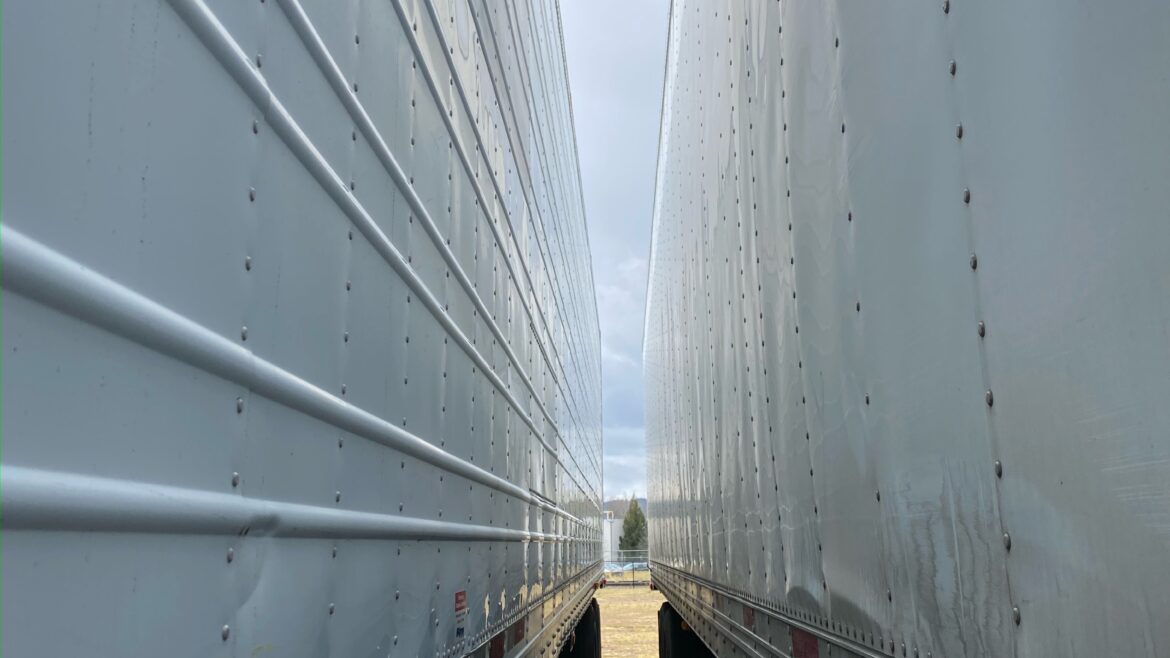
Mobile fueling hose delivering diesel between two parked trailers
On-Site Refueling in Oregon 768 1024 Star Oilco

On-Site Refueling in Oregon

       Wet Hose Fueling and Mobile On-Site Diesel Delivery in the Pacific Northwest.

If some days you have more work than drivers…

Wet Hose Fueling Service in Portland

Mobile On-site refueling or “Wet Hosing” is a solution that will push more money to your bottom line and reduce stress on your drivers.  Star Oilco can also merge our mobile onsite refueling service with our national Fleet Card system.

 One bill, labor saving in town and secured fleet fueling over the road.


  Top Five Reasons to Use Wet Hosing for your Fleet Diesel Fueling

On-site refueling or “Wet Hosing” is a preferred method for fueling these days. Fleets of all sizes prefer getting their fleet fueling delivered after hours in their yard. The reasons are numerous but at the top of the list, labor is the driving force behind it.

Shaving off even fifteen minutes of labor–which is one of the two highest costs for most fleets, right after diesel–can have a huge payback to the bottom line.

If your fleet is consistently on overtime or short that one extra hour of legal driver time, picking up fifteen to thirty minutes per truck a few times a month can be a huge opportunity. On top of that fleet fueling, your diesel can also save considerably just by controlling where you pay your fuel taxes (Oregon PUC is tax exempt on the fuel bill, while Washington cardlock and truck stops are paying nearly $.50 a gallon in Washington diesel road tax).  Though you are paying IFTA, why pay the tax earlier than you need to.

Call Star Oilco if you have questions and want to examine the payback value of Mobile On-site Refueling compared against your current vendor for diesel. You might be surprised how much it will save you in time, money and management effort.

                         Five Reasons your fleet should use Mobile On-site Refueling:

  1. Driver Time – The most valuable resource your fleet owns.
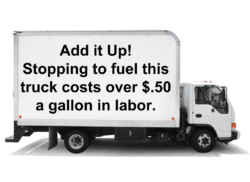
    • Truck drivers are a limited resource, and they cost more than you can usually measure in money alone. Without calculating the lost productivity of your truck, you are paying over $10 each time you allow your drivers to stop for fuel. Just the out of route, stopping, and getting back on the road time will put refueling your own trucks at a half hour of lost time. As the average fill up we see is under 50 gallons fueling your own trucks will cost you $.20 to $1 a gallon in labor costs alone.
  2. One More Stop – Picking up productivity in your fleet.
    • Getting drivers on the road and without a reason to be out of route pays back dividends. If you pay productivity bonuses, your most productive drivers will thank you as well. Even in fleets where pay is by stop, not based on hourly wages, the ability those few times a year when drivers are so busy they are bumping up against DOT work rules, they will thank you for the convenience of being ready to go the start of each shift and not having to worry about that one more stop on the way back to base. A few extra stops a year is often worth thousands of dollars to your bottom line–more than a cost of a tank of diesel.
  3. Save on the Cost of Diesel
    • Today the price of diesel at gas stations, truck stops, and other retail options is high compared to wholesale rack averages.  It is not uncommon for our customers to get an extreme labor savings with Mobile Onsite Fueling while also saving on the cost of diesel at the end of the month.  If you are using a credit card to buy fuel, the added Credit Card pricing of diesel is usually $.10 or more cents a gallon. Cut out the retail mark up on fuel and get a cost-plus deal with a true wholesale diesel seller delivering into your yard after hours.
  4. Easily Integrates with cardlock and other fleet cards onto one bill easily.
    • If you have a major hub with a critical mass of trucks in town, wet-hosing yPride Advantage Sample Cardour fleet can pay back rapidly. Even if the majority of your fleet is over the road and out of town, on-site refueling can be a money saving proposition. You can also integrate it seamlessly with a Pacific Pride, CFN, Fuelman, Voyager or another fleet card program as well. Star Oil can provide a Pacific Pride or Fuelman card that will work over the road consolidating all your fuel into one bill. Star can also accept Fuelman, Comdata, WEX or Voyager and bill those fleet cards directly with onsite refueling. Call if your fleet uses one of these national fleet cards and you want to move to wet hosing billed directly to the card and license plate of each one of your trucks. (For further reading on corporate fleet card security features please read our article on Upgrade your Fleet Card’s Security Features)
  5. Cost Plus Diesel – Budget to know every day you are getting a good wholesale rate for your fleet.
    • Star Oilco can connect your fleet to an agreed and easily verifiable cost plus supply agreements. Be it OPIS Average or Low Rack Plus agreements we can guarantee you have a good wholesale price of fuel. On-site refueling will provide a simplified fleet management experience for both your drivers and your Accounts Payable department. Call us if you want to talk about what this can do for your business. ( For further reading on the benefits of premium diesel and a wholesale partner for diesel, read our article on What is the benefit of Premium Diesel versus untreated diesel?)

We are here to serve you and keep the process simple. Contact us to learn more at, 503-283-1256.


Contact Form

  • This field is for validation purposes and should be left unchanged.
Tablet screen displaying Pacific Pride Commercial Fueling System logo
Top 4 Reasons Hotels Should Use Pacific Pride 1024 688 Star Oilco

Top 4 Reasons Hotels Should Use Pacific Pride

Pacific Pride Fuel Cards for Airport, Hotel, or Travel Shuttle Companies

Fuel for shuttle vans through Pacific Pride

ending with fuel card management, emailed receipts, transparency, and accountability for your hotel or travel shuttle bus drivers.

Star Oilco is an independent Franchisee of Pacific Pride

Pacific Pride Fuel cards for Shuttle Drivers

Running a shuttle service for a hotel for any reason can have a lot of moving parts:

  • Hiring
  • Training Drivers
  • Scheduling Shifts
  • Keeping the Vehicles Full of Fuel
  • Ensuring a Consistent Time Table

Let Star Oilco track and control the fueling for you. We can save you money and significantly reduce your risk of fuel theft while getting your drivers out of lines at a retail gas station. In addition, our locations are open even on holidays or late at night.

Shuttles going to and from the airports can be on tight schedules and  don’t have a lot of time to fuel. Meeting your guests’ needs means you can’t have your drivers in lines for a long time. Stand-alone commercial-only Pacific Pride and CFN sites in the northwest are a real resource for your business. Many stations are located near airports. They speed up the labor associated with fueling and significantly lock down the chance for fraud or theft when using your fuel card. Stand-alone sites limit access to convenience store items so employees won’t be tempted to spend time browsing and make purchases on the company credit card.

With Pacific Pride and CFN stand-alone commercial cardlock sites, there are other benefits beyond just the convenience. The biggest difference is that these commercial cardlock sites are built with security in mind. Retail stations are engineered to sell as many products as possible to those pulling up for gasoline. Commercial cardlock sites are designed for commercial users who seek the fastest fueling experience. That is a major contrast between the two.

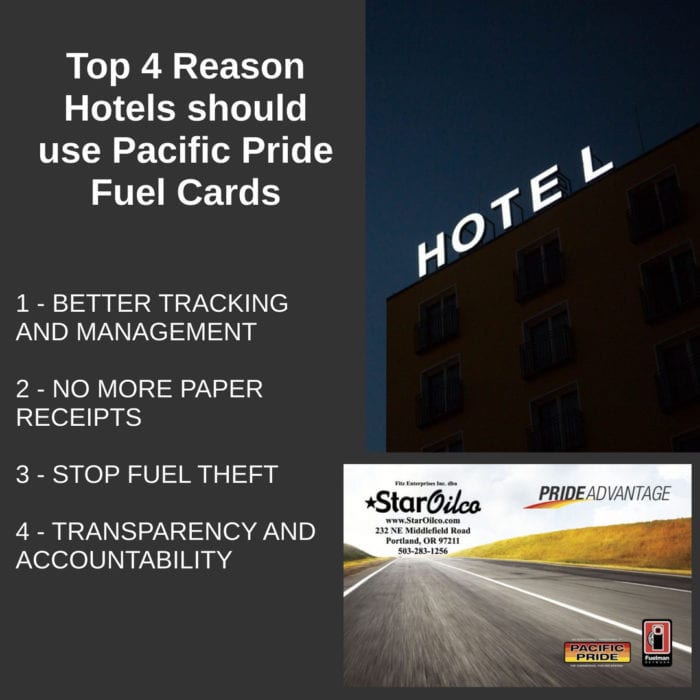
Top 4 Reason Hotels Should Use Fuel Cards

Top 4 Reason Hotels should use Pacific Pride Fuel Cards

Reason #1 – Better Tracking and Management

With a myriad of responsibilities required of those who run hotels or shuttles, simple methods to control when, where, and what is purchased any time during the day can save time and money. Controls keep fuel purchases in line and by only those with authorization.

WHEN: If the drivers only need access to fuel during specific shifts you can set the cards to work only during these times.

WHERE: Drivers can be limited to specific locations such as only Pacific Prides, or if more flexibility is needed, they can be authorized to use any of the 57,000 extended network locations. Pacific Pride locations are also open 24/7 and open even on the holidays.

WHAT: Drivers can be limited to specific types of fuel. If the van takes diesel you can set the card to only have access to diesel. These simple strategies can eliminate many of the issues that can arise when fueling.

Talk to a Card Lock expert at Star Oilco to find out more. 


Reason #2 – No More Paper Receipts 

Tracking and reviewing receipts takes up a lot of time. Pacific Pride fuel cards can be set up to automatically email every time a fueling occurs. Using a fuel card eliminates the need to continuously organize and track expense receipts from drivers. No more going through each and every receipt to see what and how much was purchased. Fuel can be set up to see which vehicle was fueled, who fueled it and when it was fueled. These transactions are easily organized with entered mileage and fuel costs in the bills that are issued twice a month. This alone can save hours of labor for accountants and controllers as they audit the bills.

Reason #3 – Stop Fuel Theft

By using a fuel card, a hotel insures the security of their shuttles and prevents theft by its drivers. This instills peace of mind, as managers know their drivers cannot use a fuel card for personal usage. Fuel cards can be assigned to vehicles and each driver has their own individual PIN#. With a quick email or phone call, card access can easily be granted or blocked as drivers leave or new ones are added.

Reason #4 – Transparency and Accountability

Star Oilco has created a template agreement for drivers to sign as they are assigned identification numbers for the cards. This form helps the driver understand that they are responsible for any unauthorized purchases with their DIN (Driver Identification Number). Setting up emails that are sent in real time can be done so that any unauthorized use can immediately be investigated.

Need to lock down your gas card from fuel theft?

Call Star Oilco, we make it simple.

Our motto is “Keep it Simple” and we make this easy. Feel free to reach out and see what Star Oilco can do for your fleet to upgrade its fleet fueling security.

What do you need to get a fuel card in Oregon?

All you need in order to access Pacific Pride sites in Oregon is a business license and proof that you use over 900 gallons of total fuel a year. CFN commercial cardlock sites have the same requirements. If you are a business using a commercial quantity of fuel, you qualify to self-serve gasoline and you can stop paying your employees to shop at the most expensive retail gas stations with the best mini-mart selection. Instead, get them back on the road 24-7 and usually without a line to wait in.

What do you need for fueling cards in Washington or any other state?

If you drive into Oregon and want to use gasoline, you still need the same requirements as stated above. If you don’t need access to Oregon gas stations, it is much easier to get a fuel card.


Star Oilco is an independent Franchisee of Pacific Pride

Contact Form

  • This field is for validation purposes and should be left unchanged.