
Posts By :

Sunny Battazzi

3D illustration of a gas pump icon made from green leaves symbolizing biofuel
Renewable Diesel or Biodiesel for Trucks? 1024 753 Star Oilco

Renewable Diesel or Biodiesel for Trucks?

The Fuel Revolution

In the realm of sustainable energy, the race for cleaner and more efficient fuels is a top of mind priority for the majority of the industry. As heavy-duty trucks continue to dominate our highways and play a pivotal role in transporting goods across the country, the choice of fuel is paramount. The two most common fuels used throughout the PNW for greener transportation are: Renewable Diesel and Biodiesel. In this blog, we’ll take a deeper look into the power generation of these fuels, highlighting the key differences between them and citing relevant studies that illuminate their qualities. 

3D illustration of a gas pump icon made from green leaves symbolizing biofuel

Renewable Diesel: The New Age Wonder Fuel 

Renewable Diesel, often referred to as “green diesel,” or R99 is a high-quality alternative fuel that shares many characteristics with traditional diesel. However, it is derived from renewable feedstocks, such as vegetable oils, animal fats, and waste greases, through a process called hydrotreating. This process not only produces a cleaner-burning fuel but also eliminates impurities and aromatics found in traditional diesel. The result is a fuel with significantly lower emissions and enhanced performance. 

Lower Emissions:

Perhaps the most significant advantage of renewable diesel is its environmental footprint. Studies, like the one conducted by the National Renewable Energy Laboratory (NREL), have shown that renewable diesel can reduce greenhouse gas emissions by up to 80% compared to standard diesel. This drastic reduction in emissions makes it a vital fuel in the efforts to combat climate change. 

Better Fuel Economy:

Renewable diesel boasts a higher energy content than biodiesel, allowing vehicles to travel more miles per gallon. A study by the California Air Resources Board (CARB) demonstrated that renewable diesel can improve fuel efficiency by 5-7% compared to biodiesel. For the trucking industry, this translates to significant cost savings. 

Compatibility:

One of the standout features of renewable diesel is its compatibility with existing diesel engines and infrastructure. Heavy-duty trucks can make the switch to renewable diesel seamlessly, without requiring any engine modifications or special storage facilities. 

Reduced Maintenance:

Studies like the one from the University of California, Riverside, have indicated that renewable diesel can lead to reduced engine wear and lower maintenance costs. The fuel’s superior lubricity and cleaner combustion help extend the lifespan of engine components. 

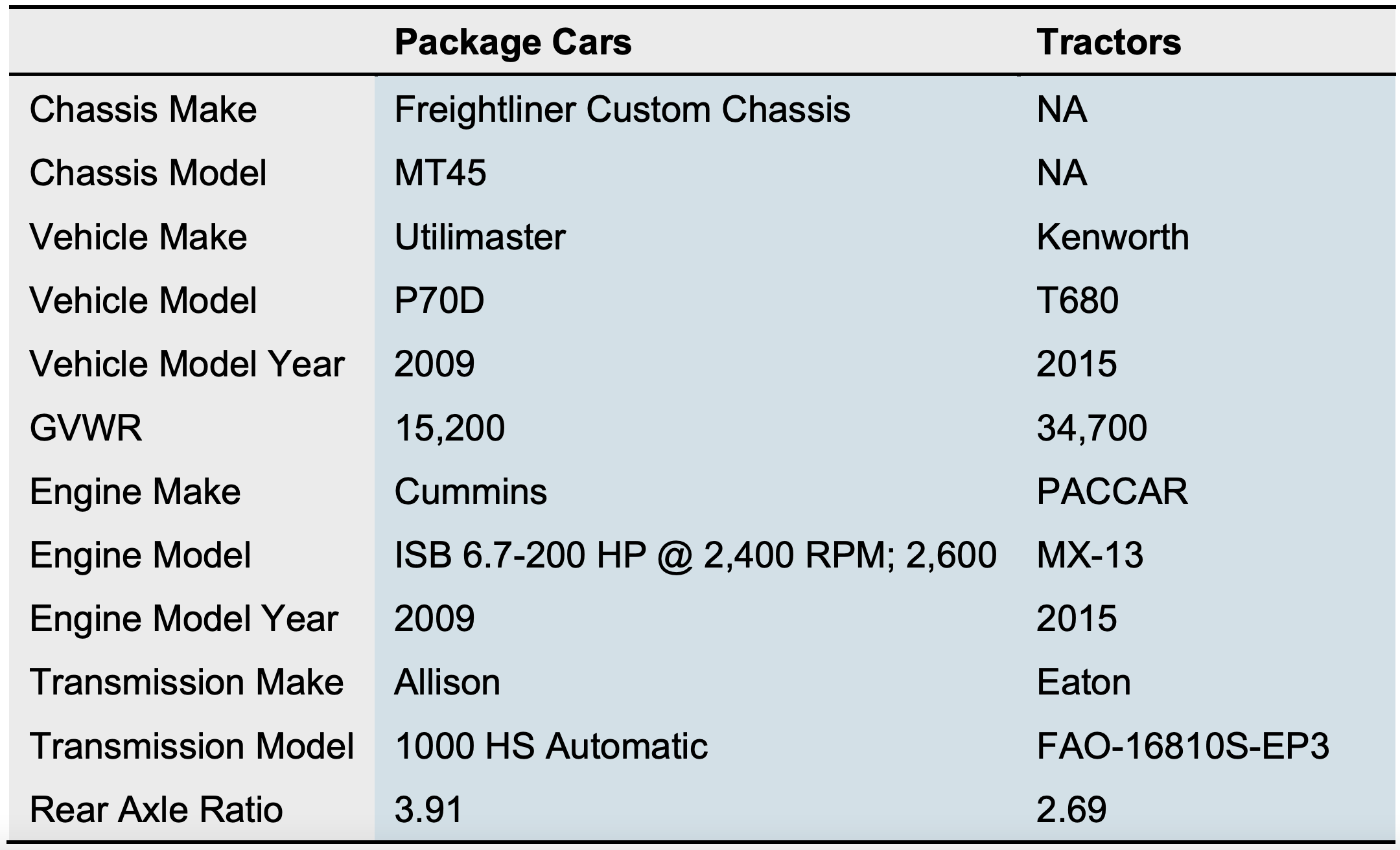
In 2015, NREL ran a study in partnership with the UPS and the Clean Cities Coilation to compare the fuel economy and overall impact of renewable diesel compared to petrelem diesel in 12 USP delivery vehicles operating out of Houston. The results of this study were that renewable diesel reduced carbon emissions by 4.2% comparatively to petroleum diesel. This finding is a result of the properties of renewable diesel given its higher mass-based heating value and lower carbon-hydrogen ratio. 

The UPS is one of the largest user of renewable diesel in the world. In 2015 UPS announced their plans to purchase over 40 million gallons of the sustainable fuel over the next three years (2015-2018). UPS was supplied this renewable diesel by Solazyme (now known as TerraVia).  

Below is a breakdown of the vehicles used in the study.

https://www.nrel.gov/docs/fy18osti/68896.pdf

BIODIESEL

Biodiesel, often derived from vegetable oils or animal fats through a process called transesterification, has been around for a while and has made significant strides in reducing emissions compared to traditional diesel. However, when pitted against renewable diesel, there are some critical differences.

The Limitations of Standard Biodiesel

Emissions:

While biodiesel is undoubtedly cleaner than traditional diesel, studies like the one published in the Journal of Environmental Science and Technology show that its greenhouse gas reduction potential is not as remarkable as that of renewable diesel. The production process of biodiesel also consumes substantial energy, offsetting some of its environmental benefits. 

Performance:

Biodiesel’s energy content is lower than that of renewable diesel, resulting in decreased fuel efficiency. Research from the University of Nevada, Reno, indicates that biodiesel can lead to a 3-10% reduction in fuel economy compared to renewable diesel. 

Cold Weather Performance:

Biodiesel has a higher cloud point and gel point than renewable diesel, making it less suitable for cold-weather operations. Trucks operating in regions with harsh winters may encounter issues with fuel gelling, potentially causing operational disruptions. 

Compatibility Challenges:

Biodiesel’s higher viscosity can lead to filter plugging and injector coking in some older diesel engines. This issue necessitates additional maintenance and potentially costly modifications. 

Close-up of green, yellow, and blue fuel nozzles at a diesel pump station

The Road Ahead: Renewable Diesel’s Triumph 

In the comparison of Renewable Diesel vs. petroleum diese for heavy-duty trucks, renewable diesel emerges as the clear winner. Its lower emissions, superior fuel economy, compatibility with existing infrastructure, and reduced maintenance requirements make it a game-changer in the transportation industry’s quest for sustainability. 

Studies across the board indicate that renewable diesel outperforms standard biodiesel in terms of environmental benefits and cost savings. For heavy-duty truck operators looking to reduce their carbon footprint and improve their bottom line, renewable diesel is undoubtedly the fuel of the future. 

In the quest for a greener future, renewable diesel has firmly taken the lead. Its remarkable reduction in emissions, better fuel economy, and seamless integration into existing diesel infrastructure make it the go-to choice for heavy-duty truck operators. While standard biodiesel has made commendable progress in reducing emissions, renewable diesel emerges as the winner in the arena of cleaner and more efficient fuels. 

The studies quoted in this blog are just the tip of the iceberg, illustrating the overwhelming evidence in favor of renewable diesel. As we move forward in our pursuit of sustainable transportation, it’s clear that renewable diesel will play a pivotal role in driving us toward a cleaner, more environmentally friendly tomorrow. 

Sign up for our newsletter to stay up to date

Name(Required)

Two semi-trucks driving on a highway with trees in the background
Weekly Fuel Market Report – July 5 – July 11, 2026 1024 683 Star Oilco

Weekly Fuel Market Report – July 5 – July 11, 2026

fuel-market-report-star-oilco
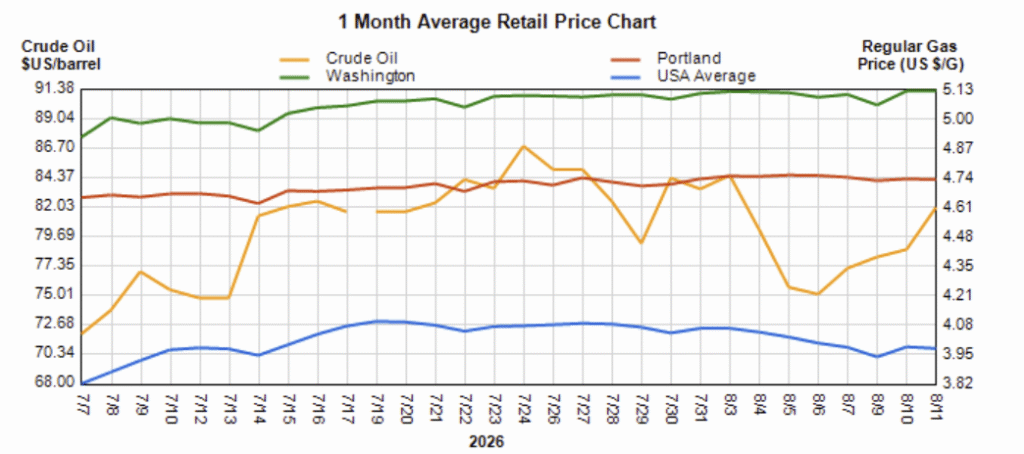
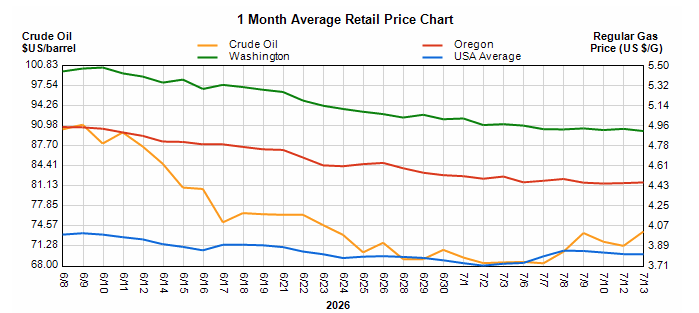
Line chart titled '1 Month Average Retail Price Chart' showing price trends for Crude Oil (orange), Washington (green), Oregon (red), and USA Average (blue) over time. Left axis shows crude oil price per barrel, right axis shows regular gas price per gallon. Communicates how crude oil and regional fuel prices change month to month in 2026.

Did You Know That R99 Is The Same Cost As Diesel Currently?

Call to set up R99 Mobile Fueling Onsite Service in Portland at the same cost of retail diesel. Dyed untaxed R99 is also available. Give us a call today to schedule your delivery.

Wholesale Price Average 7/11/26

Wholesale LowWholesale Avg
E10$3.03$3.12
B5$3.54$3.75
B20$3.59$3.72
R99$3.02$3.24

Average Retail Prices 7/11/26

NationalOregonWashington
E10$3.87$4.60$5.09
B5$4.88$5.39$5.83

Taxes

FederalState: ORLocalState: WA
Gas$0.184$0.40$0-.13$0.494
Diesel$0.244$0.40$0-.13$0.494

Portland Retail Fuel Price Variance

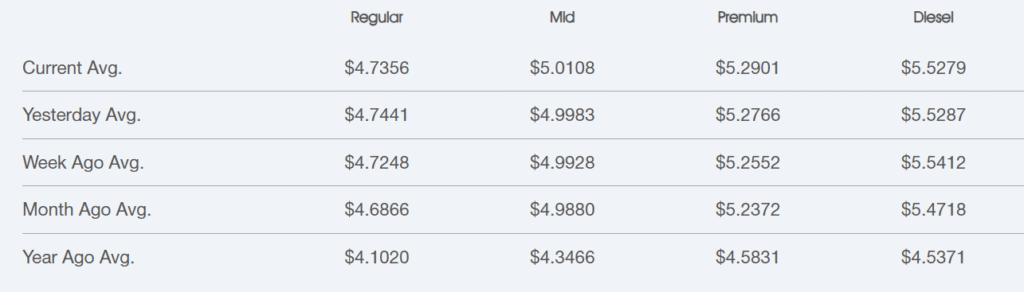
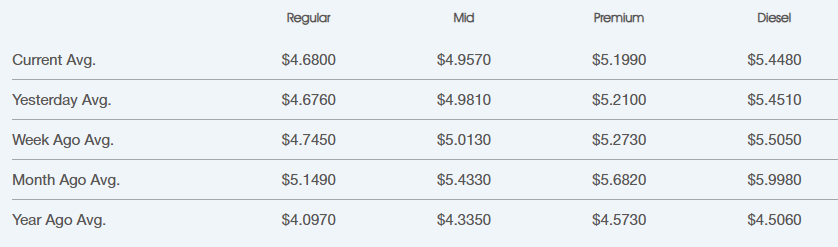
Table of current and historic average fuel prices by type: Regular, Mid, Premium, Diesel (e.g., Regular $4.68, Mid $4.96, Premium $5.20, Diesel $5.45).

Fuel Market News

Fuel prices jumped up this week as the U.S & Iran peace agreement has yet again proven to be extremely unstable, as military strikes have been re-initiated within the region, causing crude oil to shoot up 8% in 5 days. A very real problem that nobody seems to be talking about is the depletion of the federal oil reserve, which is at its lowest level since August 1983 at about 45% capacity. This should be much bigger news than it is, with no end in sight to the war with Iran

Retail gas prices in Portland are just under $5/gal at a current average of around $4.75/gal, while the Seattle area is at $5.45/gal.  Retail diesel prices in Portland are just under $6/gal at a current average of $5.55/gal, while the Seattle area is over $6.20/gal. Crude oil prices have jumped back this week as the U.S & Iran have once again started to bomb one another’s strategic assets. The doubters of the peace deal between the US & Iran were right yet again, as the peace agreement has gone to the wayside and military action and bomb strikes have resumed. This conflict truly has no end in sight, and the general public remains grossly uninformed by the U.S government about what is going on and what the timeline is.

fuel-market-report-star-oilco-5-18-24

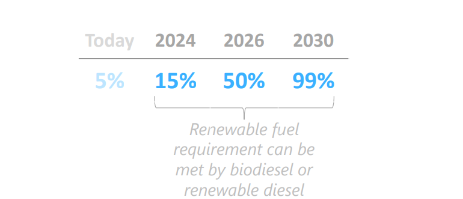
Important Note: Per the City Of Portland, “Distributors in the City of Portland are required to meet the minimum biofuel content requirements for all fuel they distribute beginning on May 15, 2024. All diesel fuel distributed to retail stations, non-retail dealers, or wholesale purchaser-consumers must include a minimum of 15% biofuel content, from either renewable diesel or biodiesel. This requirement increases to 50% on May 15, 2026, and 99% on May 15, 2030”.

Crude oil is jumped over $10/barrel and are currently hovering just above $80/barrel, at a current price of  $83.57/barrel.

Crude oil is the main ingredient for gasoline and diesel. Per AAA, on average about 50% of what you pay at the pump is the price of crude oil, breaking down as 25% refining, 11% distribution & marketing, and 14% taxes – a helpful breakdown for consumers wondering why they are paying the prices that they pay. Crude Oil is currently trading at $83.57/barrel compared to $71.88/barrel last week and $73 a year ago.

It’s essential to recognize that fuel prices result from a complex interplay of the factors mentioned above and other regional factors. Additionally, prices may vary by specific regions within Oregon and Washington. For the most precise and up-to-date information on fuel prices and the causes for these price changes within your area, use the links below for AAA & GasBuddy.

If you have any questions, feel free to contact Star Oilco and speak to one of our fuel market advisors to discuss how the market can impact your business.

Set up your R99 Mobile Fueling Onsite Service in Portland Today Including Dyed Untaxed R99.

Give Us A Call Today

For other news in the fuel market:

https://gasprices.aaa.com/?state=OR

https://www.gasbuddy.com/charts

Join the Fuel Market Report newsletter for your weekly fill of updates!

Two semi-trucks driving on a highway with trees in the background
Weekly Fuel Market Report – June 28 – July 4, 2026 1024 683 Star Oilco

Weekly Fuel Market Report – June 28 – July 4, 2026

fuel-market-report-star-oilco
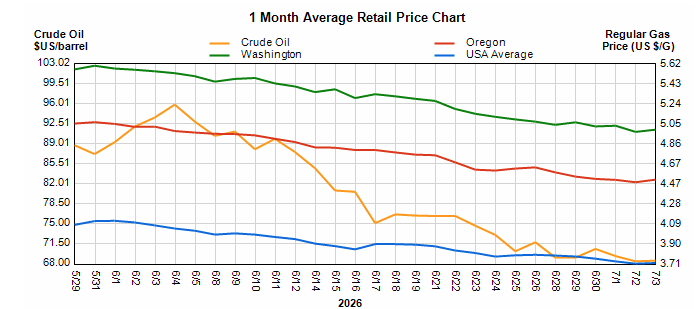
1 Month Average Retail Price Chart: trends May–early July 2026 for crude oil (orange), Washington (green), Oregon (red), USA average (blue), and regular gas price (blue/gal). Left axis: crude oil $/barrel (roughly 68–103); right axis: gas price $/gal (roughly 3.71–5.62). Green line gradually declines; orange drops after mid‑June; red remains steady; blue USA average hovers near the gas price axis.

Did You Know That R99 Is The Same Cost As Diesel Currently?

Call to set up R99 Mobile Fueling Onsite Service in Portland at the same cost of retail diesel. Dyed untaxed R99 is also available. Give us a call today to schedule your delivery.

Wholesale Price Average 7/4/26

Wholesale LowWholesale Avg
E10$3.01$3.18
B5$3.43$3.61
B20$3.43$3.58
R99$2.84$2.92

Average Retail Prices 7/4/26

NationalOregonWashington
E10$3.85$4.68$5.16
B5$4.85$5.50$6.02

Taxes

FederalState: ORLocalState: WA
Gas$0.184$0.40$0-.13$0.494
Diesel$0.244$0.40$0-.13$0.494

Portland Retail Fuel Price Variance

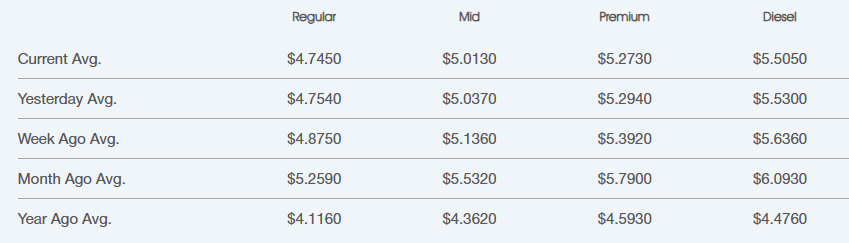
Table of fuel prices by type (Regular, Mid, Premium, Diesel) with rows for Current Avg., Yesterday Avg., Week Ago Avg., Month Ago Avg., and Year Ago Avg.

Fuel Market News

Fuel prices were mostly stagnant this week, with fuel prices only moving a few cents while crude oil still hovered just above $70/barrel. The peace agreement between the US & Iran has continued to be shaky, with the US striking Iran on the 27th of June after Trump preached of peace and a “deal being done” on Truth Social. The continued murkiness has led the US public to begin to question what is actually going on and why this “3-week” operation is now entering its fifth month of conflict. The conflict has cost US consumers approximately $45 billion due to higher fuel and oil prices and inflation across the board.

Retail gas prices in Portland are just under $5/gal at a current average of around $4.85/gal, while the Seattle area is at $5.48/gal.  Retail diesel prices in Portland are just under $6/gal at a current average of $5.87/gal, while the Seattle area is over $6.25/gal. Crude oil prices have continued to tumble upon the renewed talks of a peace agreement between the U.S & Iran. Many doubt the legitimacy of peace agreements with continued military action and missile strikes occurring over weekends on more than one occasion. Much remains unclear about the current situation in Iran to the general public in the U.S.

fuel-market-report-star-oilco-5-18-24

Important Note: Per the City Of Portland, “Distributors in the City of Portland are required to meet the minimum biofuel content requirements for all fuel they distribute beginning on May 15, 2024. All diesel fuel distributed to retail stations, non-retail dealers, or wholesale purchaser-consumers must include a minimum of 15% biofuel content, from either renewable diesel or biodiesel. This requirement increases to 50% on May 15, 2026, and 99% on May 15, 2030”.

Crude oil is hovering just above $70/barrel, at a current price of $70.11/barrel.

Crude oil is the main ingredient for gasoline and diesel. Per AAA, on average about 50% of what you pay at the pump is the price of crude oil, breaking down as 25% refining, 11% distribution & marketing, and 14% taxes – a helpful breakdown for consumers wondering why they are paying the prices that they pay. Crude Oil is currently trading at $71.88/barrel compared to $70.11/barrel last week and $76 a year ago.

It’s essential to recognize that fuel prices result from a complex interplay of the factors mentioned above and other regional factors. Additionally, prices may vary by specific regions within Oregon and Washington. For the most precise and up-to-date information on fuel prices and the causes for these price changes within your area, use the links below for AAA & GasBuddy.

If you have any questions, feel free to contact Star Oilco and speak to one of our fuel market advisors to discuss how the market can impact your business.

Set up your R99 Mobile Fueling Onsite Service in Portland Today Including Dyed Untaxed R99.

Give Us A Call Today

For other news in the fuel market:

https://gasprices.aaa.com/?state=OR

https://www.gasbuddy.com/charts

Join the Fuel Market Report newsletter for your weekly fill of updates!

Decarbonization concept with CO2 reduction icons over a globe in green grass symbolizing clean energy
Biofuels Industry Exceeds EPA Expectations 1024 618 Star Oilco

Biofuels Industry Exceeds EPA Expectations

Biofuels Industry Surpasses Expectations with a Massive Production Rise

Based on the data, biomass-based diesel production has increased massively in the United States, including biodiesel, renewable diesel, sustainable aviation fuel, and heating oil. Biomass-based diesel was expected to produce 4 billion gallons in 2023. Biofuel production and use increased by one billion gallons from last year to this year, which is a big jump. As a result of this achievement, a breakthrough has been achieved. The industry has surpassed what the EPA once thought was impossible with the development of advanced biofuels derived from sustainable sources.

So the real question is, what if we don’t choose biodiesel or renewable diesel over petroleum diesel for our diesel engines?

Biofuel production from plant oils and renewable crops for clean diesel alternatives
  • Biofuel production soared in 2023, exceeding EPA goals.

  • US biomass-based diesel production (biodiesel, renewable diesel, SAF, heating oil) reached 4 billion gallons.

  • Biofuel production and use jumped by 1 billion gallons year-over-year.

Clean Fuel Industry Beats Regulations in Decarbonization Push

While the Clean Fuels Alliance urged the EPA to set even more ambitious goals, like increasing biomass-based diesel production by 500 million gallons a year over the next three years, the EPA has taken a more conservative approach. Regulations aren’t keeping up with the industry, but it’s not waiting for them. Clean fuels are becoming more accessible and heavy-duty transportation fuels used by aviation and maritime are getting decarbonized. The industry has shown its ability to grow quickly and sustainably thanks to this collaborative effort.

  • Clean Fuels Alliance pushed for aggressive EPA goals: 500 million gallons annual increase in biomass-based diesel production for 3 years.

  • EPA’s finalized standards took a cautious approach.

  • Oil and gas producers, refiners, distributors, and retailers don’t have to wait for strict regulations to act (producers, refiners, distributors, retailers).
  • Industry collaboration demonstrates the potential for rapid, sustainable growth.

Decarbonization concept with CO2 reduction icons over a globe in green grass symbolizing clean energy

Despite this year’s achievements, the Clean Fuels Alliance remains focused on the future. There’s so much potential in sustainable biofuels that we think the EPA hasn’t tapped into yet. Supporting biodiesel, renewable diesel, and SAF production can help achieve clean energy progress.

In reality, why wouldn’t we make the switch to lower our carbon emissions today?

JOIN THE FUEL MARKET REPORT NEWSLETTER FOR YOUR WEEKLY FILL OF UPDATES!

Name
lose-up of a red fuel nozzle at a green diesel pump
Renewable Diesel or Biodiesel: Which Is Better? 683 1024 Star Oilco

Renewable Diesel or Biodiesel: Which Is Better?

What’s the difference and how do they compare in price? 

If you are looking for a cleaner and greener alternative to diesel fuel, you might have come across two options: renewable diesel and biodiesel. Both fuels are made from organic sources, such as vegetable oils and animal fats, but they have different production processes and properties. In this blog post, we will compare renewable diesel and biodiesel in terms of their pros and cons, as well as their prices and incentives in Oregon. 

What is Renewable Diesel? 

Renewable diesel is a fuel that is chemically identical to petroleum diesel, but it is made from renewable raw materials through a process called hydrotreating. Hydrotreating removes impurities and oxygen from the feedstock, resulting in a pure and refined fuel that can be used in any diesel engine without modifications or blending. Renewable diesel (R99) has a high cetane number, which means it ignites easily and burns efficiently. It also has a low cloud point, which means it can withstand cold temperatures without gelling or clogging filters. 

What is Biodiesel? 

Biodiesel is a fuel that is made from renewable raw materials through a process called transesterification. Transesterification converts the feedstock into fatty acid methyl esters (FAME), which are then blended with petroleum diesel at various ratios. Biodiesel can be used in most diesel engines, but it may require some modifications or adjustments depending on the blend level and the engine type. Biodiesel has a lower cetane number than renewable diesel, which means it may not ignite or burn as well. It also has a higher cloud point than renewable diesel, which means it may gel or clog filters in cold weather. 

The cost of renewable diesel and biodiesel depends on various factors, such as the type and availability of feedstock, the production process, the market demand, and the government incentives. In general, renewable diesel is more expensive than biodiesel, as it requires more complex processing and higher quality feedstock. According to the U.S. Energy Information Administration (EIA), the average wholesale price of renewable diesel in California was $3.06 per gallon in October 2021, while the average wholesale price of biodiesel was $2.76 per gallon in the same month. However, both renewable diesel and biodiesel can benefit from federal RIN’s and state credits such as the low carbon fuel standards, which can lower their effective prices and make them more competitive with petroleum diesel. As of July 10th of 2023 renewable diesel (R99) in Portland Oregon was 60 cents higher than biodiesel (B99). 

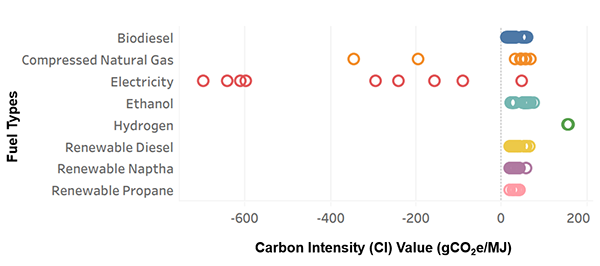
 Renewable Diesel vs Biodiesel Carbon Intensity 

According to CARB, the carbon intensity of biodiesel ranges from 14.85 to 67.45 gCO2e/MJ and, renewable diesel ranges from 15.84 to 62.86 gCO2e/MJ, depending on the feedstock and production pathway. The lowest carbon intensity for biodiesel is achieved by using waste cooking oil as the feedstock and renewable methanol as the transesterification agent. The highest carbon intensity is associated with using soybean oil as the feedstock and fossil-based methanol as the transesterification agent. The lowest carbon intensity for renewable diesel is achieved by using waste cooking oil as the feedstock and renewable hydrogen as the hydrotreating agent. The highest carbon intensity is associated with using soybean oil as the feedstock and fossil-based hydrogen as the hydrotreating agent. 

Fuel-Pathways-Carbon-Intensity-Values

Pros and Cons of Renewable Diesel and Biodiesel 

Both renewable diesel and biodiesel have some advantages and disadvantages compared to petroleum diesel. Here are some of the main pros and cons of each fuel:  

Renewable Diesel Pros: 

– Reduces greenhouse gas emissions by up to 75% compared to petroleum diesel 

– Reduces tailpipe emissions of particulate matter, nitrogen oxides, carbon monoxide, and hydrocarbons 

– Improves engine performance and efficiency with fewer regeneration cycles of the emissions system 

– Compatible with existing infrastructure and vehicles 

– Biodegradable and nontoxic 

Renewable Diesel Cons: 

– More expensive than petroleum diesel 

– Limited availability and supply 

– May increase emissions of sulfur dioxide 

Biodiesel Pros: 

– Reduces greenhouse gas emissions by up to 78% compared to petroleum diesel 

– Reduces tailpipe emissions of particulate matter, carbon monoxide, and hydrocarbons 

– Biodegradable and nontoxic 

– Supports domestic agriculture and energy security 

 Biodiesel Cons: 

– May increase emissions of nitrogen oxides 

– May cause engine problems such as injector coking, filter plugging, corrosion, and reduced lubricity 

– May degrade over time or when exposed to water or microbes 

Oregon Prices and Incentives for Renewable Diesel and Biodiesel 

Oregon is one of the states that has adopted a Clean Fuels Program (CFP), which aims to reduce the carbon intensity of transportation fuels by 10% by 2025. The CFP creates a market for low-carbon fuels such as renewable diesel and biodiesel by requiring fuel suppliers to either blend them with petroleum diesel or buy credits from low-carbon fuel producers. The CFP also provides incentives for consumers to use low-carbon fuels by reducing their fuel taxes. 

According to the Oregon Department of Environmental Quality (DEQ), the average price of diesel in Oregon as of November 2021 was $3.87 per gallon. The average price of biodiesel blends ranged from $3.88 per gallon for B5 (5% biodiesel) to $4.01 per gallon for B20 (20% biodiesel). The average price of renewable diesel was $4.05 per gallon. As of July 2023 the price of renewable diesel (R99) in Oregon was 50 to 60 cents higher than biodiesel (B99). 

The DEQ also provides a Fuel Cost Calculator that allows consumers to compare the costs and benefits of different fuels based on their vehicle type, fuel efficiency, annual mileage, fuel price, carbon intensity, and tax rate. According to the calculator, using renewable diesel instead of petroleum diesel would save an average consumer $34 per year in fuel costs and reduce their carbon emissions by 1.6 metric tons per year. Using biodiesel instead of petroleum diesel would save an average consumer $12 per year in fuel costs and reduce their carbon emissions by 0.8 metric tons per year. 

Renewable diesel and biodiesel are both viable alternatives to petroleum diesel that can help reduce greenhouse gas emissions and support renewable energy sources. However, they also have some trade-offs in terms of cost, availability, performance, and emissions. Consumers should consider their vehicle type, driving habits, fuel preferences, and environmental goals when choosing between these fuels. Oregon offers some incentives and programs to encourage the use of low-carbon fuels such as renewable diesel and biodiesel, which can help consumers save money and reduce their carbon footprint. 

home insulation representing energy efficiency for renewable fuel standard compliance in Portland Oregon
Portland Renewable Fuel Standard Explained 1024 683 Star Oilco

Portland Renewable Fuel Standard Explained

Did you hear about the time Portland banned fossil fuel diesel?

Portland is making a big move to provide cleaner air and reduce greenhouse gas emissions. Portland has implemented what’s called the Renewable Fuel Standard (RFS) beginning  its first phase on May 15th, 2024. The RFS policy in Portland mandates that there has to be an increase of use of low-carbon biofuels in diesel within city limits of Portland. This is part of the ultimate Climate Emergency plan. This RFS mandate was first implemented in 2006 as a B5 (5%) Biodiesel blend mandate with the goal of mandating a 20% blend. The RFS is the first of its kind not only in Oregon but in the entire United States. Portland’s reputation as a leader in environmental sustainability efforts continues. 

Portland’s Phases To Implement Almost 100% Renewable Diesel

What makes Portland’s mandate unique is the requirement that the biofuels have a CO2 value so low it bars most American made biodiesels. The blending requirement starts at 15% in 2024, and then it will steadily increase to 50% by 2026 and will reach 99% by 2030. This schedule demonstrates how Portland’s low-carbon ambition is present to transition away from fossil fuels and promote alternative energy sources.

This policy is expected to reduce air pollution and carbon emissions. It will also create new markets for biofuels, which will lead to increased economic opportunities. This will ultimately help the city become a more sustainable and environmentally friendly place to live as Portland has taken the lead in striving for sustainability over the years.

The policy will also help create jobs in the biofuel industry and provide opportunities for businesses to switch to renewable energy sources. It will also help reduce the city’s dependence on fossil fuels and protect the environment for future generations.

Want to learn more about meeting Portland’s requirements for the Renewable Fuel Standard mandate?

landscape view of Mount Hood representing Star Oilco’s fuel delivery service area in Oregon

Focus on Lower-Emission Biofuels

Uniquely, Portland’s RFS goes beyond just the biofuel blend. It also sets a strict carbon intensity (CI) standard for the biofuels themselves. This ensures the biodiesels used have a significantly lower carbon footprint compared to traditional options. Biodiesels produced domestically often fall short of this CI requirement, prompting many suppliers to look to renewable diesel sources. This focus on biofuels with a lower lifecycle carbon footprint makes Portland’s RFS even more impactful in reducing greenhouse gas emissions.

Iconic Portland sign on Broadway at dusk with city buildings in the background

Exemptions and Implementation Details

The initial phase of the RFS targets on-road diesel sales. This applies to diesel purchased at gas stations, by mobile fueling companies, and for use in large stationary tanks. However, the long-term goal includes all diesel use within the city. Some temporary exemptions apply to off-road diesel uses such as heating oil, generator fuel, aircraft fuels, watercraft fuels, and other dyed fuel users. One local truck stop, Jubitz Truckstop, was granted a temporary exemption. This is likely due to concerns about disrupting critical transportation operations. Daimler (the manufacturer of Freightliner and Western Star trucks) has a research facility in Portland. Daimler was also granted an exemption to meet their specific fuel needs for testing purposes. 

The RFS enforces compliance through fuel sampling and requires documentation proving the fuel meets the minimum biofuel content and CI standards. Businesses that purchase diesel need to be able to show their compliance through bills of lading (BOLs) or similar records from their fuel provider, like Star Oilco. If a business does not comply and provide this documentation, it can result in pretty hefty fines. First offenses can be a fine of $10,000 per day. Repeat offenders will end up facing even bigger penalties of up to $15,000 per day. These fines can really show the impact of how serious Portland is taking this initiative. 

Impact on Businesses and Consumers

While residential consumers who don’t purchase diesel directly are not directly impacted, businesses purchasing diesel, especially in bulk, will need to adapt to the new regulations. This may involve acquiring documentation from fuel suppliers or entering into contracts guaranteeing compliant fuel blends. Wholesale fuel distributors, who sometimes purchase from multiple vendors and blend fuel mid-route, may face additional challenges in tracking the biofuel content and CI of their product. However, as the program matures, the industry is expected to adapt and streamline these compliance procedures.

Contact Us Today To Discuss What This Means For Your Business

A Step Forward for Cleaner Transportation

Portland’s ambitious RFS sets a new expectation for sustainable transportation. Promoting low-carbon biofuels allows Portland to aim to significantly reduce its reliance on fossil fuels and be able to contribute to cleaner air for its residents. The RFS program will be able to serve as a model for other cities that are looking at implementing similar initiatives. Great job Portland for paving the way to a sustainable future for other cities! Although challenges will remain, as businesses adapt to this new norm, Portland’s RFS represents a significant step forward in creating a more sustainable transportation sector.

The RFS program is an important step in the fight towards sustainability and lower carbon fuels. It sends a clear message that cities are willing to take action to reduce emissions and protect the environment. We anticipate that other cities will follow Portland’s lead and create similar initiatives. This will have a significant impact in reducing emissions and helping to protect the environment.

It is a positive step towards a more sustainable future. Alternative fuels have become more and more readily available. Investing in alternative fuels and reducing carbon emissions is essential for protecting the planet for future generations. Governments should prioritize investing in renewable energy sources and incentivize communities to switch to alternative fuel solutions.

Thank you for choosing Star Oilco as your preferred fuel provider in Portland and Vancouver, Washington. Give us a call to discuss how the RFS mandate can affect your business and one of our team members would be happy to discuss this with you.

JOIN THE FUEL MARKET REPORT NEWSLETTER FOR YOUR WEEKLY FILL OF UPDATES!

Name
Diesel Exhaust Fluid (DEF) Quality, Storage, and Future Considerations 1024 1024 Star Oilco

Diesel Exhaust Fluid (DEF) Quality, Storage, and Future Considerations

Have you ever noticed that Diesel Exhaust Fluid (DEF) often lives in the background until suddenly it’s the reason your fleet can’t meet emissions standards or a system clogs up? DEF quality and storage isn’t just technical noise, it’s vital for keeping your SCR system happy and your operations rolling smoothly. We want to share with you what makes DEF high quality, the best ways to store it, and what trends are shaping its role in diesel emissions systems moving forward.

Diesel Exhaust Fluid (DEF) is a crucial component in modern diesel engines equipped with Selective Catalytic Reduction (SCR) systems. While many fleet operators are familiar with its basic function of reducing nitrogen oxide (NOx) emissions, understanding the intricacies of DEF quality, storage, supply chain considerations, and system maintenance can help businesses optimize efficiency and avoid costly repairs. At Star Oilco, we provide fleets with the knowledge and resources needed to navigate these complexities. This guide will explore the advanced aspects of DEF, from maintaining quality and ensuring proper storage to understanding emerging trends in emissions technology. 

Understanding DEF Quality and Purity 

 The quality of DEF plays a significant role in the performance and longevity of an SCR system. DEF must adhere to ISO 22241 standards, which regulate its composition, concentration, and purity. Using non-compliant DEF can lead to injector clogging, crystallization, and system failures. Even small amounts of contaminants such as dirt, fuel, or water can negatively impact DEF performance and damage expensive SCR components. 

To ensure DEF meets the necessary standards, regular testing should be performed. Refractometers can measure the urea concentration to verify the correct 32.5 percent solution. DEF testing strips can detect impurities, while more advanced lab analysis can help diagnose performance issues related to fluid quality. Purchasing DEF from a reliable, ISO-certified supplier is the best way to avoid contamination and maintain compliance. 

DEF Storage Best Practices to Prevent Contamination 

Proper storage is essential for maintaining DEF integrity. Temperature control is a key factor, as DEF should be stored between 12 and 86 degrees Fahrenheit to prevent degradation. Freezing does not damage DEF, but extreme heat can cause evaporation and reduce its effectiveness. To minimize exposure to environmental factors, DEF should be stored in opaque, UV-resistant containers to prevent sunlight from breaking down its chemical properties. 

Choosing the right storage material is also critical. DEF should be kept in plastic or stainless steel containers, as certain metals such as aluminum, copper, and zinc react with DEF, leading to contamination. Additionally, keeping storage containers sealed will prevent air exposure, which can introduce dust or debris. Managing inventory efficiently is another important aspect of storage. DEF typically has a shelf life of 12 months, but in warmer climates, its lifespan may be reduced to six months. Using a first-in, first-out (FIFO) inventory approach ensures that older stock is used before it degrades. 

Regular inspections and cleaning of storage equipment are also recommended to maintain DEF purity. Be sure to check for residue buildup, leaks, or any signs of contamination in tanks, nozzles, and dispensing systems. Training staff on proper handling procedures can further reduce the risk of accidental contamination. By taking these proactive steps, you can ensure your DEF stays clean, effective, and ready to support emissions compliance.

DEF dispensing station pump showing control panel, hose, and DEF push button

How Temperature Affects DEF Performance 

Temperature fluctuations can significantly impact DEF performance. In cold climates, DEF freezes at 12 degrees Fahrenheit, causing operational challenges for fleets. While frozen DEF does not degrade, it must be properly thawed before use. Heated DEF dispensers and insulated storage solutions can help prevent freezing issues in extreme weather conditions. It is important to avoid adding water to thaw frozen DEF, as this disrupts the precise urea concentration and compromises its effectiveness. 

On the other end of the spectrum, high temperatures can cause DEF to degrade. Exposure to prolonged heat above 86 degrees Fahrenheit can lead to evaporation and an increase in urea concentration, which may result in improper dosing and SCR malfunctions. Storing DEF in shaded or climate-controlled areas can help mitigate heat-related degradation. Seasonal changes also impact DEF consumption rates, with colder temperatures often leading to increased DEF usage as SCR systems adjust to lower combustion efficiencies. 

DEF Supply Chain Considerations 

DEF relies on a stable global urea supply, making it susceptible to market fluctuations. Since urea is also used in fertilizer production, shifts in agricultural demand, export restrictions, and production slowdowns can lead to price increases and supply shortages. In times of high demand, fleets may struggle to secure sufficient DEF, leading to increased costs and operational challenges. 

To avoid supply disruptions, fleet operators should consider strategic sourcing options. Establishing relationships with reliable DEF suppliers and securing bulk deliveries can help mitigate the risk of shortages. On-site DEF storage solutions can also provide a buffer against market volatility, allowing businesses to maintain an adequate supply without relying on just-in-time purchasing. Planning ahead for seasonal or industry-wide fluctuations in DEF availability can help fleets remain operational without unexpected expenses. 

The Economics of DEF for Fleet Operations 

DEF consumption is directly tied to diesel fuel usage, with most fleets using approximately two to three percent DEF per gallon of diesel burned. Understanding this ratio allows businesses to budget accordingly and monitor costs. Optimizing fuel efficiency can also lead to lower DEF usage, as well-maintained engines operate more efficiently and require less NOx reduction. 

Using high-quality DEF prevents costly maintenance issues. Non-compliant or contaminated DEF can cause injector clogging, pump failures, and SCR system malfunctions, resulting in expensive repairs and downtime. Some manufacturers void engine warranties if improper DEF is used, making it even more important to source DEF from a certified provider. Preventative maintenance and regular DEF quality testing can help fleets avoid hidden costs associated with poor-quality fluid. 

DEF System Failures: Causes and Prevention 

Common DEF system failures can be traced back to improper handling, storage, and contamination. Crystallization, for example, occurs when DEF is exposed to air and loses moisture, leaving behind solid urea deposits that can clog injectors and sensors. Contaminated DEF can lead to buildup in the SCR system, affecting performance and triggering warning lights that may lead to vehicle derating or shutdown. 

Preventing DEF system failures requires proactive maintenance. Regularly flushing DEF tanks, inspecting nozzles for blockages, and ensuring proper storage conditions can help prevent these issues. Using ISO-certified DEF from a trusted supplier also reduces the risk of contamination. Scheduled maintenance checks and SCR system inspections allow fleet operators to address minor issues before they escalate into costly repairs. 

The Future of DEF and Emissions Technology 

As emissions regulations continue to evolve, the role of DEF in diesel technology is likely to expand. The Environmental Protection Agency (EPA) continues to push for stricter NOx reduction targets, which may lead to advancements in SCR systems and increased DEF usage. Some manufacturers are exploring alternative NOx-reduction methods, such as ammonia-based catalysts or hydrogen fuel cell technology, but DEF remains the most effective solution for modern diesel engines. 

While DEF will remain a key component of emissions compliance for the foreseeable future, fleet operators should stay informed about regulatory changes and advancements in emissions technology. Investing in high-quality DEF and optimizing storage and usage practices will help businesses stay ahead of evolving environmental standards. 

DEF Myths and Misconceptions 

Several misconceptions about DEF persist, leading to improper use and maintenance practices. One common myth is that water can be added to DEF in emergencies. This is incorrect, as dilution disrupts the precise 32.5 percent urea concentration, rendering it ineffective and potentially damaging the SCR system. 

Another common belief is that DEF improves fuel efficiency. While DEF itself does not enhance fuel economy, it allows for optimized engine performance by reducing backpressure in the exhaust system. This results in better combustion efficiency, which can lead to slight improvements in fuel usage. 

A final misconception is that DEF does not expire. In reality, DEF has a shelf life and degrades over time, especially when exposed to heat or contaminants. Proper storage and inventory management are essential to maintaining DEF quality. 

How Star Oilco Ensures High-Quality DEF for Customers 

Star Oilco provides high-quality, ISO 22241-certified DEF to ensure fleets remain compliant and operational. Our bulk DEF delivery services allow businesses to secure a reliable supply, reducing the risk of shortages and minimizing costs. We also offer on-site DEF storage solutions to help fleets manage their inventory efficiently. 

In addition to supplying high-quality DEF, we assist customers with DEF system maintenance, testing, and best practices to ensure long-term reliability. With our commitment to quality and service, Star Oilco is the trusted partner for businesses looking to optimize their DEF usage and reduce the risk of SCR system failures. 

We also help customers stay up to date on regulatory changes and evolving DEF standards to ensure full compliance. Whether you’re a small fleet or a large operation, our team is ready to tailor a DEF solution that meets your specific needs.

For more information on our DEF solutions, contact Star Oilco today to learn how we can help keep your fleet running efficiently while meeting emissions compliance standards. 

Frequently Asked Questions

DEF (Diesel Exhaust Fluid) is injected into the exhaust stream of modern diesel engines equipped with Selective Catalytic Reduction (SCR) systems. It reacts with exhaust gases to convert harmful nitrogen oxides (NOx) into harmless nitrogen and water vapor. This process dramatically cuts emissions, keeping your fleet compliant with strict EPA standards.

Stored properly, DEF generally has a shelf life of up to 12 months. However, exposure to heat can shorten this to 6 months or less, especially in warmer climates. That’s why using a first-in, first-out (FIFO) system is crucial. It ensures older DEF is used before it degrades, protecting your SCR systems from concentration issues that could cause costly repairs. 

Most fleets use about 2-3% DEF relative to diesel fuel burned. That means for every 100 gallons of diesel, you’ll consume roughly 2 to 3 gallons of DEF. Knowing this ratio helps you forecast DEF needs alongside your fuel budgets.

Not directly. DEF doesn’t boost fuel economy on its own. However, by reducing exhaust backpressure through the SCR process, your engine can operate more efficiently, which may lead to slightly better combustion and fuel performance over time. 

Yes. DEF naturally degrades over time, even under ideal conditions. Keeping it cool, sealed, and protected from UV rays slows this process, but eventually it ages out. That’s why FIFO inventory management and routine checks of DEF age are important to avoid using degraded product.

Colder temperatures can make diesel engines burn less efficiently, leading the SCR system to dose more DEF to keep NOx emissions in check. This seasonal variance is normal, but it means winter months may see DEF usage spike slightly higher than your average.

Regulations on NOx emissions are only getting tighter. This means future SCR systems could demand even more precise DEF dosing, or fleets might see an overall increase in DEF consumption. Staying committed to quality DEF, proper storage, and system maintenance now will help keep you ahead of regulatory curves and avoid penalties later.

We supply only ISO-certified DEF, deliver it in bulk or packaged form, and provide on-site storage solutions to keep your operations protected. Our team also supports customers with DEF quality testing, maintenance guidance, and proactive system checks to help you avoid breakdowns, warranty headaches, and surprise costs.

Portland-Oregon-Pacific-Pride-Location-Map
Mobile Cardless Pay with Pacific Pride & CFN 349 335 Star Oilco

Mobile Cardless Pay with Pacific Pride & CFN

Pacific Pride offers a mobile cardless pay option through their app, PRIDE PAY.

With PRIDE PAY, drivers can initiate fueling directly from the app at participating Pacific Pride locations without a physical card.

Here’s how it works: 

Download and install the PRIDE PAY app on your mobile device.

Pride Pay App Icon
Pacific-Pride-Login-credentials

Sign in using your Pacific Pride account credentials.

Locate a participating Pacific Pride station within the app.

Portland-Oregon-Pacific-Pride-Location-Map
Driver using Pacific Pride app on smartphone to activate fuel pump from inside vehicle

Once at the station, initiate fueling through the app, responding to any prompts for authorization.

Fuel your vehicle and complete the transaction directly through the app.

Mobile phone screen showing fuel card transaction history with Pacific Pride

There are many Pacific Pride fueling locations throughout the United States and Canada. There are over 1,400 locations in total, and that number is still growing. You can find Pacific Pride stations in a variety of places, including truck stops, convenience stores, and travel plazas. Since Pacific Pride locations are independently owned and operated, not all services are available at all locations. It’s always a good idea to call ahead to confirm amenities offered at a station.   

PRIDE PAY offers many benefits like convenience, security, and potential fuel discounts. Remember to check with your Pacific Pride account manager for details and ensure your company account is enrolled in the program. 

An additional bonus is the ability to track multiple drivers, companies can gain insights into their routes, driving behavior, and travel times. This allows for better coordination, improved time management, and reduced fuel consumption. Additionally, tracking helps to identify inefficiencies and areas for improvement in the overall transportation process, leading to cost savings and reduced paperwork through automated reporting. 

In the end, this advanced tracking system goes beyond simple location monitoring, transforming fleet management into a data-driven operation that optimizes efficiency, cuts costs, and streamlines the entire transportation process. 

JOIN THE FUEL MARKET REPORT NEWSLETTER FOR YOUR WEEKLY FILL OF UPDATES!

Name
Two semi-trucks driving on a highway with trees in the background
Weekly Fuel Market Report – June 7th – June 13th, 2026 1024 683 Star Oilco

Weekly Fuel Market Report – June 7th – June 13th, 2026

fuel-market-report-star-oilco

Did You Know That R99 Is The Same Cost As Diesel Currently?

Call to set up R99 Mobile Fueling Onsite Service in Portland at the same cost of retail diesel. Dyed untaxed R99 is also available. Give us a call today to schedule your delivery.

Wholesale Price Average 6/13/26

Wholesale LowWholesale Avg
E10$3.45$3.56
B5$3.99$4.09
B20$43.88$4.01
R99$3.34$3.49

Average Retail Prices 6/13/26

NationalOregonWashington
E10$4.07$5.00$5.50
B5$5.19$5.84$6.42

Taxes

FederalState: ORLocalState: WA
Gas$0.184$0.40$0-.13$0.494
Diesel$0.244$0.40$0-.13$0.494

Portland Retail Fuel Price Variance

Fuel Market News

Upon the news of a potential peace agreement between the US & Iran, crude oil prices took a steep dip, causing fuel prices to follow. It will take a week or more of continued stability and peace between the regions for drivers to see the real price difference as prices continue to fall. The question is how real this peace agreement is and how long it will last. Global markets have responded very positively, with stock markets going up and crude oil prices dropping. President Trump announced that the Strait of Hormuz has reopened entirely, ending the naval blockage and bottleneck of the entire region.

Retail gas prices in Portland are still over $5/gal at a current average of around $5.12/gal, while the Seattle area is over $5.76/gal.  Retail diesel prices in Portland are still over $6/gal at a current average of $6.01, while the Seattle area is over $6.75/gal. As of June 8th, the main pipeline in Washington state is down for maintenance. The Olympic pipeline has been fixed and is back to full operational status. This, with the combination of a hopeful end of the conflict in the Middle East should continue to push fuel prices lower into this week and next.

fuel-market-report-star-oilco-5-18-24

Important Note: Per the City Of Portland, “Distributors in the City of Portland are required to meet the minimum biofuel content requirements for all fuel they distribute beginning on May 15, 2024. All diesel fuel distributed to retail stations, non-retail dealers, or wholesale purchaser-consumers must include a minimum of 15% biofuel content, from either renewable diesel or biodiesel. This requirement increases to 50% on May 15, 2026, and 99% on May 15, 2030”.

Crude oil is hovering just above $77/barrel, at a current price of $77.05/barrel.

Crude oil is the main ingredient for gasoline and diesel. Per AAA, on average about 50% of what you pay at the pump is the price of crude oil, breaking down as 25% refining, 11% distribution & marketing, and 14% taxes – a helpful breakdown for consumers wondering why they are paying the prices that they pay. Crude Oil is currently trading at $77.05/barrel compared to $94.35/barrel last week and $72 a year ago.

It’s essential to recognize that fuel prices result from a complex interplay of the factors mentioned above and other regional factors. Additionally, prices may vary by specific regions within Oregon and Washington. For the most precise and up-to-date information on fuel prices and the causes for these price changes within your area, use the links below for AAA & GasBuddy.

If you have any questions, feel free to contact Star Oilco and speak to one of our fuel market advisors to discuss how the market can impact your business.

Set up your R99 Mobile Fueling Onsite Service in Portland Today Including Dyed Untaxed R99.

Give Us A Call Today

For other news in the fuel market:

https://gasprices.aaa.com/?state=OR

https://www.gasbuddy.com/charts

Join the Fuel Market Report newsletter for your weekly fill of updates!

Two semi-trucks driving on a highway with trees in the background
Weekly Fuel Market Report – May 31st – June 6th, 2026 1024 683 Star Oilco

Weekly Fuel Market Report – May 31st – June 6th, 2026

fuel-market-report-star-oilco
Line chart showing a month-long trend with crude oil price per barrel and regular gas prices for Oregon, Washington, and USA average (May–June 2026). Gas prices generally decline while crude oil fluctuates.

Did You Know That R99 Is The Same Cost As Diesel Currently?

Call to set up R99 Mobile Fueling Onsite Service in Portland at the same cost of retail diesel. Dyed untaxed R99 is also available. Give us a call today to schedule your delivery.

Wholesale Price Average 6/6/26

Wholesale LowWholesale Avg
E10$3.52$3.65
B5$4.19$4.31
B20$4.16$4.24
R99$3.63$3.72

Average Retail Prices 6/6/26

NationalOregonWashington
E10$4.17$5.13$5.62
B5$5.31$5.96$6.56

Taxes

FederalState: ORLocalState: WA
Gas$0.184$0.40$0-.13$0.494
Diesel$0.244$0.40$0-.13$0.494

Portland Retail Fuel Price Variance

Fuel price table by grade with current averages: Regular $5.2410, Mid $5.5010, Premium $5.7690, Diesel $6.0590.

Fuel Market News

Fuel prices fell this past week, while rack gas prices dropped, and retail prices were mostly stagnant. Wholesale rack prices for diesel dropped by only $0.01/gal in Portland, while gas dropped by over $0.12/gal. Retail gas prices in Portland are still over $5/gal at a current average of around $5.13/gal, while the Seattle area is over $5.85/gal.  Retail diesel prices in Portland are still over $6/gal at a current average of around $6.06, while the Seattle area is over $6.81/gal. As of June 8th, the main pipeline in Washington state is down for maintenance. The area will likely see price upticks rolling into this week.

fuel-market-report-star-oilco-5-18-24

Important Note: Per the City Of Portland, “Distributors in the City of Portland are required to meet the minimum biofuel content requirements for all fuel they distribute beginning on May 15, 2024. All diesel fuel distributed to retail stations, non-retail dealers, or wholesale purchaser-consumers must include a minimum of 15% biofuel content, from either renewable diesel or biodiesel. This requirement increases to 50% on May 15, 2026, and 99% on May 15, 2030”.

Crude oil is hovering just below $95/barrel, at a current price of $94.35/barrel.

Crude oil is the main ingredient for gasoline and diesel. Per AAA, on average about 50% of what you pay at the pump is the price of crude oil, breaking down as 25% refining, 11% distribution & marketing, and 14% taxes – a helpful breakdown for consumers wondering why they are paying the prices that they pay. Crude Oil is currently trading at $94.35/barrel compared to $95.45/barrel last week and $74 a year ago.

It’s essential to recognize that fuel prices result from a complex interplay of the factors mentioned above and other regional factors. Additionally, prices may vary by specific regions within Oregon and Washington. For the most precise and up-to-date information on fuel prices and the causes for these price changes within your area, use the links below for AAA & GasBuddy.

If you have any questions, feel free to contact Star Oilco and speak to one of our fuel market advisors to discuss how the market can impact your business.

Set up your R99 Mobile Fueling Onsite Service in Portland Today Including Dyed Untaxed R99.

Give Us A Call Today

For other news in the fuel market:

https://gasprices.aaa.com/?state=OR

https://www.gasbuddy.com/charts

Join the Fuel Market Report newsletter for your weekly fill of updates!