
• 232 NE Middlefield Rd, Portland, OR 97211

StarOilCo

Star Oilco truck refueling off-road diesel at a job site in Portland OR
Every Question We Have Been Asked About Renewable Diesel 1024 768 Star Oilco

Every Question We Have Been Asked About Renewable Diesel

Renewable Diesel Frequently Asked Questions (FAQ)

Every Question we have been asked about Renewable Diesel

What is renewable diesel?

Renewable diesel is a synthetic diesel fuel, known for it’s lower CO2 characteristics, typically seeing purity and real world performance response superior to petroleum diesel fuel.  Renewable diesel is a next generation hydrocarbon diesel biofuel made by either the Fischer-Tropsch or Hydrogenation processes.

Hydrogenated renewable diesel is made by taking fats, oils, and greases by use of a hydro-treater.  The biomass based oil or fat is cracked and reformed in the presence of hydrogen and  catalyst forming a hydrocarbon diesel molecule.

Fischer-Tropsch renewable diesel is used by converting any btu dense feedstock (wood waste, woody biomass, municipal garbage, coal, and an endless list of low value waste products into syngas, then converting this into a wax that is reformed into hydrocarbon diesel.

Is it true that Renewable Diesel reduces CO2 emissions by more than half?

It depends on the feedstock and processes that determine the fuel pathway.  But for the most part it is safe to presume that if you use a R99 Renewable Diesel product in Oregon that it will have a lower than 50CI which would cut the CO2 emissions in half versus an equivalent gallon of gasoline used.  Sometimes Renewable Diesel can be blended with fossil fuel diesel as well as biodiesel.  Star Oilco currently presumes 99% renewable diesel is the fuel being used when describing Renewable Diesel and “cutting emissions in half” as a claim, backed up by the scientific data associated with the Oregon Clean Fuels Program and its pathways.

According to the Oregon Clean Fuels Program list of pathways for Renewable Diesel approved to be sold in Oregon shows the lowest CO2 value to be 16.36 CI and the highest to be 65CI.  Most, nearly all, of the Renewable Diesel pathways in Oregon are below 50% reduction in CO2 emissions associated with the fuel.  You can see these by reviewing the downloadable spreadsheet of “Fuel Pathways – Carbon Intensity Values” available on the left hand side of the Oregon Clean Fuels Program website under the heading “Participating Facilities” as an easy sharable link is not available.

To learn more about this please see the Oregon Department of Environmental Quality’s Clean Fuels Program page where CO2 emission pathways are disclosed for renewable fuels distributed in Oregon.  The system used to measure CO2 emissions and reduction is a modified Oregon “GREET” model.  GREET stands for Greenhouse gas, Regulated Emissions, and Energy Use in Technology. The GREET scientific system to review CO2 emissions was developed by the US Department of Energy and similar systems are used by California and Washington in their Low Carbon Fuel Standards as well.

Is HVO or Hydrogenated Vegetable Oil the same as Renewable Diesel?

Yes.  HVO is either R100 or R99 renewable diesel. The reason you will hear the phrase HVO or Hydrogenated Vegetable Oil instaed of renewable diesel is that the regulations and various incentives for renewable diesel have restrictions.  If renewable diesel is used in stationary power generation it is treated differently for the various subsidies and incentives.  The regulations on fuels for vehicles and equipment differ compared to utility scale power generation.  For this reason the power generation industry will refer to renewable diesel as “HVO” to denote it’s end use.

Is Sustainable Aviation Fuel or “SAF” the same as Renewable Diesel?

No.  Sustainable Aviation Fuel or “SAF” is a Jet A specification or a Number 1 diesel fuel. A Number 1 diesel fuel can be mixed with Number 2 without impacting it’s specification requirements.  Number 1 though cannot be mixed with Number 2 diesel weights and stay in specification.  It is a lighter end than Number 2 diesel meaning it has a different specific gravity weight of the fuel.   So in short SAF can be used as Renewable Diesel but has a much higher standard to meet than is required for Renewable Diesel. Therefore the products are very different based on this need for quality assurance to meet the aviation jet fuel specification.

There is a huge demand for Sustainable Aviation Fuel and many of the current Renewable Diesel plants in operation are upgrading their technology to make SAF.  It is expected that in the hydrotreating processes to make renewable diesel and SAF, the Jet A fuel specification is a harder one to produce.  So as the refining of SAF increases we will expect to see subgrade SAF (product made to be SAF that does not meet the standard) be moved to the Renewable Diesel market.  We will not see Renewable Diesel being used in jets though.

Can Renewable Diesel be used as Heating Oil?

Yes.  Renewable Diesel is a synthetic hydrocarbon diesel fuel.  It can be used interchangeably with petroleum diesel products of similar grade. Heating Oil is typically number 2 diesel which is the same specification as Dyed R99 Renewable Diesel (or blends of Renewable Diesel with petroleum diesel).   Star Oilco now offers R99 Heating Oil delivered in the Portland metro region area of Oregon.

Most modern oil heat appliances use a Becket Burner.  For more on heating fuel compatibility with oil furnaces and oil burning appliance please see “Alternative Fuels and Becket Burners” for more information.

Why do people use renewable diesel over petroleum diesel?

Fleet managers operating R99 Renewable Diesel report a lower mechanical cost of operation using the fuel.  Beyond the immediate benefit of R99 cutting CO2 emissions by half or more, fleets experience performance benefits from the fuel.  The big savings are seen the the performance of Tier 4 Emission systems on modern diesel seeing far less wear of the Diesel Particulate Filter system as well as far fewer regenerations of the system.  Additionally Renewable Diesel is a very clean and dry diesel fuel improving the storage stability, field operation, and general predictability of the fuel’s performance.

How do I know Renewable Diesel is being sold at a retail location?

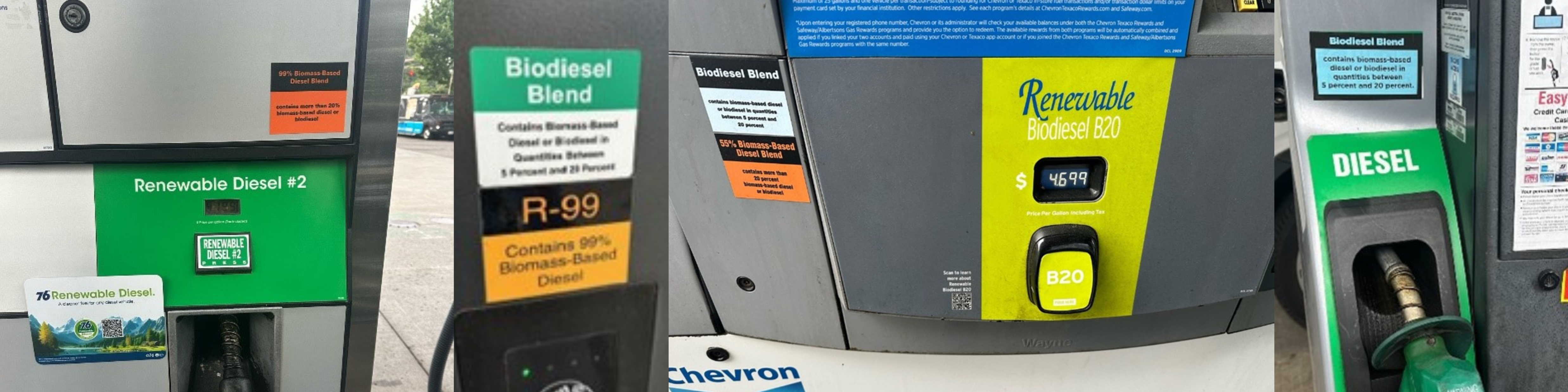
Renewable Diesel is a hydrocarbon diesel that meets the specification for petroleum diesel known as ASTM D975 specification.  This means currently R99 can be readily blended and sold with petroleum diesel without a disclosure.  The US Federal Trade Commission and local state Weights and Measures have rules for retail pump labeling.  Blend percentages of biomass based diesel must be labeled especially if being advertised.  As R99 Renewable Diesel has a higher value and is sought out by many consumers though usually it is disclosed.  The pump labeling for R99 Renewable Diesel typically looks like the below.

R99 Renewable Diesel fuel dispenser label

What is renewable diesel made of?

Renewable diesel can be made from a host of things, usually a low value waste product. The most common feedstock used currently is waste vegetable oil, wastes from animal rendering, and other biologically derived oils. Processes using bio-oils are following a Hydrogenation process to turn low value waste oils into high value diesel and jet fuel.

Chevron Renewable Energy Group and Diamond Green Diesel (Diamond Green is in a joint venture with Valero) are the largest producer of renewable diesel with their REG Ultra Clean Diesel product in the United States. Neste is the largest producer of renewable diesel internationally, with its “Neste My” product.  being the two largest producers of low CO2 bio-oil derived renewable diesel fuels.

Major petroleum refiners have also turned around existing petroleum refineries into Renewable Diesel Refineries to produce this in demand low CO2 fuel. HF Sinclair , Marathon, Phillips 66, and Montana Renewables. There are quite a few newer Renewable Diesel projects planned and in progress around the United States as well as in the Pacific Northwest.

Other refiners of renewable diesel (on a much smaller scale of production) are using a Fischer-Tropsch process with wood waste, sorted higher grade municipal garbage, and other high btu value carbon based waste products.  Many expect this to technology to be the future of all diesel and jet fuel refining turning refuse into fungible low carbon fuel.

What is renewable hydrocarbon diesel?

Renewable hydrocarbon diesel is a synthetic diesel fuel made from non-petroleum feedstocks like vegetable oil, animal fats, municipal waste, agricultural biomass, and woody biomass. It is characterized by having a low CO2 and renewable resource for its feedstock and is made without crude petroleum, coal, or natural gas as a direct feedstock input in the refining process.

How do they make renewable diesel?

Renewable diesel is made by several processes. If you are buying renewable diesel, it is probably from a Hydrogenation process used by Renewable Energy Group and Neste for their products. Other smaller volume producers are using a Fischer-Tropsch process or Fast Pyrolysis. Both processes involve taking energy dense molecules, cracking those molecules under heat and pressure, then reforming them in the presence of a catalyst and added hydrogen, which forms a renewable diesel molecule.

Is renewable diesel a lower carbon fuel compared to petroleum diesel?

Yes, to this point all renewable diesel made from renewable feedstocks have appeared to be a lower CO2 fuel compared to petroleum diesels. The California Air Research Board in particular has done research on this in depth.

The low CO2 lifecycle emissions of Renewable Diesel also is tracked closely and supervised by California’s Low Carbon Fuel Standard, Washington’s Low Carbon Fuel Standard, and Oregon’s Clean Fuels Program. The highest value markets for low CO2 fuels in the United States are California and Oregon, which both have mechanisms that track and price the CO2 intensity of diesel fuels as well as the sustainable lower CO2 substitutes and blend-stocks that can go in those diesels. They track, rate, and determine the carbon intensity of the fuels providing a neutral and scientifically defensible number for CO2 reduction.

Is renewable diesel available in Oregon?

Renewable diesel is readily available for delivery from Star Oilco throughout the Pacific Northwest via 10,000 gallon volumes of bulk delivery.   Star Oilco is also offering bulk delivery of any size and mobile onsite fueling service within 100 miles of the Portland, Oregon market.

Star Oilco has R99 Renewable Diesel available with a Star Oilco CFN Cardlock card in Portland, Oregon.

What is the difference between biodiesel and renewable diesel?

Biodiesel and renewable diesel are very different fuels made with very different processes. In a nutshell, biodiesel is made with a simple chemical reaction that turns vegetable and animal fats into fuel. Renewable diesel is made from far more complicated process where vegetable and animal fats (as well as other feedstocks) are cracked on a molecular level and built back into synthetic diesel fuel.

What is the difference between renewable diesel and Sustainable Aviation Fuel?

The difference between the fuels is the specific gravity and general specification for what the fuel is used for. Jet fuel, or Sustainable Aviation Fuel, and on-road diesel fuel are different fuels and therefore have different specifications. Renewable diesel is typically referring to a #2 diesel specification for on road diesel use.

Sustainable Aviation Fuel or “SAF” is typically referring to “Jet A” or “JP8” jet fuel specification for fuel. This is a #1 diesel range fuel with use and handling requirements that are far more stringent than for on-road or off-road diesel fuels. Renewable jet fuel can be used as a kerosene or #1 diesel fuel but renewable diesel cannot be used as a jet fuel.
Where do I buy renewable diesel in Oregon or Washington?

Renewable Diesel is currently available for bulk delivery and mobile onsite fueling. It will soon be offered at commercial cardlock in the Portland area. It is being sold as R99 and as Ultra Clean Diesel, which is a mixture of biodiesel, renewable diesel, and petroleum diesel.

What is R99?

R99 stands for 99% renewable diesel and 1% petroleum diesel.  Federal rules over alternative diesel fuels made fuels requires that manufacturers of non-petroleum derived diesel fuels must blend a minimum 1% petroleum with the fuel to generate a Renewable Industry Number or “RIN” under the US Federal Renewable Fuel Standard. Additionally there are other incentives that require a “blender of record” to receive these tax credits.

Is renewable diesel being made in Oregon?

As of Spring 2022, renewable diesel is not being manufactured in Oregon. There is a major projects underway, Next Renewable Fuels in Port Westward, Oregon.

What is renewable diesel made from?

Renewable diesel can be made from many energy dense carbon based material.  By volume of produced product sold in the United States, vegetable oils and animal fat-based wastes are the most common feedstock. Woody biomass, agricultural wastes, and sorted municipal wastes are also sources for renewable diesel production.

Is renewable diesel made from palm oil?

Palm oil can be used as a feedstock for renewable diesel. There are producers who use palm oil as a feedstock. In the United States, feedstocks and carbon intensity are tracked closely under both Oregon and California’s fuel programs.  You can determine if a supplier is using palm oil as a feedstock through these regulated pathways.

How much does renewable diesel cost?

This is a tough question to answer given there are several markets intersecting.  From the feedstocks to the market demand for the finished product as well as both California and Oregon’s Clean Fuel Standards which place a price on the CO2 intensity of the fuel which reduces the cost of the fuel if consumed in Oregon and California.

It has consistently been trending between the same cost and over $1 a gallon higher than petroleum diesel depending on the state, you buy renewable diesel in. In California, renewable diesel is very close to petroleum diesel depending on the value of CO2 credits for lower-carbon fuels. In Oregon, it has consistently been between $.05 to $.80 a gallon higher than diesel also depending on the value of CO2 abatement associated with the fuel and what these carbon credits are trading for.

When petroleum diesel costs are high Renewable Diesel tends to be more competitive with petroleum diesel.  When petroleum diesel is below $3 a gallon the cost of Renewable Diesel by comparison is usually higher unless CO2 credits are in higher than normal demand for Clean Fuels Program demands.

Can you mix petroleum diesel and renewable diesel?

Yes. Renewable diesel and petroleum diesel can be blended in any mixture without worry. They are drop-in substitutes for each other in your fleet’s use.  Renewable Diesel is a drop-in fuel. It is a hydrocarbon diesel that will work mixed with diesel or biodiesel blends of petroleum diesel.

Green fuel nozzle representing renewable diesel with Star Oilco logo - serving Oregon and Washington fleets.

Learn more about renewable diesel and how it can benefit your operations. Contact us today.

Contact Form

  • This field is for validation purposes and should be left unchanged.

Star Oilco black fuel truck parked on rural road with trees in background
Do Diesel Soaps Cause Engine Problems? 1024 768 Star Oilco

Do Diesel Soaps Cause Engine Problems?

Star Oilco answers: What are Diesel Soaps?

Cliff Burbrink, chemical technology specialist at Cummins Filtration, provides a layman’s definition of diesel soaps:

“Diesel soap is not very different chemically than the soap used to wash your hands. The main ingredient in a bar of soap is formed when lye reacts with fats or oils. Lye is sodium hydroxide.

Fats and oils contain fatty acids. When they react, they form sodium soaps. Diesel soaps are formed from acidic additives in the fuel [such as some corrosion inhibitors and lubricity improvers] reacting with trace amounts of sodium.”


Rick Chapman, Industry & OEM Liaison Manager, Innospec Fuel Specialties, adds that acids can be derived also from other sources:

“[Soaps] can also be formed from free fatty acids in biodiesel starting materials and carboxylic acids derived from oxidatively degraded fuel and/or biodiesel.”


From a layman’s point of view, then, the formation of diesel soaps is the result of metals, such as sodium, calcium and potassium (in the form of positively charged ions, or cations), reacting with various sources of acid in the fuel.


“When these two species [acidic compounds and cations (usually sodium)] come together, diesel soap can form,” says Chapman.

“There are a lot of other factors or variables that can play into it, of course, such as pH, solubility, mixing intensity and so forth—but this is the basis for it. Unfortunately, when these soaps form, assuming they are formed from additives, they make the corrosion inhibitor or lubricity improver inert, and the corrosion or lubricity protection provided by the additive is lost.”


 Diesel soaps


  1. Plug fuel filters
  2. Form injector deposits that lead to over-fueling
  3. Create Turbocharger problems
  4. Generate Oil dilution
  5. Cause Poor performance, and poor fuel economy


In a May 2013 report, “Case Study—Impact of Poor Diesel Fuel Quality on an Urban Fleet,” Cummins Filtration investigated problems with diesel engines in a New York City bus fleet.

Complaints ranged from an excessive number of turbocharger fault codes to smoke at start-up to fuel-injector failures. The investigation uncovered excessive soot deposits in the turbocharger, resulting from over-fueling, which was determined to be the result of fuel injectors sticking because of deposits that were “rich” in the metals of sodium and calcium.

Although injectors showed sign of scuffing—the result of hard particle contamination, which, says the report,

“is the greatest fuel quality concern for high-pressure/common-rail fuel systems, worldwide”

—investigators determined that scuffing was not the primary issue for the immediate problems the bus engines were exhibiting.

The culprits in this instance were “metal carboxylates” in the fuel, more commonly know as “diesel soaps.” The recommended fix for the problem was use of a fuel additive that could both clean the Injectors and minimize further deposits, coupled with much tighter filtration.


Another Bad Actor


Biofuel is manufactured by reacting a plant-derived fat or oil (usually soybeans in the United States) with an alcohol, using sodium hydroxide as a catalyst. An unwanted by-product of the process is glycerin.

Although most of the glycerin is washed out during the manufacturing process, regulations do allow 200 ppm to remain.

Biofuel usually is mixed with petroleum diesel in 5-, 10- or 20-percent concentrations to form biofuel blends, but even at these relatively low concentrations, enough glycerin remains to create filter-plugging problems when, under certain fuel moisture and temperatures conditions, it becomes a solid and drops out of solution.

To help counteract glycerin’s effects, Jim Peterson, sales manager for Donaldson’s Hydraulics and Clean Solutions Group, suggests these measures:

  • Filter fuel on the dispensing side of the bulk tank and use proper on-machine filters
  • Keep fuel dry with proper tank flushing and proper breathers
  • If possible, moderate the temperature of stored fuel above the glycerin dropout level
  • Turn over fuel as quickly as possible
  • Keep fuel infrastructure as free from particulate contamination as possible
  • Ask OEMs about using detergent additives to keep glycerin in solution, both in equipment and bulk storage


Filtration and Additives


As noted before, the contamination of diesel fuel with soaps is not as prevalent, at least in many fleets, as other sources of fuel contamination.

These other fuel contaminates include hard particulates, increased water in biofuel blends, rapid oxidation of such blends, microbial growth, so-called asphaltenes (compounds that can agglomerate into an oily sludge), acetic acid formation and glycerin.

Glycerin being an unwanted by-product of biofuel manufacturing. “There are so many inherent problems with diesel fuel today,” says Hydrotex’s Cummins, “that machine owners must take a holistic approach when attempting to resolve them.”

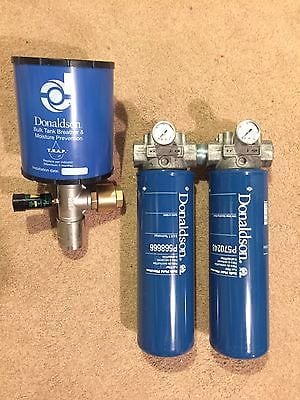
The best defense against diesel soaps (and for most other contaminants, as well) seems to be the use of premium filtration, like the “Donaldson clean & Dry kit which includes 4 micron particulate and water filters. The kit also incorporates a desiccant breather to absorb moisture.”

Donaldson Clean and Dry Filter kit

In addition, (tank intake, tank dispensing, and on-machine), good tank housekeeping, and a well-chosen additive package.

Additives might be included in “premium” diesel fuel offered by some jobbers, but solving a serious soap problem might require consultation with an additive supplier who can take a comprehensive, laboratory-assisted view of all the fuel-quality issues in a particular fleet.

But, the best efforts are no guarantee of complete success when dealing with diesel soaps.

We’ve seen soap deposits form in engines that use our most effective filters—those proved to remove 99.9 percent of material 4 microns and larger and significant amounts of material smaller than 4 microns,”  says Cummins Filtration’s Burbrink.

“If soap particles don’t agglomerate before the filter, they can pass through it. When they hit the injectors, the heat can cause these particles to deposit on metal.”


Deposit control


“We have seen great success with some additives,” says Burbrink. “The use of good detergents has dropped the failure rate significantly in some applications. Unfortunately, we also have seen customers having issues even though they are using detergents.”

That said, a well-formulated additive package seems to be an integral part of the potential resolution of problems with diesel soaps.

A good, multi-functional package will contain corrosion inhibitors and lubricity improvers (some formulations use nonacid, non-reacting lubricity improvers), as well as a deposit-control agent that will assist in cleaning injectors and minimizing further deposits.


The Key


“The key to diminishing field issues is the use of a two-prong strategy,” says Innospec’s Chapman. “One, use an additive that provides the required lubricity but is resistant to reaction with metal hydroxides, and, two, use a deposit-control additive to ‘clean up’ and ‘keep clean’ any deposits that may form, regardless of the their source. Deposit-control additives are useful for reducing injector deposits, reducing filter plugging, and for carrying through trace amounts of water. In lower-dose rates, or at a ‘keep-clean’ level, they will put a protective coating on metal surfaces and not allow deposits to form—or will limit their formation.”

Hydrotex’s Cummins makes the point, too, that treatment rates for additives, a corrosion inhibitor, for example, might have to be adjusted to meet the conditions of a particular storage tank. Cummins also reminds machine owners that deposit-control additives might need time to work in certain situations: “Soap deposits can get very deep into the injectors, become sticky, and cause poor actuation of the pintle. A good additive package will help clean the injectors, but given the nature of the deposits, it’s usually not a quick fix. The process might require four or five tanks of treated fuel before improvement is noticed.”

Sunrock’s Dennis offers this suggestion to fellow fleet managers: “I would recommend that fleet managers, if they haven’t already done so, educate their fuel suppliers on the subject of upstream fuel-contamination issues and their effects on diesel engines.

Managers can use that opportunity to register their concerns about diesel soaps—for the purpose of promoting a partnership in utilizing countermeasures against diesel-fuel contamination. Their fleet reliability depends on it.”


To read more technical data on Diesel Soap click link below

SOAP AND GLYCERIN REMOVAL FROM BIODIESEL  

multi colored fuel pump nozzles indicating different fuel types at Portland fueling station
Clear Premium Non-Ethanol Gasoline 683 1024 Star Oilco

Clear Premium Non-Ethanol Gasoline

Do you need Non-Ethanol Gasoline delivered in the Portland, Oregon area?

If you are looking for Non-Ethanol Premium Gasoline delivered to your bulk tank or available at a Commercial Cardlock, Star Oilco has your needs covered in the Pacific Northwest.

Premium Unleaded without Ethanol in the Gasoline

Nonoxy Premium is the fuel you want in a gasoline tank if you are storing equipment with a full tank of fuel.

Premium gasoline without any ethanol blended into it goes by several names.  Clear premium unleaded, Non-Oxy (non-oxygenated) premium, nonethanol gasoline, or Clear 91 Octane are a few of the terms used.  Regardless of what it is called, getting gasoline without ethanol in the Portland, Oregon area requires buying a premium rated gasoline.

Clear Gasoline Premium bulk tank delivery

Why is the only ethanol free gasoline in Oregon and Washington premium grade of 92 octane?

This is because of several laws in Oregon as well as Washington that require the blending of 10% ethanol with all gasoline with the exception of premium grades for small engines, classic cars, aviation uses, and other type specification needs.

With the blend requirements for 10% ethanol this changed the way gasoline was supplied in the Pacific Northwest.  This was caused by the octane ratings of gasoline.  Regular gasoline is a 87 octane rating.  E98 ethanol has a 107 octane rating. With this blend requirement, the gasoline changed to account for the high octane of ethanol.  So refiners and sellers of gasoline began to use what the industry calls a “sub-octane” gasoline at 85 octane because the guaranteed blend of 10% ethanol would boost the octane rating back up to 87 octane.

This is usually where people ask: “Why does this effect premium unleaded as well, and why the heck is clear premium so expensive?”

There are three reasons nonoxygenated gas costs more:

1- Ethanol is a lower cost fuel than gasoline, so less ethanol means a slight higher price of the fuel.

2- Fewer terminals carry a non-ethanol option for Premium unleaded reducing options for customers demanding the fuel and therefore higher prices.

3- CO2 regulations have raised the cost of fuels without biofuel blends in them as well.

REASON 1

The reason why is for several decades before the 10% ethanol blend mandate, the industry has been upgrading retail gas stations, cardlocks, and truckstops to blend regular gasoline and premium gasoline to the midgrade gasoline at the island. With a 10% ethanol blend mandate for regular unleaded and midgrade this required any and all retailers with blending pumps to use E10 (10% ethanol) premium to be legal with their midgrade product sold.  This also means that a non-ethanol premium pump requires a stand alone pump, line set up, and infrastructure need.

REASON 2

The blend mandates for gasoline caused all of the major branded gas station chains to move to a defacto 10% blend at the terminal level reducing availability of non-ethanol or “Clear” premium gasolines. With far fewer petroleum terminals, brokers, refiners, and other upstream wholesale dealers of gasoline exiting the non-ethanol gasoline market due to far lower volumes of it, the price went up.  This also means that there is far less volume of ethanol free premium unleaded being sold at the wholesale level. Reducing the volume of sales of a single fuel grade raises the cost risk in a volatile commodity market like gasoline.

REASON 3

Recently the entire western coastal states (Oregon, Washington, and California) passed laws around CO2 emissions and liquid fuels like gasoline.  This means that there is a cost for fossil fuels over biofuels which prices into the gallon of fuel.  The less biofuel the higher the CO2 cost for those buying it. Add to that the western states have Cap and Invest rules which put a total limit on volumes of fossil fuels.  These “Cap at the Rack” charges for fossil fuel have been as high as a full $1 for a gallon of fossil fuel in past years.  Cap at the Rack charges on fossil fuel gasoline is usually in the $.40 a gallon added cost range of the price you pay.

If Clear Premium Gas is so expensive why do people still use it?

It is the optimal fuel for small engines that have a habit of being stored for long periods of time without use.  Nonethanol fuel stores stable for a longer time and has a better cold start performance than an E10 gasoline fuel that has sat for over a year.  Add to that it also does not absorb water or impact plastic/rubber/elastomer seals in equipment.  That is why people prefer it.  Sure, the limited availability of terminals carrying this product makes it a specialty in Oregon and Washington.  But the added cost is worth it for sensitive low tolerance engines or for vehicles with long periods of storage between uses.

Choose Star Oilco as your fuel provider for your clear premium non-ethanol gasoline

Star Oilco’s Commitment to Sustainability 150 150 Star Oilco

Star Oilco’s Commitment to Sustainability

Star Oilco’s Commitment to Sustainability

What is biodiesel? Is it the same as raw vegetable oil?

Biodiesel is a cleaner burning diesel fuel made from vegetable oil. Simply stated, a biodiesel molecule is a                                                              vegetable oil molecule with the glycerol removed. Chemically, biodiesel is defined as a mono-alkyl ester of                                                           vegetable oil.

Biodiesel is NOT the same as raw vegetable oil or straight vegetable oil (SVO). Diesel engines actually can                                                             operate on straight vegetable oil (SVO) as a fuel. In fact, Rudolf Diesel’s first compression ignition (Diesel)                                                            engine introduced in 1895 used peanut oil as its fuel. Modern diesel equipment, however, requires some                                                          modification to burn straight vegetable oil, and it is yet unclear the effects of straight vegetable oil on diesel                                                         engine performance and longevity.

Will biodiesel void my engine warranty?

According to the National Renewable Energy Laboratory, “Original Engine Manufactures (OEM) provide a material and workmanship warranty on their products. Such warranties do not cover damage caused by external conditions, such as fuel. Thus, if an engine using biodiesel experiences a failure unrelated to the biodiesel use, it MUST be covered by the OEM’s warranty. Federal law prohibits the voiding of a warranty just because biodiesel was used – it has to be the cause of the failure. If an engine experiences a failure caused by biodiesel (or any other external condition, such as bad diesel fuel), it will not be covered by the OEM’s warranty.”

Star Oilco distributes only commercially produced biodiesel that meets ASTM D6751-03 specification – a demanding fuel testing regimen that guarantees the fuel will perform properly in your engine.

Biodiesel is considered an additive in blends less than 6% (B5). Petroleum diesel with 5% biodiesel added still meets ASTM specifications for #2 petroleum diesel fuel. The National Renewable Energy Laboratory and numerous states and federal fleets, including all branches of the U.S. Military, have performed more than 40 million miles of road testing on B20. The results of which have only been positive.

Fleets such as Yellowstone National Park and the City of Berkeley (CA) Solid Waste Management Division have had great success running diesel vehicles on pur biodiesel (B100).

Does biodiesel cost more than petroleum diesel?

Yes. The current retail price for on road B99 is $3.29 per gallon. Our customers pay a premium for biodiesel to support domestic energy sources and because of environmental concerns. Many biodiesel users experience a lower maintenance cost when they use biodiesel.

Can I use Oregon produced biodiesel?

Yes! In fact, the biodiesel you purchase through Star Oilco is produced right here in Oregon! Sequential Biofuels opened their first plant in Salem, OR in July 2005. This plant will produce 1 million gallons of biodiesel annually from waste vegetable oil. Oil sources include the Salem Kettle Chips plant. Country singer Willie Nelson is an investor in the effort.

Does biodiesel provide similar miles per gallon, torque, and horsepower?

In terms of energy contained in the fuel, a gallon of biodiesel contains slightly less energy than a gallon of petroleum diesel. For example, B20 tends to reduce fuel economy by approximately 1%. B20 users rarely report changes in torque or power. With B100, torque, power and fuel economy can be reduced by approximately 8%. However, the increased lubricity of biodiesel may help to counteract this energy difference. Some drivers report better performance with biodiesel, but most do not notice any difference.

Can I switch back and forth between diesel and biodiesel?

Yes! Biodiesel is the ultimate flexible fuel, so you can switch back and forth between biodiesel and petroleum diesel whenever necessary. Also, you can blend biodiesel with petroleum diesel in any percentage.

Is biodiesel safe to handle?

Yes! Biodiesel is ten times less toxic than table salt and biodegrades faster than sugar. The EPA has tested biodiesel’s health effects extensively and has classified it as a non-toxic substance that poses absolutely no threat to human health. Biodiesel is such a clean fuel that it is used to remediate petroleum spills in water.

Can I use biodiesel in an oil furnace (to heat my home)?

Yes! Biodiesel can be used in any diesel application. Oil #2 is the primary heating oil sold in the U.S. It is essentially the same as the diesel sold at gas stations, but contains much more of the pollutant sulfur. Sulfur contributes to acid rain formation, as well as the creation of nitrous oxides and particulate matter, both of which have serious air quality and human health impacts.

Biodiesel is just as warm as regular heating oil, but will help keep both the furnace and the air cleaner. It reduces the oily smell of the liquid fuel and makes the exhaust coming from the chimney smell better – a little like French fries. Pure biodiesel is biodegradable, and it is far less toxic than diesel. With a higher flash point, it is also less of a fire hazard. Biodiesel reduces emissions of cancer-causing compounds by up to 50%, and emissions of nitrogen oxides, particulate matter and hydrocarbons by approximately 20%.

Do I have to modify my furnace to use biodiesel?

No. B20 requires no modification to your heating system. However, biodiesel is a solvent, and will actually clean heating oil tanks and all fuel-wetted parts of a furnace. Because of this, users may experience clogging of the furnace fuel filter early on. Fuel filters are cheap and easy to replace, and the problem will end once the system is cleaned out.

If your heating oil tank is outside and/or underground,Star Oilco will only deliver B20 home heating oil. If your heating oil tank is located inside and above ground, Star Oilco will deliver B20 or B99.

Can biodiesel replace petroleum diesel?

For most of the 20th century, petroleum diesel has been consumed as though it would last forever. Experts disagree about how much petroleum is left and how long it will last. They do agree, however, that less new oil will be found and that prices will increase. Because biodiesel is “home-grown”, it provides energy security. Biodiesel can be produced on a yearly cycle, instead of a 10-million-year-cycle. While we can not displace all petroleum with renewable fuels, it is one important piece of reducing our dependence on foreign oil.

Red fuel nozzle inserted into a blue vehicle at a fueling station
Oregon Cardlock Safety Training 1024 683 Star Oilco

Oregon Cardlock Safety Training

Consider using this Oregon Fire Marshall Training for your driver’s Cardlock or Fleet Card training.


Fueling your Car in Oregon


As anyone with a Pacific Pride, CFN, or Voyager gas card in Oregon knows, to use an un-staffed Cardlock location, the Oregon Fire Marshal requires safety training.

Typically, it is just reading and signing a form. Many fleets provide this form to their employees as a training piece for refueling safety. But if you’re training in a group, nothing beats a video to get everyone engaged.

The Oregon State Fire Marshal’s office has produced a training video to make it easier to on-board your team about using Cardlock fuel safely. This tool makes training those unfamiliar with cardlock a little easier and more professional.

If you have an Oregon fleet seeking to use Pacific Pride, CFN, or Voyager fuel cards for self-serve commercial fuel, this training is required annually by your company in Oregon state. This handy training video is great for training your new employees on Commercial Cardlock.

If you have questions about using Pacific Pride Fuel Cards or other 24/7/365 stand-alone Cardlock locations give Star Oilco a call. We can get you set up and your drivers out of fuel lines. Save money and reduce the risk of fuel theft with Star Oilco’s fleet card program.

For more on using Commercial Cardlock in Oregon please read other posts below:

STOP FUEL THEFT WITH PACIFIC PRIDE CARDS

HOW TO AUDIT YOUR CURRENT FUEL BILL

WHAT DOES A BUSINESS NEED TO USE PACIFIC PRIDE OR CFN IN OREGON

Leave us a message to set up a Star Oilco Fleet Card account.

Contact Form

  • This field is for validation purposes and should be left unchanged.
B99 Biodiesel for Fleets & Heavy Equipment 150 150 Star Oilco

B99 Biodiesel for Fleets & Heavy Equipment

Using B99 Biodiesel in a Tier 4 Heavy Duty Diesel

B99 Biodiesel reduces CO2 footprint of a 105,500 GVW truck and trailer by more than half at a lower cost than petroleum diesel.

What is B99 Biodiesel?

B99 Biodiesel is as pure of blend of Biodiesel you can get in the United States and still participate in the incentives associated with this alternative fuel.  B99 is the product received by petroleum refiners, terminals, and truck stops to blend with petroleum diesel.  Biodiesel is a renewable, clean-burning diesel replacement.  B99 Biodiesel is a common blendstock with petroleum diesel (being 99% biodiesel).  It can be presumed that nearly every major truck stop throughout the US is consistently using either a blend of 5%, 10% or 20% of biodiesel   The reason for this is both due to its price advantage against petroleum currently as well as Federal/State laws requiring it’s use.

Why Higher Blends of Biodiesel Matter?

Biodiesel is a low CO2, net energy positive fuel.  Depending on the feedstock Biodiesel is made from a CO2 reduction of 30% to 80%+ can be expected compared to petroleum diesel.  As the West Coast (Oregon, Washington and California) ramps up CO2 regulations that charge an additional cost for carbon emissions associated with petroleum diesel the financial case for Biodiesel becomes obvious.  Early adopters will see direct financial benefit.

B99 Biodiesel for Fleets & Heavy Equipment

Star Oilco has fielded the Optimus Technologies system on our 105,500 GVW truck and trailers.  Star Oilco began with a single Freighliner truck and trailer operating a Cummins ISX as a trial.  This truck’s typical route was approximately 305 miles round trip from Portland, Oregon to Grays Harbor, Washington.  This run is from Star Oilco in Portland, Oregon to the Grays Harbor REG Biodiesel plant and back to the Portland terminals for delivery of this product.    Over the last year and a half this truck has performed amazingly well, the only maintenance concern is swapping the fuel filters more regularly with every oil change.  Mileage and power difference are negligible as noticed by drivers or our Elog system.  On a few occasions a loss of power was experienced requiring an in between service fuel filter swap.

This field trial of the Optimus Technologies system Star Oilco has regularly saved between $15 and $75 a day when running this dedicated route, depending on the cost of B99 Biodiesel versus petroleum ultra low sulfur diesel.  Consistently the price of B99 Biodiesel has been below petroleum diesel in the Portland, Oregon market. This has been due to a combination (or is effected by) RIN values, a Blender’s Tax Credit on biodiesel, and Oregon’s Clean Fuels Program which also prices the CO2 reduction value of B99 Biodiesel.   We see this trend continuing as an assumed market reality for biodiesel.

What is the business case for our deploying B99 Biodiesel Optimus Tech upfit kits?

The systems increase the intelligence of our late model trucks with their very complicated Tier 3 and Tier 4 emissions systems.   The Optimus Kit enables two saddle tanks to operate with the duty cycle of the truck. One tank (which we will be running B5 ULSD or R99 through) is dedicated to fuel the particulate trap and SCR systems.  These systems have extremely tight tolerances and tend to choke on higher blends of biodiesel.  By dedicating a tank with a smart controlling system we reduce the maintenance and concern with these after treatment systems hopefully extending the maintenance cycle on these traps by years while reducing inconvenient efficiency killing regens.

The Optimus Kit also enables a modern diesel engine to run B99 Biodiesel.  It does this by controlling the temperature of the fuel in it’s dedicated saddle tank and routing B99 to the engine when the RPMs and operating temperatures are best for this fuel. Upon start up and shut down the Optimus Technology kit will flush the engine, fuel rail, and injectors with the petroleum/R99 tank ensuring easy start up and no cold weather effects.  The B99 saddle tank is temperature controlled as well to enable performance in extreme weather.  When operating under load the Optimus Kit will move to B99 as the fuel into the engine.  As B99 Biodiesel has a substantial reduction of emissions, particulate, and other compounds when combusted; this further reduces the impact of miles on a truck to the particulate trap and it’s service needs.

Beyond this maintenance experience, the performance and function of the system has been indistinguishable to our other trucks running the same route.

Biodiesel Mandates in the Pacific Northwest

Oregon and Washington have passed legislation which puts a price on the CO2 emissions associated with petroleum diesel.   These laws mean that petroleum fuel costs more than biofuels with a low CO2 footprint.  These laws are also added on top of other mandates and incentives for biofuels.  Biodiesel blends between 5% and 20% are common on the west coast at every gas station, cardlock, and truckstop.

How Can I Utilize B99 or B100 in My Own Fleet? 

Star Oilco uses The Vector System developed by Pittsburgh-based Optimus Technologies. The Vector System is the only EPA-compliant biodiesel engine system and upgrades any medium or heavy-duty engine to operate on 100% biodiesel. It can be installed in as little as 12 hours. Learn more about The Vector System by contacting Optimus Technologies here directly or by reaching out to Star Oilco locally. 


Contact Form

  • This field is for validation purposes and should be left unchanged.


For more on Biodiesel, Renewable Diesel or Low CO2 fuels please see these other Star Oilco articles:

Every Question Star Oilco has been asked about Biodiesel

Every Question Star Oilco has been asked about Renewable Diesel 

Do you have questions about Renewable Diesel in Oregon 

Wet Hose Fueling Service in Portland, Oregon

About Diesel Fuel 

Biodiesel Use and Handling Guide 

comparison chart showing difference between off-road diesel and on-road diesel fuel in Portland OR
The Future of Diesel Fuel: Trends & Outlook 940 788 Star Oilco

The Future of Diesel Fuel: Trends & Outlook

Retail Diesel Dispenser Example
Retail Diesel Pumps with a variety of blends of diesel. Biodiesel, Renewable Diesel, and Fossil Diesel blends shown in Portland, Oregon.

Diesel Fuel In Oregon and Washington

Star Oilco has been getting questions on the changes of diesel in Portland, Oregon.  If you have not noticed, many diesel pumps at retail gas stations and cardlock have seen changing stickers on the face of the fuel pumps.  As of July 1st, 2024 the City of Portland requires a minimum 15% biofuel content of all diesel sold.  This policy is called the Portland Renewable Fuel Standard.

This has caused quite a few changes in what fuel pumps have for fuel.  Diesel fuel buyers are noticing the bright yellow color of B20 biodiesel, the water clear color of Renewable Diesel or a a mix of several fuels tinting the color of their diesel.  This trend is bigger than just Portland.

Today on the west coast there are a variety of product label stickers you will see on diesel pumps.  These show the variety of diesel fuel specifications that are being sold to diesel vehicles today. Blends of petroleum ultra low sulfur diesel, R99 (99%) renewable diesel, and B99 (99%) Biodiesel are combined to meet the market needs of the diesel we all buy.

This change is because of a combination of pure market forces, government rules and local decisions by fuel haulers.  Today’s diesel not only has a commodity market for the fuel it also has a market for CO2 credit value and a cap of total petroleum diesel fuel that can be sold into a west coast state with a “Cap and Investprogram requiring blends of low CO2 biofuels, the liquid fuels sold for vehicles.

Add on top of these market forces, advances in technology used to make the liquid diesel fuel.  The diesel arriving at truck stops, gas stations, cardlock or out of a hose from a bulk truck has been changing and it’s often in good ways.  Knowing how can be helpful in navigating why diesel may cost one price or another and may have a need or maintenance that another fuel does not.

THE RISE OF RENEWABLE DIESEL

Renewable diesel is a synthetic diesel fuel made from the same feedstock as biodiesel, but the finished product is hydrocarbon diesel.  Though it is a biofuel, it is also diesel. For fuel regulation they refer to it (as well as biodiesel) as “Biomass Based Diesel” for labeling at the fuel pump.

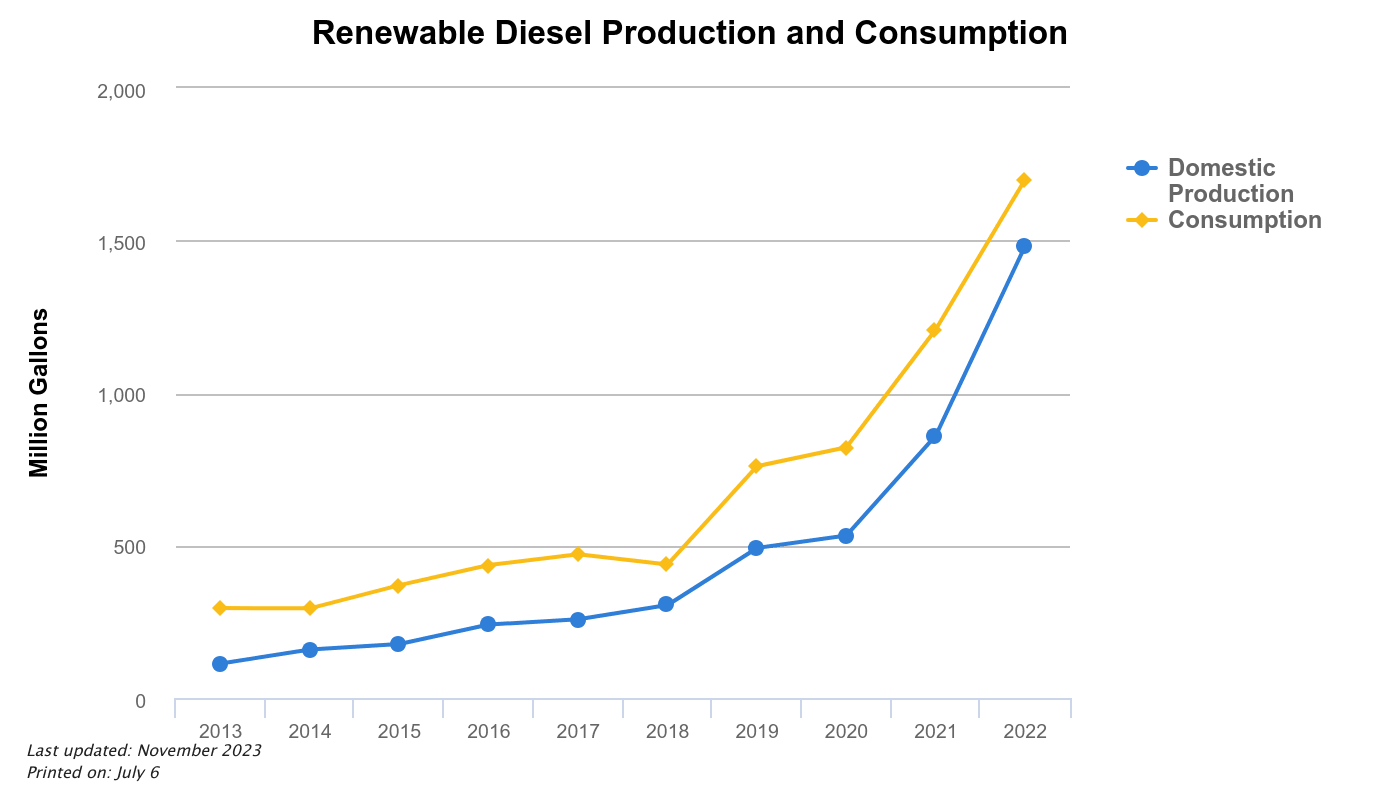
There have been billions of plant capacity brought online for renewable diesel.  During the COVID collapse of fuel prices a number of petroleum refineries shut down, then upgraded their technology to make hydrocarbon diesel fuels out of the very biobased fats, oils, and greases biodiesel is made from.  These refineries use hydrotreating technology just like they do with a crude petroleum to make an actual hydrocarbon diesel molecule.   With this technology adoption to make diesel and jet fuels from vegetable oils and animal fats billions of gallons of low CO2 diesel fuels are coming on the market and governments are requiring it’s use, such as Portland’s Renewable Fuel Standard.

Renewable Diesel Consumption it the US Source: Alternative Fuels Data Center

THE AVAILABILITY OF BIODIESEL

The US makes billions of gallons of biodiesel.  A fuel that’s quality and performance continues to improve.  If you are not a fan of biodiesel in your fuel thinking strategically about the fuel will likely benefit your fleet operation.  The big concern with diesel fuel in a ultra low sulfur world is water and dirt suspended in the fuel affecting the performance of diesel emission systems.  With clean and drier quality specifications of B99 blend stocks today versus a decade ago the use of this fuel has grown substantially especially in the truck stop market.

When crude petroleum prices are high and therefore refined diesel prices are equally as high biodiesel is often an extremely competitive fuel.  If a large seller of diesel (including petroleum refiners) can pick up pennies per gallons on millions of gallons sold they will do so.  Therefore Biodiesel is often seen in diesel in small blends even if you do not see a label on retail pump.  For blends above 5% a label is required for retail fuel sales. RTHWEST?

R99 Renewable Diesel label indicating 99% biomass-based diesel content
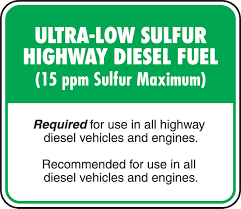
Ultra Low Sulfur Retail Diesel Label
Biodiesel Blend Percentage label for retail diesel dispenser

Above are a variety of labels used to denote what fuel blend is coming out of a retail diesel dispenser. Feel free to call Star Oilco at 503-283-1256 if this confuses you and you want it explained.  We would be glad to do so.

These labels can be found together often at one pump.  All state and Federal standards require ultra low sulfur diesel for any on-road diesel sale.  The Federal standards also adopted by the states require a disclosure at the fuel pump if a blend is above 5% biodiesel.  The max allowable blend of biodiesel for diesel truck manufactures is a 20% blend.  If a truck dealership says that you cannot blend biodiesel up to 20% they need to take that up with the Federal Government because they need to support it.  This is why the label shows a blend may contain between 5% and 20% biodiesel content.

Renewable diesel is a hydrocarbon diesel. 


It is diesel meeting the ASTM D975 specification for diesel. 

Retailers selling blends of R99 in their fuel do not need to label it given this.  They still do label it given the benefits of the fuel’s performance and that customers are seeking that fuel.

Contact Us Today To Schedule Your Next Bulk Fuel Delivery

Many retail places will have stacked labels showing they may be blending 5% to 20% biodiesel as well as may be adding R99 Renewable Diesel to the fuel as market conditions dictate it is the more cost competitive fuel.  When seeing a label like this it can usually be assumed they are blending a R80 (80% Renewable Diesel) and a B20 (20% Biodiesel) blend of fuel.  This blend is actually believed by some to be a higher performing fuel seeing better performance that a R99 or B20 fossil fuel blend.

Fossil fuel diesels are being replaced or blended with biomass based diesels.  Be it Renewable Diesel or Biodiesel.  These blends are driven by more than one industry requirements, government rules, or other market forces. One of these being Portland’s banned on petroleum diesel through the Renewable Fuel Standard (RFS). This is resulting in an increase of low-carbon biofuel blends that will ultimately move to a mix of 99% renewable fuel requirement by 2030.

Renewable Diesel and Biodiesel Blend fuel dispenser label.

The big drivers are industry specification for fuels (both labeling as well as chemical characteristics), state rules on selling these fuels, their quality assurance as well as CO2 content, and of course the market forces.  Market forces being the supply and demand availability of fuel needed to meet customers.  Less fuel available to sell means higher prices for customers.

A decade ago the market for diesel was far simpler. Though you had biofuels and some blend mandates basically you had a diesel specification accepted and the daily price as tracked by a lighted retailers sign, a wholesale market average or spot buying by some customers.   Today this market is far more complicated by government regulation on the west coast.  There are three big programs at state levels impacting this.

State Fuel Rules cause a unique need for one state or another. Whereas twenty years ago if Oregon or Washington fuel was selling for more than the Gulf Coast you might see brokers bring fuel into the region then driving down high prices.  With the creation of various complex and unique rules on diesel, imports of fuel to these low CO2 fuel states has dropped.  The amount of people moving product into west coast states has dropped.  The big rules causing this are the Cap and Invest programs of the West Coast states, the Low CO2 Fuel Standards of the states, and the fuel blend mandates of various jurisdictions of these states. For instance California now requires all off-road diesels but 99% renewable diesel.  Portland, Oregon also has a CO2 requirement and minimum 15% blend of biomass based diesel on all fuel sold in the state.

WHAT ARE THE DIESEL FUELS AND THEIR SPECIFICATIONS

Petroleum Diesel:
ASTM D975 Specification.

The ASTM D975 is a series of tests used to maintain consistent industry standard product performance for diesel fuel.  It includes among several tests cloud point, cold filter plug point (CFPP), several masurements of diesel fuel operability performance, intrained water content, sediment, carbon residue, ash, distillation, viscosity, sulfur, copper corrosion, cetane number, cetane index, aromaticity, and conductivity.

Renewable Diesel:
ASTM D975 Specification.

Renewable Diesel is following the same series of tests as petroleum refined diesel fuels.  It is the same ASTM D975 specification. Though Renewable Diesel has some different properties that exceed the ASTM specification of diesel.  Renewable Diesel is highly prized as a fuel because it typically is a cleaner and drier diesel fuel than petroleum diesel. This being seen by the tests on sediment and water content in a parts per million level.  Renewable Diesel content in diesel fuel can also be tested for looking for a C14 molecule (the chain typically created in a Hydrotreated Diesel process from fats, oils and greases.

Biodiesel (Methyl Esther):
ASTM D6751 Specification.

The ASTM for Biodiesel tests a mono-alkyl esters of long chain fatty acids derived from vegetable oils and animal fats. The testing for quality assurance covers an analysis for flash point, methanol, water and sediment, kinematic viscosity, sulfated ash, oxidation stability, sulfur, copper strip corrosion, cetane number, cloud point, acid number, carbon residue, total and free glycerin, phosphorus, reduce pressure distillation temperature, atmospheric equivalent temperature, combined calcium and magnesium, and combined sodium and magnesium.

For more on Biodiesel Use and Handling the National Renewable Energy Laboratory has a great book on the subject.

THE HISTORY OF DIESEL FUEL SPECIFICATIONS IN THE UNITED STATES

In the 1990’s the US EPA passed rules that demanded a phase out of sulfur in diesel fuel.  The presence of sulfur was very good for the fuel’s storage stability as well as fuel lubricity, but was horrible for air quality.   Additionally the big smog contributor was NOx (nitrous oxide) which was one of the EPA’s reason’s for pulling sulfur out of diesel.  For the EPA to get engine manufacturers to treat the NOx emissions at the tailpipe they needed all the sulfur gone (ultra low sulfur diesel) for modern diesel emission systems to be able to eliminate NOx as well as a host of other pollutants including particulates.

The story of changing diesel fuel standards in the US under the EPA is one of removing sulfur from our diesel fuel.  In 1996 the fuel refiners and sellers of diesel had to move the sulfur content of the fuel sold for on-road purposes to below a 500 parts per million standard. Commonly referred to as Low Sulfur Diesel fuel.   In 2006 the standard moved to a maximum of 15 parts per million of sulfur for all on road fuels.

In 2006 while the sulfur content of fuel was dropping the City of Portland released the first mandated blend of biodiesel content.  This being a 5% biodiesel blend.  The next year, the State of Oregon followed with its own Renewable Fuel Standard requiring this throughout the state.  This began the expectation of biodiesel in most diesel fuel in the Portland, Oregon area.  Washington also passed a similar policy for blending biodiesel but the enforcement and need for the fuel is less specific at Washington fuel pumps.

Sign Up To Receive Our Fuel Market Report For Your Weekly Fill Of Updates!

Name
Ceramic house with red winter hat and pinecones
Heating Oil FAQ: Common Questions Answered 1024 683 Star Oilco

Heating Oil FAQ: Common Questions Answered

Heating Oil FAQ (and not so FAQ)

heating-oil-tank

When it gets cold in the Pacific Northwest, it’s time to take a look at some common questions we have been asked about Heating Oil.  If you don’t see an answer to a question you have, please feel free to call, email, or message Star Oilco and we will gladly answer. We especially welcome questions  that require research.

What is Heating Oil in Oregon?

Heating Oil in Oregon is diesel and can have a biodiesel blend as well.  Diesel fuel has several grades either #1 or #2 Diesel.  The number refers to the grade with #1 being called either “stove oil” or “Kerosene” as another term for it.  Typically when someone is requesting or talking about heating oil they are talking about #2 Diesel dyed red to denote there are no on-road fuel taxes associated with the fuel.

There are several types of oil furnaces.  The most common is a vaporizing burner.  These furnaces typically work by taking a liquid combustible fuel, vaporizing it into a fine mist through a fuel oil nozzle, and igniting that mist into fire. That fire heats either air or water for your home’s comfort.

Air furnaces usually move the air through a heat exchanger where a blower then moves air over the heat generated by your furnace, and finally the air is pushed through your home’s vents. 

Boilers and Water furnaces heat a tank of water which is then distributed several different ways to heat your home.  Either by moving hot water to radiators, radiant plumbing under your floor, or to a heat exchanger and blower which transfers the heat from the hot water into vents blown throughout your home. 

The parts leading up to the Burner of of an oil furnace system are simple. There is a tank to hold a reservoir of oil, a line from that tank (and sometimes a line back to it), a fuel filter, a fuel pump, and a vaporizing burner that combusts the heating oil into fire. Combustion of the fuel takes place in a fire box next to the heat exchanger. The heat exchanger takes on the heat of the flames to heat either air or water. In an oil furnace, the heat exchanger is assisted with a blower that pushes the hot air throughout your home to keep you comfy.

If you have an above or below ground heating oil tank you can confirm your fuel volume by the inches of fuel in the tank.  If you have an above ground tank there is probably a tank gauge that can tell you an approximate volume in the tank.  If you have an below ground tank you can confirm how many gallons are in the tank by putting  a measuring stick or tape-measure into the tank.

You will want to confirm the size of the tank you have. Your oil provider will probably have an idea of what size your tank is by looking or historic deliveries. Star Oilco has a tank chart which will help.  If you place a stick or tape measure into your tank and see how much fuel is in it you can compare that to a tank chart found on Star Oilco’s website.  When delivering fuel you can “stick” measure the tank before and after the delivery. Compare these volumes with the delivery and you can often figure out your tank size based on the before and after volume lining up with how much fuel filled your tank.

To view Star Oilco’s Tank Chart please click HERE. 

Home heating oil can be either a petroleum diesel fuel, bio-synthetic diesel fuel, or biodiesel fuel. In Oregon and Washington, home heating oil is typically ultra-low sulfur diesel fuel often containing between 5% and 20% biodiesel. Star Oilco’s standard home heating oil fuel is B5 dyed ultra-low sulfur diesel. Oregon mandates require that all diesel fuel sold contain a minimum 5% biodiesel. For that reason Star Oilco carries B5 or 5% biodiesel blends in our heating oil.

(NOTE: Kerosene sold by Star Oilco contains no biodiesel due to the reality that wick heaters cannot handle even a minute amount of biodiesel in them.) Star Oilco also carries a 20% biodiesel blend, called B20 Bioheat, for customers who want a cleaner burning low carbon fuel for their home.

Kerosene is a heating oil product that is capable of being picked up and fed consistently by a wick heater. Kerosene is a diesel product that is very similar to the fuel used for over the road trucks. The big difference is that kerosene is a “lighter end” distillate fuel, which means it has a lighter specific gravity. This lighter characteristic means that it also works better in certain systems like wick heaters, pressure washers, and pot burner stoves.

It depends on what type of system the kerosene heater is operating with. If you have a wick heater it will not work with heating oil. You will likely have to replace the wick to get it to work again as diesel will not readily drawn into the wick. Even if it does, it will burn far dirtier. If it is a pot burning system like a Toyostove or Monitor heater, then it will burn ultra low sulfur heating oil. Increased maintenance is to be expected on the pot burner, as there is a likelihood of more coking (crusty black soot build up) to occur inside that system.

Bio heating oil and bioheat refer to heating oil products with a blend of biodiesel in them. Typically bioheat is a blend between 5% to 20% biodiesel with ultra low sulfur diesel for a clean burning and low CO2 heating fuel.

For a really in-depth look at biodiesel used as a heating oil check out this article. 

Yes, heating oil will run in a diesel engine. Heating oil is diesel. Be aware though that on-road vehicles must only run clear diesel fuels. If caught using heating oil in an on-road vehicle in Oregon and Washington, the fines can run in the tens of thousands of dollars. Heating oil can also be dyed to signify it isn’t for on-road use. 

Also be aware that even many off-road pieces of equipment and generators need ultra low sulfur diesel to operate without very expensive maintenance. Heating oil can have low sulfur or even high sulfur contents that could cause real issues for modern clean diesel engines. Some consideration is needed prior to burning a fuel marked “heating oil” in a diesel engine.

Consult your furnace, stove, boiler or water heater’s factory recommended specification. Typically it’s Number 2 Diesel unless it is a stove pot or wick heated system. If you have a furnace or a boiler in your basement, you can assume it’s heating oil. Call a licensed and bonded heating oil furnace technician to tune up your furnace to confirm for sure. If you do not have one, Star Oilco can refer you to a number of reputable long-time firms who can help.

Heating oil additives are added to fuel in order to improve it’s long term storage and performance.  They are worth it and most reputable heating oil providers additize their fuel without an extra charge.  This is because most heating oil customers store their fuel for long periods of time.  If you are planning on storing heating oil for years you will need a fuel additive to keep that fuel in the quality needed for your furnace.

Star Oilco provides a premium diesel additive called Hydrotex PowerKleen to every gallon of heating oil we sell.  Beyond this stabilizers, if you are planning on storing fuel for years we recommend ValvTect Plus 6.  You will want to treat your fuel with a biocide like ValvTect Plus 6 to will kill any bacteria, yeast, algae, or other biological organism that can grow inside your heating oil tank.

For more on storing diesel or heating oil for long periods of time please read this article on long term fuel storage.

Heating oil smells like diesel. It is a diesel product and often, depending on location, it is the same as on-road diesel. It may be dyed to denote that it is an off-road fuel with a untaxed use. Heating oil is dyed red in the Pacific NW to show it is off-road diesel.

Heating Oil #2 is number 2 diesel or the standard diesel sold in most places for on-road diesel use. Heating Oil #2 is a slightly different specification than on-road diesel that allows for more sulfur. That is a big difference as far as the EPA is concerned. On-road and off-road vehicles in the U.S. are required to use ultra-low sulfur diesel. Heating oil systems can use low or high sulfur diesel fuels. Ultra low-sulfur diesel is the most common Heating Oil #2 fuel that is delivered by Star Oilco since it is a superior and cleaner burning fuel, in our opinion.

In the Pacific NW heating oil is ultra low sulfur diesel. Therefore, you can buy any diesel sold at a retail gas station, truckstop, farm supply or other liquid fuel seller.  Heating oil is dyed red to show that it is not taxed for on-road fuel use.  Other than that red dye, typical auto-diesel will work in your oil furnace if you need to supply it from a diesel can.

Heating Oil Gel Point:

In the Pacific NW we expect number 2 diesel heating oils to be operable beyond -10 degrees. The record cold weather in the Willamette Valley is above 0 degrees (recent decades 16 degrees was our record low in Portland). We do test and add additives to our fuels to ensure they meet this specification even if they contain 5% biodiesel blended into heating oil.

Kerosene Gel Point:

Kerosene fuels (Number 1 Diesel, Number 1 Stove Oil, and Kerosene labeled fuels) are expected to be good below -30 degrees and are designed to be used in high altitude applications. (Kerosene and jet fuels are often the same specification in the Pacific NW.)

B20+ Biodiesel Gel Point:

Biodiesel blends of B20 and above are assumed to be good to 20 degrees but if Star Oilco expects below-freezing weather, we highly recommend B5 as your delivered fuel. B99 biodiesel typically gels at 40 degrees, so it’s not a winter fuel unless you have a system designed to keep the fuel warm in the middle of winter.

“Oil Heat” or “Oil Fired” refers to a heating system reliant on burning heating oil. Typically this is by use of a vaporizing burner that takes the combustible liquid that is heating oil and vaporizes it through a nozzle into an igniter that causes it to burn.  This system burns the heating oil, creating a great deal of heat that can warm air, water, or both to heat a home or commercial space.

NOTE: IF HEATING OIL HAS BEEN INGESTED PLEASE SEE A MEDICAL PROFESSIONAL.

Heating oil by itself is not dangerous or toxic if it come in contact with your skin.  It is easily washed off with soap and water.  A small amount of diesel spilled on the surface of the ground, typically will break down on it’s own in the presence of the environment.  A small amount spilled on concrete or asphalt can be cleaned up easily with dish soap and water. If your tank leaks and heating oil is soaked below ground this will not break down easily and will take professional help to treat.

The exhaust from heating oil systems contains carbon monoxide and carbon dioxide as well as particulates.  Heating oil and other diesel exhausts are very dangerous and toxic and should be avoided.  Do not allow exhausts of any kind to collect in an enclosed space.

Heating Oil’s vapor point (the temperature it turns to vapor and evaporates) is around 140 degrees Fahrenheit.  Heating oil ignites at 160 degrees.  Typically in the Pacific NW the temperature (especially outside) is well below the vapor and flash point of diesel fuels including heating oil and kerosene. If spilled it will not usually evaporate. You can clean heating oil and diesel up with regular dish soap and water.

Heating oil ignites at 160 degrees.  So unless the temperature is that high an explosion is not a risk.  Fire Code regulating heating oil tanks and placement takes this concern into account.  So typically except in extreme scenarios heating oil vapor does not pose an explosion risk.

If you drop a match into a cup of heating oil at room temperature it will go out.  If you hold a match to the surface of the heating oil in that cup the flame will get large and bright but the heating oil itself will not ignite.  Heating oil needs to be vaporized before it will ignite. It is a combustible fuel so it must be in a vapor form to light.  The vaporizing nozzle of your heating oil furnace turns diesel into a vapor mist easily ignitable.

Yes, heating oil can go bad. If you are planning to store heating oil for longer than a year, you should use a diesel additive that stabilizes fuel for long term storage. If you are storing the fuel as a back-up where you might go years without using it, you should also consider adding a biocide to ensure nothing grows in your tank. The two biggest threats to your fuel staying in specification are water and biological growth. Biological growth occurs inside the water that can collect in your tank bottom naturally through condensation over time.

Star Oilco treats 100% of our dyed fuels with Hydrotex Powerkleen to ensure that it is stable for storage for over a year. If you need to store it longer than that, we further recommend adding a desiccant breather to scrub moisture out of the air when your tank breaths, which protects it from additional water.

For more on additizing your heating oil for long term storage please follow THIS link.

Yes, heating oil tanks properly installed outside are perfectly safe and capable of ensuring your fuel stays clean and dry.

Yes, at several different levels. With residential use, there are local jurisdictions’ building permit requirements for installation and safety. With commercial use, there is the same building permit regulation and usually an added level of Fire Marshall sign-off for siting of any tanks. In rural areas, regulations are different if the tank is associated with an agricultural use.

In Oregon and Washington, a 90 day temporary tank for construction purposes (to move from one tank to another in a formal process) is usually allowed, but you should ensure the temporary tank is a double wall tank and is in a safe place. If your tank leaks (or even if there is a suspicion of a leak), the Oregon Department of Environmental Quality and Washington Department of Ecology have an involved process to close out a leaking oil tank.  

Yes, you need to ensure you maintain your oil furnace. Star Oilco recommends getting a tune up annually or at least every other year.  If you are seeking a referral to a HVAC company that specializes in oil heat, call Star Oilco’s office 503-283-1256 and ask for a list of qualified license and bonded companies we recommend. You also want to check your oil furnace for water annually. Star Oilco can stick your tank for water at no charge upon request with a fuel delivery.

One of the great benefits of oil heat is that oil furnaces are known to last for over fifty years if maintained properly. Natural gas and propane furnaces typically wear out every ten to twenty years dependent on their construction. The primary wear consideration on any furnace is the heat exchanger. The heavy steel part takes the flame of burning fuel, transmits this heat to the air, and is then pushed to heat your home. Oil furnaces must be tuned up every year or two to ensure the heat exchanger is cleaned.

If you do not service the heat exchanger, it will collect soot. Soot insulates the heat exchanger unevenly and causes wear that will eventually lead to a crack. If a heat exchanger is cracked, the furnace is no longer safe to operate. Additionally, an annual tune-up will pay for itself by ensuring your furnace is burning at peak efficiency. You will want to replace your furnace air filter regularly on an annual basis.

Tuning your furnace annually or every other year is highly recommended. Adjusting the fuel air mixture for the most efficient combustion goes a long way to ensure you use as little heating oil as possible. Star Oilco has witnessed fifty and even seventy year oil furnaces operate at modern efficiencies when maintained regularly over their lives. Today, there are a host of high efficiency oil furnaces manufactured and supported to reduce your cost of fuel.  Additionally, confirming the envelope of your home is not drafty or needlessly wasting heat can go a long way in reducing your heating expenses.

The price of heating oil fluctuates frequently due to market conditions. Comparison shopping is your best way to ensure you pay the best possible price. One web based tool we have heard customers like to use to save time while shopping for heating oil is Fuelwonk.com.  It is free and easy to use.

Even though the cost of fuel is dependent on the market and out of our control, there are best practices to reduce the amount of oil you’ll need. The temperature you keep your house will affect how much oil you go through. Keeping your temperature higher will lead to more oil burned during the winter months. How insulated your home is will also affect the amount of oil you burn. Having poor insulation will result in having your furnace running hotter for longer periods of time, increasing fuel use. Annual maintenance of your furnace will keep your furnace operating at top efficiencies. Having a well working and operating furnace will keep costs down by not wasting oil on an underperforming unit.

Star Oilco also has a number of discounts and programs for price reduction. We offer $.05/gallon veteran and senior citizen discount. We frequently have discounts on Google and our social media pages so make sure to check those out. Mention where you saw it to receive the discount.

Heating oil customers at Star Oilco have the opportunity to enroll in our Equal Pay program. The program allows you to make equal monthly payments on future heating oil deliveries. As an Equal Pay customer, you will receive a discount of .20 cents per gallon on all heating oil deliveries. We also have an Autofill program which dictates you receive our best price as well as automatic deliveries. You don’t have to keep track of your fuel or when you need a delivery. We do the work for you!

If you do not like our price and someone else is cheaper let us know.  We will match their price.

Heating Oil is a modern fuel that uses today’s heating oils and biofuels.  The investments in research and development for heating oil furnace by the National Oil Research Alliance to use a wider variety of biofuels in higher lower CO2 blends have kept heating oil relevant in many applications.  As a heating fuel, it’s use will become more rural than urban rather than a phase out. As it is today, the use of heating oil will be used where natural gas is not available especially if the temperatures get below zero. Urban adoption of natural gas has increased, as it’s cheaper than heating oil due to increased fracking development of petroleum.

Star Oilco uses a Degree Day system for our customers on Automatic Keep-Full Service.  We fill your tank before it needs it automatically. A statistical regression analysis correlates your typical use of heating oil in your home and the weather.  Our systems will track your usual fuel usage and we automatically schedule delivery to keep your tank full.

The technical term “BTUs” refers to “British Thermal Units” which is a measure of energy content of a fuel. The energy content of diesel fuels can vary slightly by regions and specifications of those regions.  In the Pacific Northwest, heating oil is typically Ultra Low Sulfur Diesel with a blend of biodiesel content. This can range from 5% to 20% biodiesel added to the fuel. This means the exact BTU measured for a gallon of heating oil an slightly vary.

Source: US Alternative Fuel Data Center Fuel Properties Comparisons
Ultra Low Sulfur Diesel: 128,488 BTUs to 138,490 BTUs per gallon.
B5 Biodiesel is presumed to be about the same BTUs as ULS Diesel.
B100 Biodiesel: 119,550 BTUs to 127,960 BTUs per gallon.
B20 Biodiesel: 126,700 BTUs to 136,384 BTUs per gallon.

Get A Heating Oil Quote Today

  • This field is for validation purposes and should be left unchanged.
Two Pacific Pride fuel cards on a country road background
Rules for Getting a Pacific Pride or CFN Card in Oregon 512 440 Star Oilco

Rules for Getting a Pacific Pride or CFN Card in Oregon

What are the rules for getting a Pacific Pride and CFN Cardlock Card in Oregon?

Star Oilco is a proud independent Franchisee of Pacific Pride

Pacific Pride fueling is a wholesale cost plus way to buy fuel.  With the crazy market conditions getting 24 hour access to fuel has a renewed appeal to both individuals as well as businesses.  Today the price difference between retail gas stations and wholesale prices at CFN and Pacific Pride sites in part of the state of Oregon provides a huge price value for small businesses.  Add to that the convenience of getting out of gas lines and being able to fuel 24 hours a day, 7 days a week, 365 days a year is a big value add for commercial cardlock over retail gas stations.

Pacific Pride and CFN cardlock both use a cost plus from the commercial wholesale rack prices to determine what you pay for fuel.

Avoid the volatility of retail credit card mark up with a cost plus agreement and a Star Oilco cardlock card.

Call Star Oilco and ask for a representative quote to see what CFN and Pacific Pride Cardlock costs compared to other fleet cards used at retail gas stations charging a credit card mark up.  Also look at what a small business can benefit from with the security features of cardlock over giving your drivers unsecured credit cards.

Many small businesses wonder what it takes to use a stand-alone cardlock location. As wages rise, the cost of full serve retail gas stations rise too. In contrast, stand-alone commercial fueling stations have little wait and 24 hour access, which save business owners time and money. Star Oilco makes it easy to set up with Pacific Pride in Oregon.

Self-serve diesel fueling is legal in Oregon

Self-serve gasoline is restricted in Oregon

Here are the rules for self-serve gasoline in Oregon:

Oregon has legalized the option for any consumer to fuel their own car at a gas station. But a 24-7 stand alone self serve gasoline option like cardlock is not legal in Oregon without a business license or purpose.  So though you can pump your own gasoline at a retail gas station, you cannot use commercial cardlock without being a business.

Diesel is legal for self serve throughout the state of Oregon. Gasoline is restricted in the more populated counties of Oregon except in certain cases. Commercial fleet fueling is one of the exemptions allowed, enabling a business to get its drivers out of gas lines and cut the labor wasting wait at retail gas stations.

Self-serve diesel has always been legal in Oregon and often cheaper at a commercial cardlock throughout the state. Anyone in Oregon who only uses diesel can get a Pacific Pride or CFN card for personal use.

Gasoline, on the other hand, has some rules that are regularly enforced. Self-serve gasoline is allowed in several rural counties in Oregon outside of the I-5 corridor. Self-serve gasoline in the more populated parts of Oregon is available at a retail gas station only if they offer full serve during business hours.

If you operate a company vehicle, commercial cardlock is the best way to upgrade your fleet security from fuel theft and seize control of corporate and small business fleet fueling. We can serve your business all around the United States. In Oregon though, gasoline is not legally dispensed without a few required safety precautions.

For commercial uses, Pacific Pride, CFN, Comdata, Voyager and other Commercial Cardlock networks are allowed for businesses in Oregon. If you are fleet operator or an individual outside of Oregon, these requirements do not apply in your home state. If you substantially operate in Oregon, the state Fire Marshall will expect these rules to apply to you.

What are the rules for using commercial cardlock in Oregon?

  • Business purpose required for gasoline cardlock use in Oregon (not any other state).
  • If you are only using diesel, commercial cardlock is available to everyone (individuals and businesses).
  • If you are planning on fueling gasoline vehicles, you must be a business (or use it for commercial use).
  • To access gasoline at cardlock in Oregon, you must be able to prove that you use over 900 gallons of fuel a year.
  • To access gasoline at cardlock in Oregon, someone in your business must take a Oregon Fire Marshall Safety Test.
    • Message Star Oilco below for a copy of the Oregon Fire Marshall Safety Test

If you have questions about Pacific Pride, CFN, or other cardlock systems, please don’t hesitate to contact us with any questions you may have. Star Oilco has a long tradition of making cardlock easy for businesses large and small. In particular, we specialize in helping you secure fuel usage to eliminate fuel theft and reduce any chance or opportunity for thieves.

To get access to Pacific Pride and CFN locations in Oregon, the first step is to open an account with Star Oilco.

Message Star Oilco below to get started with opening an account to save time and money while fueling.

For more information about how to use commercial cardlock to secure your business from theft, please also check out Star Oilco’s white paper on knocking out fuel theft by implementing a No Tolerance Fuel Theft Policy in your business at www.NoMoreFuelTheft.com.

Pacific Pride logo: bold black letters with white outline on a red-to-yellow rainbow stripe background in a rounded rectangle.

CardLock Landing Form

  • This field is for validation purposes and should be left unchanged.

Star Oilco fuel truck delivering to a construction jobsite in Portland
Easy Construction Jobsite Fueling 1024 768 Star Oilco

Easy Construction Jobsite Fueling

Diesel Fueling for Construction Projects in Oregon

Construction Site Fuel in Portland

Get a Star Oilco account and make your jobsite fueling easy.

Star Oilco is on the road fueling construction, jobsites and generators.

Star Oilco is here to serve your diesel fueling needs.

Fueling in the Portland, Oregon and Vancouver, Washington service areas.

We are now Serving Salem, OR and Surrounding areas.

Regardless if your project is for one day or a few years, we are here to keep that equipment topped off and running. Star Oilco does wet hose fueling construction jobsites in Vancouver, Washington and Portland, Oregon.  We have also expanded in the Salem, Oregon and the surrounding areas with fleet fueling and On-site fueling.   Our dyed diesel, clear diesel, or gas construction refuelers are on the road ready for your order.

We fill your equipment with diesel and we can deliver DEF as well.

Whether it’s backhoes and loaders or lightsets, generators, refrigerated trailers, and pumping equipment.  Star Oilco is there with regular on-time, off-road diesel fuel in the Portland and Vancouver markets. If you have a need for gasoline in small volumes on your site, we can help with that as well. If you need fuel and want it there on time, we are here to keep you up and running.  We keep your equipment full so you can focus on the project.

We loan diesel and gasoline tanks to simplify your project fueling needs.

Loaner tanks are also immediately available for your project to keep fuel costs down. Avoid the recurring rental costs and go with a vendor who truly cares about your up time and schedule needs. Whether it is high service hands on wet hosing fueling or bulk drops, Star Oilco makes fueling your construction project easy.

Save money, time and labor with a better construction fueling partner.

Sending your scarce and expensive human resources to gas stations to pay retail prices for diesel eats up far more money than you think. Make fueling your project an afterthought and keep the equipment making you money moving. Star Oilco is here to make your project management easier. Keep your equipment moving and on the job and kick those fuel cans.

Let us know if we can be of help. We keep it full!

On-Site Fueling and Fleet Cards: Combine your construction fueling with Pacific Pride fuel cards to improve your operational efficiency as well as save on your cost of fuel.  Get away from those credit card fees while increasing your security from fuel theft with Star Oilco. 

How to use secure gas cards to protect your business from fuel theft:  Star Oilco can also pair your construction fueling account with a Pacific Pride card.  We approach Commercial Cardlock and Fleet Cards differently. With an easy to implement system to ensure you are not seeing fuel theft.