
Star Oilco

Close-up abstract image of diesel fuel with suspended droplets and fluid motion
What is Heating Oil? 1024 512 Star Oilco

What is Heating Oil?

                In the Pacific Northwest heating oil is diesel

New heating oil customers often ask us, “What is heating oil?” Heating oil is diesel fuel and there are several grades and types. For Star Oilco our standard heating oil product is a ultra low sulfur diesel with a 5% biodiesel blend in order to meet Oregon mandates for off-road diesel fuel. That way our heating oil trucks can also serve construction fueling, emergency back up generators, and other common off-road diesel uses.

Star Oilco has a simple Heating Oil FAQ available.

For full on fuel nerds though, check out this more in depth deeper technical dive below.  If we leave anything out please don’t hesitate to ask for those seeking a nerd-level understanding of heating oil, kerosene and bioheat.

There are three typically grades of heating oil you can order

Number 1 Diesel

Number 1 diesel is also called Kerosene or Stove Oil. This fuel has a lighter specification than typical heating oil which enables it to burn better in a “pot burner” or wick heater. Kerosene has its own specification as the fuel used by wick heaters. Kerosene is typically Number 1 diesel but not all Number 1 diesel’s are kerosene due to the need to be taken up by a wick heater. Any biodiesel content in a kerosene product WILL NOT work in a wick kerosene heater. So be very aware of confirming that your kerosene has never come into any contact with a biodiesel blend of fuel.

Red Number 2 Diesel

Red dyed diesel also called Heating Oil, Dyed Diesel, Off-Road Diesel is the default heating oil fuel. The fuel is dyed red to denote no on-road fuel taxes are attached to it. When you call and ask for heating oil, this is the fuel you are requesting. Clear or Green Number 2 Diesel is the fuel sold at retail gas stations and truck stops. That fuel will also work in your furnace, you just are paying for on-road taxes attached to that fuel.

Bioheat or Biodiesel Heating Oil

“Bioheat” is a blend of biodiesel and petroleum diesel to make a lower emission and lower CO2 heating fuel.  Typically Bioheat is Number 2 Heating Oil with a 20% blend of biodiesel or higher in it. It is a drop-in fuel for your heating oil furnace. There is no change other than routine maintenance is required. It is a cleaner burning fuel with a significant drop in CO2 emissions associated with your heating oil fuel consumption.  If you would like more information on biodiesel as a heating oil you can follow this link.

B20 Biodiesel Heating oil provider

Where do heating oil companies get their fuel?

In the Portland, Oregon market, diesel is fungible. Everyone buys or is expected to mix their fuel from each other in some way. Primarily this is due to the Portland/Vancouver market receiving most of its fuel down the Kinder Morgan-operated Olympic Pipeline. Which means all the refiners transporting fuel are mixing their product in transit. Additionally, there are shared terminal locations, which also have co-mingled owned diesel products.

Every refiner is typically expecting to mix their diesel and gasoline products. The difference is in the care a vendor takes to filter the fuel, using additives and continuously check their fuel quality. If you are buying at the absolute lowest price possible, know that there is an incentive to skip any added value of quality assurance.

Star Oilco buys our diesel products from a variety of vendors. The source refiner typically being either BP, Shell, Marathon(formerly Tesoro), Phillip 66, or a number of other refiners.

Portland, Oregon and Vancouver, Washington are not unique in in having fungible diesel and heating oil fuel specifications. Through its Pacific Operations unit, Kinder Morgan operates approximately 3,000 miles of refined products pipeline that serves Arizona, California, Nevada, New Mexico, Oregon, Washington and Texas. With roots dating back to 1956, it is the largest products pipeline in the Western U.S., transporting more than one million barrels per day of gasoline, jet fuel and diesel fuel to our customers. The company-owned terminals also provide additional services, such as liquid petroleum product storage and loading facilities for delivery trucks.

The heating oil and biofuel blends Star Oilco sells its customers

Heating oil is essentially off-road diesel. You can legally use a higher sulfur content for boilers and heating systems than you can off-road equipment and back-up generators. Regardless, we sell the lowest sulfur fuel available and optimize our fuel to be as versatile to our customers as possible. Construction equipment, back up generators and a host of others systems use off-road diesel, as do heating oil systems. Star Oilco sells the same diesel fuel specification for all of our off-road uses.

We also blend this fuel with biodiesel for our customers that want higher blends of low CO2 biodiesel fuels and heating oil. Star Oilco carries nothing but ultra low sulfur diesel fuels. In fact, our minimum blend of biodiesel is a B5 biodiesel blend (5% biodiesel and 95% petroleum diesel) and we also offer B20 (20% biodiesel blend) and B99 (99% pure biodiesel) for our customers.

About Diesel Fuels Specifications 

In the United States, diesel fuel is controlled according the American Society for Testing and Materials Standard D975-97. This standard describes a limited number of properties that diesel fuels must meet. It should be noted that the requirements are all performance-based, meaning they do not mandate the composition of the fuel, only the specific performance related requirements demanded of a fuel for a diesel engine. The requirements of D975 are described below.

ASTM Specifications for Diesel Fuel Oils (D975)*

*More info on ASTM specifications

Diesel fuel is characterized in the United States by the ASTM standard D975, which identifies five grades of diesel fuel. We are only going to talk about the two most popular commercially diesel fuel used — No 1 and No. 2 diesel. The ASTM D975 standard is made up of a series of different tests that check the characteristic ranges of a fuel to confirm it is adequate to operate in your equipment.

In simple terms, they are checking for specific gravity, the vapor point (when it turns into a gas), the flash point (when it catches fire), the dirt content, water content (how much microscopic entrained water) and a host of other requirements diesel must meet in order to be legal to be sold for use in your engine.

Grade No. 1-D and Ultra-Low Sulfur 1-D:

This is a light distillate fuel for applications requiring a higher volatility fuel to accommodate rapidly fluctuating loads and speeds, as in light trucks and buses. The specification for this grade of diesel fuel overlaps with kerosene and jet fuel, and all three are commonly produced from the same base stock. One major use for No. 1-D diesel fuel is to blend with No. 2-D during winter to provide improved cold flow properties. Ultra-low sulfur fuel is required for on-highway use with sulfur level < 0.05%. 

Grade No. 2-D and Ultra-Low Sulfur 2-D:

This is a middle- or mid-grade distillate fuel for applications that do not require a high volatility fuel. Typical applications include high-speed engines that operate for sustained periods at high load. Ultra-low sulfur fuel is required for on-highway use with sulfur level < 0.05%.

Biodiesel Fuels for Heating Oil

Biodiesel is a renewable fuel produced from oil seed crops, used cooking oil, and/or animal fat waste. It is chemically similar to petroleum diesel, and is produced by combining the oil stock with catalysts and then heating it. Biodiesel is not the same as vegetable oil or SVO (straight vegetable oil) and can be used in any diesel engine.

Biodiesel and biodiesel blends significantly reduce tailpipe emissions, especially carbon dioxide, carbon monoxide, sulfur dioxide and particulates (black smoke). ASTM D975 standard, as of 2008, allowed up to 5 percent biodiesel to be blended into the fuel. This is the called B5 — the ‘B’ stands for biodiesel and 5 stands for up to 5 percent biodiesel.

B6 to B20 – ASTM D7467-17:

Diesel blends up to 20% and more than 6% are referred to as B20. Biodiesel is a cleaner burning fuel than petroleum diesel. Using biodiesel can help reduce the amount of harmful emissions released into the air. Emissions such as sulfur dioxide, carbon monoxide, polycyclic aromatic hydrocarbons and other compounds found in diesel exhaust. Read the ASTM D7467-17 standards.

B99 & B100 –  ASTM D6751-15ce1:

These are fuels made of up to 100% biodiesel. Due to environmental regulations, most retailers will carry a maximum of B99. The standards for B99 and B100 are identical. Unlike gasoline, biodiesel can gel at cold temperatures. This can cause stress on fuel pumps and fuel injection systems, or can clog filters or even become too thick to pump to the engine. B99 has a higher temperature gel rate – meaning that it begins to cloud and thicken at higher temperatures – than conventional diesel.

“The cloud point of soybean biodiesel is about 34°F (1°C), whereas the cloud point for No. 1 diesel is about – 40°F (-40°C) and for No. 2 diesel between -18°F (-28°C) and +20°F (-7°C).” (Biodiesel Cloud Point and Cold Weather Issues) The solutions for cold weather involve additives and lower blends to ensure continuous operations. Read the ASTM D6751-15ce1 standards.


FURTHER READING ON DIESEL FUEL:

For a question and answer format about heating oil please see: Every question Star Oilco has been asked about Heating Oil

Here is an article about: an In-depth look at Biodiesel as a heating fuel 

Read about Star Oilco’s approach to Fuel Quality Assurance: Star Oilco – Precision Fuel Management

Read about dealing with biological growth in your diesel tank: Bioguard Plus 6 biocide treatment for diesel

Get Chevron’s Technical Manual to Diesel Fuel (essentially an easy to read text book on diesel): Chevron’s Fuel Technical Review

Get a white paper from Donaldson Filtration on tier 4 engines and fuel cleanliness: Donaldson on Tier 4 Engine Fuel Contamination

Read more about Donaldson Desiccant Breathers for bulk diesel tanks: Why use a Donaldson Desiccant Breather for a bulk diesel storage tank.

Mobile fueling hose delivering diesel between two parked trailers
On-Site Refueling in Oregon 768 1024 Star Oilco

On-Site Refueling in Oregon

       Wet Hose Fueling and Mobile On-Site Diesel Delivery in the Pacific Northwest.

If some days you have more work than drivers…

Wet Hose Fueling Service in Portland

Mobile On-site refueling or “Wet Hosing” is a solution that will push more money to your bottom line and reduce stress on your drivers.  Star Oilco can also merge our mobile onsite refueling service with our national Fleet Card system.

 One bill, labor saving in town and secured fleet fueling over the road.


  Top Five Reasons to Use Wet Hosing for your Fleet Diesel Fueling

On-site refueling or “Wet Hosing” is a preferred method for fueling these days. Fleets of all sizes prefer getting their fleet fueling delivered after hours in their yard. The reasons are numerous but at the top of the list, labor is the driving force behind it.

Shaving off even fifteen minutes of labor–which is one of the two highest costs for most fleets, right after diesel–can have a huge payback to the bottom line.

If your fleet is consistently on overtime or short that one extra hour of legal driver time, picking up fifteen to thirty minutes per truck a few times a month can be a huge opportunity. On top of that fleet fueling, your diesel can also save considerably just by controlling where you pay your fuel taxes (Oregon PUC is tax exempt on the fuel bill, while Washington cardlock and truck stops are paying nearly $.50 a gallon in Washington diesel road tax).  Though you are paying IFTA, why pay the tax earlier than you need to.

Call Star Oilco if you have questions and want to examine the payback value of Mobile On-site Refueling compared against your current vendor for diesel. You might be surprised how much it will save you in time, money and management effort.

                         Five Reasons your fleet should use Mobile On-site Refueling:

  1. Driver Time – The most valuable resource your fleet owns.
    • Truck drivers are a limited resource, and they cost more than you can usually measure in money alone. Without calculating the lost productivity of your truck, you are paying over $10 each time you allow your drivers to stop for fuel. Just the out of route, stopping, and getting back on the road time will put refueling your own trucks at a half hour of lost time. As the average fill up we see is under 50 gallons fueling your own trucks will cost you $.20 to $1 a gallon in labor costs alone.
  2. One More Stop – Picking up productivity in your fleet.
    • Getting drivers on the road and without a reason to be out of route pays back dividends. If you pay productivity bonuses, your most productive drivers will thank you as well. Even in fleets where pay is by stop, not based on hourly wages, the ability those few times a year when drivers are so busy they are bumping up against DOT work rules, they will thank you for the convenience of being ready to go the start of each shift and not having to worry about that one more stop on the way back to base. A few extra stops a year is often worth thousands of dollars to your bottom line–more than a cost of a tank of diesel.
  3. Save on the Cost of Diesel
    • Today the price of diesel at gas stations, truck stops, and other retail options is high compared to wholesale rack averages.  It is not uncommon for our customers to get an extreme labor savings with Mobile Onsite Fueling while also saving on the cost of diesel at the end of the month.  If you are using a credit card to buy fuel, the added Credit Card pricing of diesel is usually $.10 or more cents a gallon. Cut out the retail mark up on fuel and get a cost-plus deal with a true wholesale diesel seller delivering into your yard after hours.
  4. Easily Integrates with cardlock and other fleet cards onto one bill easily.
    • If you have a major hub with a critical mass of trucks in town, wet-hosing yPride Advantage Sample Cardour fleet can pay back rapidly. Even if the majority of your fleet is over the road and out of town, on-site refueling can be a money saving proposition. You can also integrate it seamlessly with a Pacific Pride, CFN, Fuelman, Voyager or another fleet card program as well. Star Oil can provide a Pacific Pride or Fuelman card that will work over the road consolidating all your fuel into one bill. Star can also accept Fuelman, Comdata, WEX or Voyager and bill those fleet cards directly with onsite refueling. Call if your fleet uses one of these national fleet cards and you want to move to wet hosing billed directly to the card and license plate of each one of your trucks. (For further reading on corporate fleet card security features please read our article on Upgrade your Fleet Card’s Security Features)
  5. Cost Plus Diesel – Budget to know every day you are getting a good wholesale rate for your fleet.
    • Star Oilco can connect your fleet to an agreed and easily verifiable cost plus supply agreements. Be it OPIS Average or Low Rack Plus agreements we can guarantee you have a good wholesale price of fuel. On-site refueling will provide a simplified fleet management experience for both your drivers and your Accounts Payable department. Call us if you want to talk about what this can do for your business. ( For further reading on the benefits of premium diesel and a wholesale partner for diesel, read our article on What is the benefit of Premium Diesel versus untreated diesel?)

We are here to serve you and keep the process simple. Contact us to learn more at, 503-283-1256.


Contact Form

  • This field is for validation purposes and should be left unchanged.
Close-up of a person selecting a red fuel nozzle at a gas station pump
Lock Down Your Gas Card To Prevent Theft, In Oregon 683 1024 Star Oilco

Lock Down Your Gas Card To Prevent Theft, In Oregon

                                    Pacific Pride Cardlock in Portland, Or.

                   Lock Down Your Gas Card To Prevent Theft, In Oregon

If you are in Oregon, the widespread available Pacific Pride and CFN commercial fueling sites allows you to lock down your gas card security.  Eliminate fuel theft and save money with commercial fueling.

Star Oilco is an independent Franchisee of Pacific Pride

Pacific Pride Fueling Network Provider

If you have employees buying gasoline for your business fleet, the most expensive risk to your business is fuel theft. Use Star Oilco to secure yourself from that fuel theft while also saving on your cost of fuel over retail. As Oregon’s minimum wage and regulations increase so does the cost at retail gas stations. We can save you money and significantly reduce your risk of fuel theft while also getting your drivers out of retail gas station lines.

Stand alone commercial only Pacific Pride and CFN sites in Oregon are a real resource for small business. They speed up the labor associated with fueling and significantly lock down the chance fraud or theft will occur to you related with a fuel card. Given Oregon has a legal history of outlawing self-serve of gasoline, these commercial only sites are near industrial and commercial areas.

What do you need to access a Commercial Cardlock in Oregon?

All you need to access Pacific Pride sites in Oregon is a business license and proof that you use over 900 gallons of total fuel a year. CFN commercial cardlock sites have the same requirements. If you are a business using a commercial quantity of fuel, you qualify to self serve gasoline and you can stop paying your employees to shop at the most expensive retail gas stations with the best mini-mart selection. Instead, get them back on the road 24-7 and usually without a line to wait in.

Regardless of what system you choose, there are some organizational best practices that when implemented, will be self-reinforcing in your organization. Simple little changes to how you approach fuel cards will greatly reduce any opportunity for theft. These commercial sites also often can take other commercial gas cards as well. Typically anything with a Fuelman logo, Voyager, WEX, Comdata, and several others allow you to access Pacific Pride sites in Oregon.

With Pacific Pride and CFN stand alone commercial cardlock sites, there are other benefits beyond just the convenience. The biggest difference is that these commercial cardlock sites are built with security for your gas cards in mind. Retail stations are engineered to sell as many products as possible to those pulling up for gasoline. Commercial cardlock sites are designed for commercial users who seek the fastest fueling experience. That is a big difference between the two.

Commercial Cardlock also provides superior security if you use it strategically.

Top 5 Strategies to lock down your gas card from theft.

Pacific Pride Fleet Card

Gas Card Strategy #1

TAKE INVENTORY OF YOUR GAS CARDS – Annually take inventory of what cards you have and who is using them. Star Oilco will gladly do this for you in conjunction with our annual Oregon Fire Marshall audit. We will line up a list of active cards with your employees and make sure there isn’t a lost or unused card out there. You can also do this more regularly in-house. Often a card policy implemented by Human Resources or your Dispatcher is a good way to track what employees (or vehicles) have what cards. On a regular basis, pass a clip board around asking each employee with a fleet card to confirm they still have that card and initial a confirmation that the card is still in their possession. You would be surprised how individual cards can float between employees as it is easier than asking for a new card.

Gas Card Strategy #2

HAVE AP AUDIT YOUR TRANSACTIONS – Audit your transactions regularly for the one thing that most likely is theft. Just look for multiple transactions per day on a single vehicle or card. Also check for switching fuel types and refuels when your business isn’t open. Having your Accounts Payable looking for transactions that occur outside of normal business hours and days or more than once a day is usually the best way to spot theft. Look for locations outside of your service area as well. Also look for cards with more than one transaction in a day or large volumes. The most common times of day for employee fuel theft are early morning on the way to work (before you open) or after the bars close after midnight.

Gas Card Strategy #3

 ATTACH GAS CARDS TO VEHICLE KEYS – Put your Fleet Cards on the key ring dispatched with the vehicle, not with the driver. To limit a risk of a stolen card, restrict card ownership to management and maintenance. Everyone else should have cards directly connected with a vehicles license plate, so if that card goes missing it is obvious. You  can also connect this strategy to an e-receipt program so you are seeing fuel buying in real time as well.

Gas Card Strategy #4

SET THE GAS CARDS UP WITH LIMITS –  Program your cards for the vehicles they are attached to.  You know historically the max amount of gasoline a vehicle can use.  Limit it to that. You can also restrict a card to ensure no one accidetnaly buys expensive premium or worse puts the wrong fuel in the vehicle. By programming the gas card to only allow a specific fuel and amount for that vehicle (regular, premium or diesel) you lock the card down from thieves.  This reduces the opportunity for theft to exceed a small minimum and also makes theft obvious when the limits are hit. You an also add limits on zip codes, states, and times of days.  If someone does steal a card they would be limited of the time, how much, and where they could buy fuel making sure your own theft exposure is a few dozen gallons instead of thousands of dollars.

Gas Card Strategy #5

USE E-RECEIPTS TO MANAGE FUEL IN REAL TIME – It’s the 21st Century so manage in real time. If your gas card is emailing your Dispatch or fleet management in real time as the fuel cards are being used, you can address anything the day of. Better yet, if theft is occurring you will see it immediately and be able to react. Not only will this lock down your gas card’s security, it will also allow you to address mistakes relating to efficiency. Instant feedback and communication is critical to change bad behavior of drivers who mean to do well but may just have made a simple mistake.


Lock down your gas card from fuel theft. 
Call Star Oilco, we can make it simple.

Star Oilco can help you field all of these best practices. Our motto is “Keep it Simple” and we are here to make this easy. Feel free to reach out and see what Star Oilco can do for your fleet to upgrade its fleet fueling security.

To download a white paper on these Pacific Pride fuel card security feature best practices, go to our Stop Fuel Theft page.


Star Oilco is an independent Franchisee of Pacific Pride

Contact Form

  • This field is for validation purposes and should be left unchanged.
Close-up of diesel engine components and fuel system
Make And Keep Your Diesel Fuel A Lot More Clean 1024 768 Star Oilco

Make And Keep Your Diesel Fuel A Lot More Clean

                               Make And Keep Your Diesel Fuel A Lot More CleanClean, dry, premium diesel

What is Clean Diesel? 

Clean diesel is free of the contaminants that harm modern diesel engines. Today, there is a gap between ASTM diesel standards and the ISO cleanliness standards needed for use in high pressure common rail engines. Anyone operating a modern clean diesel engine is seeing the effect, including injector replacement, DPF regeneration, and a host of other fuel quality related maintenance concerns we never saw twenty years ago. On top of all of that, today’s refined diesel fuels are less storage stable than ever before. What is on the bottom of your bulk tank can also complicate matters further. When diesel is bought wholesale, it typically meets and exceeds ASTM required industry standards, but almost always requires additional filtration to avoid excessive engine wear and premature part failures.

Having clean diesel requires an additional amount of care. Namely, you need to make sure that the fuel is aggressively filtered at 4 microns to catch the microscopic particles that are big enough to damage your modern diesel engine’s high pressure fuel rail system. Furthermore, clean diesel is fuel that is free of water and stabilized with Premium Diesel to guarantee no bacteria, yeast and other creatures can grow and further contaminate the saddle tanks on your trucks.

For more on clean diesel, see Donaldson’s description of “The New Clean” for an in-depth explanation of what ISO cleanliness and filtration mean for your diesel fleet.

Making Diesel Cleaner!

Knowing the quality of your fuel is the first step. This is done by taking samples off of the bottom of your bulk storage, as well as a representative sample from your fuel dispenser. Lab tests of those samples will tell you if you have water, biological growth, or dirt issues with your storage. The contaminants in the tank being sampled are almost always visible, which is to say that they look horribly ugly. If your fuel quality assurance has been on autopilot, do not be surprised if you find this. After gathering knowledge about your fuel, the next step is to get your fuel quality clean.

Filtration and tank bottom sampling is the start. Beyond that, the only way to improve your fuel quality performance is to filter your fuel, ensure water is not getting into the tank through condensation, and additize it with a Premium Diesel additive to upgrade the performance of the fuel. Many fleets today are seeing injector wear and continual problems with particulate trap maintenance. This is a combination of water in fuel and microscopic particles not captured by a 10 or 30 micron filter used at most diesel dispensers. You have to filter more aggressively than this.

Clean, Dry, and Premium Diese

Where To Start?

The first step is sampling your bulk diesel tank. We check your bulk tank for water and dirt to make sure and meet the specifications your engine is built for. Star Oilco can help by providing a complementary diesel test for those fleets interested in taking control of their fuel quality assurance. Usually when testing fuel, we take a sample off of the tank bottom as well as a representative sample out of the fuel dispensing nozzle.

What we usually find is ASTM specification diesel fuel (it meets ASTM spec) that is higher than you’d want (still in spec) for water with far more dirt than the OEM’s would want to see in your engine. This dirt fails to be within the “ISO Cleanliness” specifications recommended by engine manufacturers. Usually, we also see water on the bottom of the fuel tank, which is a likely source for future or current biological growth in your fuel tank.

Star Oilco can help you fix this! The first step is to sample your fuel tank.

NOTE: If you have a current biological growth problem in your bulk fuel tank or fleet, your first step is to treat that effected fuel with a diesel microbiocide to kill the bugs growing in your tank. For more on this, see our Valvtect Plus 6 Diesel Microbiocide page.

Tank Testing Form

  • This field is for validation purposes and should be left unchanged.
Two semi-trucks driving on a highway with trees in the background
Fuel Market Report: Nov 9th – Nov 15th, 2025 1024 683 Star Oilco

Fuel Market Report: Nov 9th – Nov 15th, 2025

fuel-market-report-star-oilco

Did You Know That R99 Is The Same Cost As Diesel Currently?

Call to set up R99 Mobile Fueling Onsite Service in Portland at the same cost of retail diesel. Dyed untaxed R99 is also available. Give us a call today to schedule your delivery.

Wholesale Price Average 11/15/25

Wholesale LowWholesale Avg
E10$2.33$2.40
B5$2.62$2.72
B20$2.65$2.77
R99$2.47$2.51

Average Retail Prices 11/15/25

NationalOregonWashington
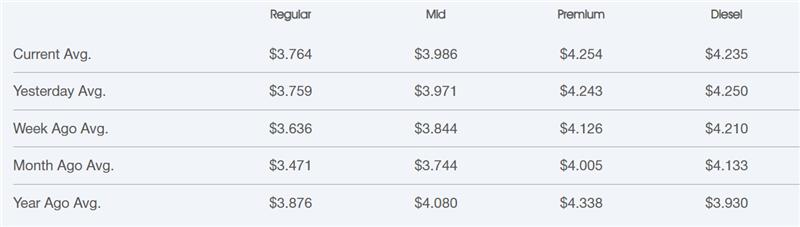
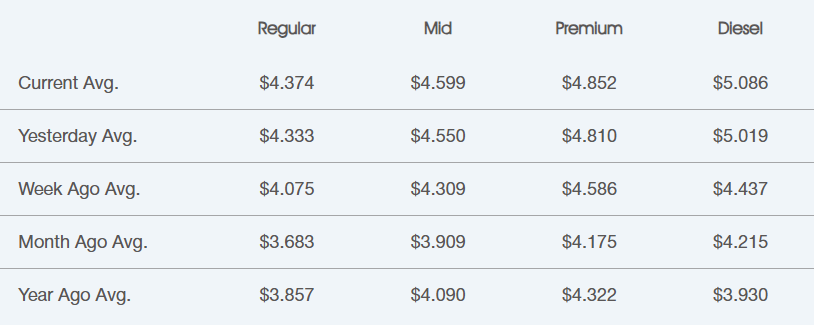
E10$3.07$3.78$4.19
B5$3.77$4.30$4.91

Taxes

FederalState: ORLocalState: WA
Gas$0.184$0.40$0-.13$0.494
Diesel$0.244$0.40$0-.13$0.494

Portland Retail Fuel Price Variance

Fuel Market News

Fuel prices rose this week, as prices are up on both gas and diesel. Rack averages in Portland for E10 gasoline jumped $0.07/gal, while diesel jumped $0.05/gal. Just as fuel prices hit their annual lows, the Olympic Pipeline reported leaks near Everett, Washington, which caused BP to shut down sections of the pipeline. This will likely put a bottleneck on the supply of gas and diesel throughout the PNW, as prices will likely jump significantly over the next few days and continue to remain high for the following weeks. This comes at a less-than-ideal time for commuters, as fuel prices were expected to remain low rolling into December and the holiday season. With Thanksgiving approaching next week, the demand for fuel will continue to rise as the supply experiences temporary bottlenecks.  

fuel-market-report-star-oilco-5-18-24

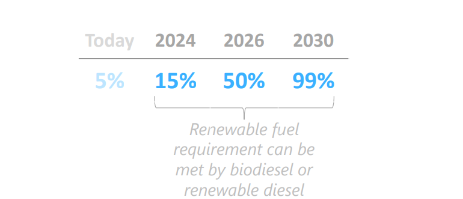
Important Note: Per the City Of Portland, “Distributors in the City of Portland are required to meet the minimum biofuel content requirements for all fuel they distribute beginning on May 15, 2024. All diesel fuel distributed to retail stations, non-retail dealers, or wholesale purchaser-consumers must include a minimum of 15% biofuel content, from either renewable diesel or biodiesel. This requirement increases to 50% on May 15, 2026, and 99% on May 15, 2030”.

Want to know what to expect this Fall in regards to our diesel market? You can read our 2025 Diesel Market Outlook For Oregon.

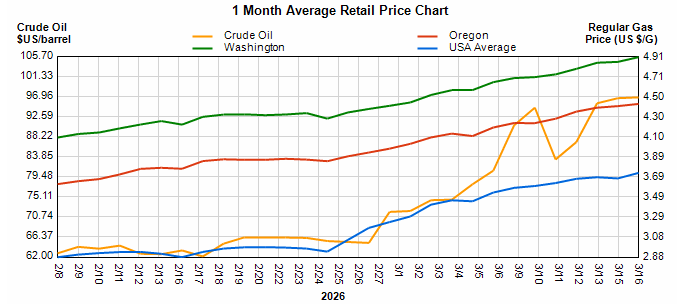
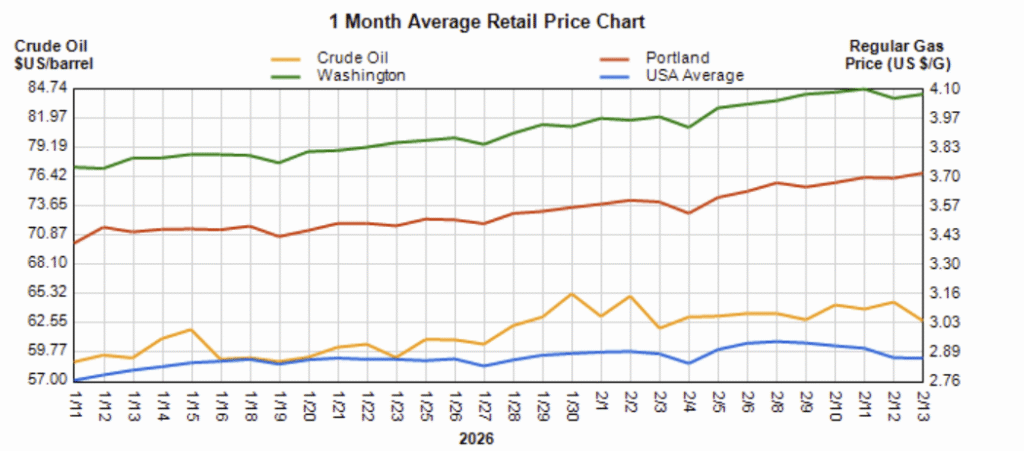
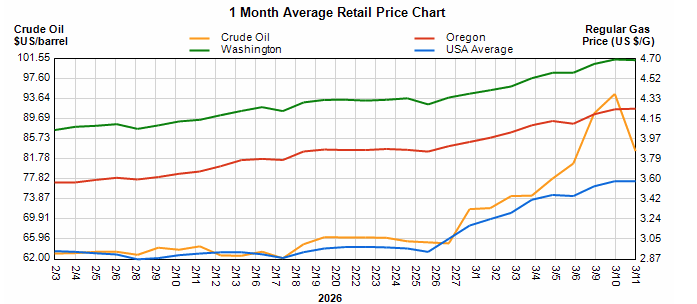
Crude oil is trading below $60, at a current price of $59.71/barrel. This is $0.98/barrel lower than it was last week.

Crude oil is the main ingredient for gasoline and diesel. Per AAA, on average about 50% of what you pay at the pump is the price of crude oil, breaking down as 25% refining, 11% distribution & marketing, and 14% taxes – a helpful breakdown for consumers wondering why they are paying the prices that they pay. Crude Oil is currently trading at $59.71/barrel compared to $60.69/barrel last week and $66 a year ago. 

It’s essential to recognize that fuel prices result from a complex interplay of the factors mentioned above and other regional factors. Additionally, prices may vary by specific regions within Oregon and Washington. For the most precise and up-to-date information on fuel prices and the causes for these price changes within your area, use the links below for AAA & GasBuddy.

If you have any questions, feel free to contact Star Oilco and speak to one of our fuel market advisors to discuss how the market can impact your business.
Set up your R99 Mobile Fueling Onsite Service in Portland Today Including Dyed Untaxed R99.

Give Us A Call Today

For other news in the fuel market:

https://gasprices.aaa.com/?state=OR

https://www.gasbuddy.com/charts

Join the Fuel Market Report newsletter for your weekly fill of updates!

Golden diesel fuel swirling in abstract motion
Star Oilco Diesel Fuel Quality Assurance 1024 574 Star Oilco

Star Oilco Diesel Fuel Quality Assurance

                                 Star Oilco Diesel Fuel Quality Assurance


Diesel Fuel Tank Cleaner


  • Diesel Fuel Is Often A Company’s Largest Expense. Unfortunately, there is very little control over its quality.
  • Fuel Quality Has Declined over the last 25 years…
  • Engine manufacturers have tightened the tolerances for fuel
  • Newer tier 4 engines starting from 2008 need cleaner fuel


“Over the last two decades, the cetane number and the API gravity, the basic measures of crude oil quality have declined.”

—Society of Automotive Engineers, (SAE) Bulletin 872243


Cetane number is actually a measure of a fuel’s ignition delay. This is the time period between the start of injection and start of combustion (ignition) of the fuel. In a particular diesel engine, higher cetane fuels will have shorter ignition delay periods than lower cetane fuels.

What is a typical API gravity for diesel fuel? The classic book “Petroleum Refinery Engineering” by W.L. Nelson (4th ed., McGraw-Hill, 1958) gives numbers ranging from about 25 to 40 (with “Grade 1-D” around 40 and “Grade 2-D” around 35). In a Web search using the keywords “diesel” and “API gravity” I found a couple of sites with specs for #2 diesel fuel; these had minimum values of 26 and 30 API gravity. So a reasonable guess would be that typical #2 diesel fuel would have an API gravity of about 35; I’ll let you plug that into the above formula to get the specific gravity.

The densities of petroleum products are traditionally (especially in the U.S.) expressed as “API Gravity” The API Gravity is related to the specific gravity by the equation: API = (141.5/SPGR) – 131.5, where the specific gravity is the density relative to that of water and everything is measured at a temperature of 60 degrees F.

MadSci Network © 1997, Washington University Medical School

“Diesel fuel quality has deteriorated for the past 20 years and is expected to continue this trend for the foreseeable future.”

American Society for Testing and Materials, (ASTM) Pub. # 10056


COMMON PROBLEMS WITH 21st CENTURY DIESEL FUEL IN THE PACIFIC NW

Fuel Quality Deterioration

industrial-townProblem 1


Problem 2


Problem 3

Problem 6a


Problem 4


Problem 4a


Problem 5

Problem 3b

Problem 6

The odds are stacked against the fleet owners

what can be done to help alleviate or control the problems?

you have questions, we have the solutions, call us to find out.

 CAll Today

If you have bulk fuel storage, the first step is testing your tank bottom and what is coming out of the nozzle.  Star Oilco can do a complementary ASTM and ISO specification analysis of your diesel fuel.  If you are seeing recurring fuel system issue, the first step is to make sure your bulk storage isn’t the problem. We can help.

Tank Testing Form

  • This field is for validation purposes and should be left unchanged.

Mobile app showing Pacific Pride fleet fueling data and location alerts
Get an email every time your fleet stops for fuel 1024 541 Star Oilco

Get an email every time your fleet stops for fuel


Get an Email every time your driver fuels up

Driver management tools built into a fleet card.

-Fleet card services mean more than just a bill, it is knowing who buys what, when, and where in real time.

-Make sure your Dispatcher on duty gets an email every time fuel is bought in real time.

-Know in real time what your fleet is buying and doing to get ahead of bad decisions.


Driver efficiency can drain your profits.  Drivers making the wrong decision about where to buy fuel is also a trainable experience.  Add to that the bad actors who might palm a fleet card.

We give you actionable data in real time as the driver makes a decision.

At those rare moments when thieves creep into your business, we also make sure you see it as it occurs.  This means you can save yourself thousands of dollars in theft before it happens.  Fuel theft usually occurs on the way to work or when bars close.  We make sure you are getting notified at every fuel purchase so you can see the out of place fuel purchase.

Our Pacific Pride cards tie a suite of tools into our E-Receipt tool making sure your team knows who is doing what with your fuel cards.  We also have added tools, if you want them, to turn the cards off by hour of day, days of the week, and by states/zip code protections.  We secure your business from those risks so you can protect yourself from surprises.


Star Oilco is an Independent Franchisee of Pacific Pride.
Know who, what vehicle, what fuel, at what location in real time – to manage your fleet in real time.

Knock out fuel theft by knowing what is happening when it happens.

-E-Receipts are a simple tool that allow you total knowledge and control of your fleet’s fueling.

Managing a fleet is an orchestra of well organized chaos.  Your driver’s decision making, unforgiving customer needs, the randomness of traffic all merge into the daily life of a fleet.  Star Oilco can provide you a very simple tool to help you seize control of where, when and who makes fuel purchasing decisions.  The Star Oilco Pacific Pride card can provide an email notification every time fuel is bought notifying your team so that your fuel policy can be managed in real time.

Control the fuels they can buy, the zip codes they can buy fuel in, limit the quantity of fuel, windows of time to buy fuel (so after hours a borrowed card cannot be use), and get an email after someone gets fuel. Manage your driver’s habits as things happen.

Email notification of who, where, and what fuel was purchased after it occurs.

Many fleets have policies of when and where to fuel.  Avoiding high cost retail pumps, the nearly $.50 fuel higher tax difference for an Oregon fleet buying in Washington state, or if you use wet-hose mobile fueling to save labor and depend on a gallon quantity for a discounted price.  A driver not following your policies is very expensive.

With Pacific Pride’s e-receipt at time of transaction you will have instant confirmation, not month end audits.

Regardless of coaching and communicating often drivers have a habit of departing from even the best managed fleet’s policies.  Knowing the moment this happens can make all the difference.  It also has an added benefit of keeping people from even contemplating fuel theft as the transaction and who the offender is will be immediately noted.

Imagine it.  Your driver stops out of route for fuel, shortly after a text from dispatch asks why?   As you discuss the fuel stop with the wayward driver, they will forever and always think twice before stopping out of route again.

Know who stopped for fuel in real time. 

Get started below.

Contact Form

  • This field is for validation purposes and should be left unchanged.


Fuel bill audit best practices

Read more on how a Fuel Audit can help your business control fuel costs and demystify what and how you are buying fuel.  Find out what’s in a Star Oilco “Keep it Simple” Fuel Audit.

For a strategy on using Fleet Cards as a human resource management tool to stop fuel theft in your business see the Star Oilco white paper on Stopping Fuel Theft in your Business.

Two semi-trucks driving on a highway with trees in the background
Fuel Market Report: Nov 2nd – Nov 8th, 2025 1024 683 Star Oilco

Fuel Market Report: Nov 2nd – Nov 8th, 2025

fuel-market-report-star-oilco

Did You Know That R99 Is The Same Cost As Diesel Currently?

Call to set up R99 Mobile Fueling Onsite Service in Portland at the same cost of retail diesel. Dyed untaxed R99 is also available. Give us a call today to schedule your delivery.

Wholesale Price Average 11/8/25

Wholesale LowWholesale Avg
E10$2.21$2.33
B5$2.71$2.71
B20$2.72$2.77
R99$2.43$2.49

Average Retail Prices 11/8/25

NationalOregonWashington
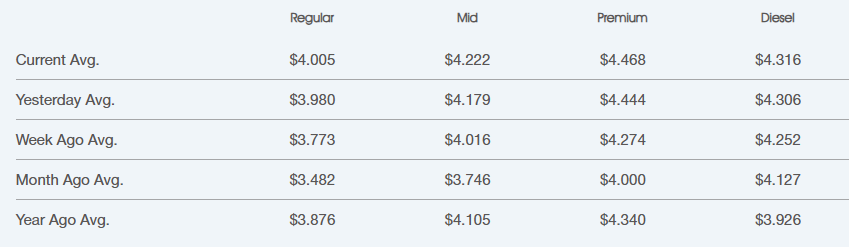
E10$3.07$3.82$4.22
B5$3.74$4.33$4.94

Taxes

FederalState: ORLocalState: WA
Gas$0.184$0.40$0-.13$0.494
Diesel$0.244$0.40$0-.13$0.494

Portland Retail Fuel Price Variance

Fuel Market News

Fuel prices dropped across the board this week, with gas and diesel prices down. It was the first week in 2 months where wholesale prices dropped while retail prices increased. Wholesale rack averages dropped $0.03/gal for E10 gasoline, and over $0.15/gal for B5 & B20 diesel. The government shutdown has seemingly come to an end with a vote from the Senate last night to continue funding and operating the government. This has calmed many worries within the market as the shutdown was the longest recorded in historyWith the government back in session, we may see prices continue to fall as fears of a continued shutdown are fading within the market. Crude Oil prices are hovering just about $60/barrel for WITI crude, as prices have risen slightly over the last two weeks.

fuel-market-report-star-oilco-5-18-24

Important Note: Per the City Of Portland, “Distributors in the City of Portland are required to meet the minimum biofuel content requirements for all fuel they distribute beginning on May 15, 2024. All diesel fuel distributed to retail stations, non-retail dealers, or wholesale purchaser-consumers must include a minimum of 15% biofuel content, from either renewable diesel or biodiesel. This requirement increases to 50% on May 15, 2026, and 99% on May 15, 2030”.

Want to know what to expect this Fall in regards to our diesel market? You can read our 2025 Diesel Market Outlook For Oregon.

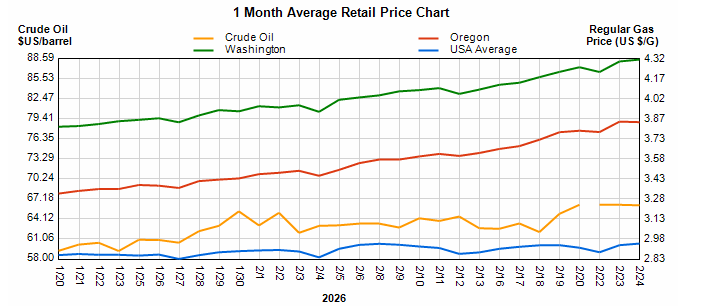
Crude oil is trading just below $61, at a current price of $60.69/barrel. This is $0.43/barrel higher than it was last week.

Crude oil is the main ingredient for gasoline and diesel. Per AAA, on average about 50% of what you pay at the pump is the price of crude oil, breaking down as 25% refining, 11% distribution & marketing, and 14% taxes – a helpful breakdown for consumers wondering why they are paying the prices that they pay. Crude Oil is currently trading at $60.69/barrel compared to $60.26/barrel last week and $66 a year ago.

It’s essential to recognize that fuel prices result from a complex interplay of the factors mentioned above and other regional factors. Additionally, prices may vary by specific regions within Oregon and Washington. For the most precise and up-to-date information on fuel prices and the causes for these price changes within your area, use the links below for AAA & GasBuddy.

If you have any questions, feel free to contact Star Oilco and speak to one of our fuel market advisors to discuss how the market can impact your business.
Set up your R99 Mobile Fueling Onsite Service in Portland Today Including Dyed Untaxed R99.

Give Us A Call Today

For other news in the fuel market:

https://gasprices.aaa.com/?state=OR

https://www.gasbuddy.com/charts

Join the Fuel Market Report newsletter for your weekly fill of updates!

Tablet screen displaying Pacific Pride Commercial Fueling System logo
Top 4 Reasons Hotels Should Use Pacific Pride 1024 688 Star Oilco

Top 4 Reasons Hotels Should Use Pacific Pride

Pacific Pride Fuel Cards for Airport, Hotel, or Travel Shuttle Companies

Fuel for shuttle vans through Pacific Pride

ending with fuel card management, emailed receipts, transparency, and accountability for your hotel or travel shuttle bus drivers.

Star Oilco is an independent Franchisee of Pacific Pride

Pacific Pride Fuel cards for Shuttle Drivers

Running a shuttle service for a hotel for any reason can have a lot of moving parts:

  • Hiring
  • Training Drivers
  • Scheduling Shifts
  • Keeping the Vehicles Full of Fuel
  • Ensuring a Consistent Time Table

Let Star Oilco track and control the fueling for you. We can save you money and significantly reduce your risk of fuel theft while getting your drivers out of lines at a retail gas station. In addition, our locations are open even on holidays or late at night.

Shuttles going to and from the airports can be on tight schedules and  don’t have a lot of time to fuel. Meeting your guests’ needs means you can’t have your drivers in lines for a long time. Stand-alone commercial-only Pacific Pride and CFN sites in the northwest are a real resource for your business. Many stations are located near airports. They speed up the labor associated with fueling and significantly lock down the chance for fraud or theft when using your fuel card. Stand-alone sites limit access to convenience store items so employees won’t be tempted to spend time browsing and make purchases on the company credit card.

With Pacific Pride and CFN stand-alone commercial cardlock sites, there are other benefits beyond just the convenience. The biggest difference is that these commercial cardlock sites are built with security in mind. Retail stations are engineered to sell as many products as possible to those pulling up for gasoline. Commercial cardlock sites are designed for commercial users who seek the fastest fueling experience. That is a major contrast between the two.

Top 4 Reason Hotels Should Use Fuel Cards

Top 4 Reason Hotels should use Pacific Pride Fuel Cards

Reason #1 – Better Tracking and Management

With a myriad of responsibilities required of those who run hotels or shuttles, simple methods to control when, where, and what is purchased any time during the day can save time and money. Controls keep fuel purchases in line and by only those with authorization.

WHEN: If the drivers only need access to fuel during specific shifts you can set the cards to work only during these times.

WHERE: Drivers can be limited to specific locations such as only Pacific Prides, or if more flexibility is needed, they can be authorized to use any of the 57,000 extended network locations. Pacific Pride locations are also open 24/7 and open even on the holidays.

WHAT: Drivers can be limited to specific types of fuel. If the van takes diesel you can set the card to only have access to diesel. These simple strategies can eliminate many of the issues that can arise when fueling.

Talk to a Card Lock expert at Star Oilco to find out more. 


Reason #2 – No More Paper Receipts 

Tracking and reviewing receipts takes up a lot of time. Pacific Pride fuel cards can be set up to automatically email every time a fueling occurs. Using a fuel card eliminates the need to continuously organize and track expense receipts from drivers. No more going through each and every receipt to see what and how much was purchased. Fuel can be set up to see which vehicle was fueled, who fueled it and when it was fueled. These transactions are easily organized with entered mileage and fuel costs in the bills that are issued twice a month. This alone can save hours of labor for accountants and controllers as they audit the bills.

Reason #3 – Stop Fuel Theft

By using a fuel card, a hotel insures the security of their shuttles and prevents theft by its drivers. This instills peace of mind, as managers know their drivers cannot use a fuel card for personal usage. Fuel cards can be assigned to vehicles and each driver has their own individual PIN#. With a quick email or phone call, card access can easily be granted or blocked as drivers leave or new ones are added.

Reason #4 – Transparency and Accountability

Star Oilco has created a template agreement for drivers to sign as they are assigned identification numbers for the cards. This form helps the driver understand that they are responsible for any unauthorized purchases with their DIN (Driver Identification Number). Setting up emails that are sent in real time can be done so that any unauthorized use can immediately be investigated.

Need to lock down your gas card from fuel theft?

Call Star Oilco, we make it simple.

Our motto is “Keep it Simple” and we make this easy. Feel free to reach out and see what Star Oilco can do for your fleet to upgrade its fleet fueling security.

What do you need to get a fuel card in Oregon?

All you need in order to access Pacific Pride sites in Oregon is a business license and proof that you use over 900 gallons of total fuel a year. CFN commercial cardlock sites have the same requirements. If you are a business using a commercial quantity of fuel, you qualify to self-serve gasoline and you can stop paying your employees to shop at the most expensive retail gas stations with the best mini-mart selection. Instead, get them back on the road 24-7 and usually without a line to wait in.

What do you need for fueling cards in Washington or any other state?

If you drive into Oregon and want to use gasoline, you still need the same requirements as stated above. If you don’t need access to Oregon gas stations, it is much easier to get a fuel card.


Star Oilco is an independent Franchisee of Pacific Pride

Contact Form

  • This field is for validation purposes and should be left unchanged.
Two semi-trucks driving on a highway with trees in the background
Fuel Market Report: Oct 26th – Nov 1st, 2025 1024 683 Star Oilco

Fuel Market Report: Oct 26th – Nov 1st, 2025

fuel-market-report-star-oilco

Did You Know That R99 Is The Same Cost As Diesel Currently?

Call to set up R99 Mobile Fueling Onsite Service in Portland at the same cost of retail diesel. Dyed untaxed R99 is also available. Give us a call today to schedule your delivery.

Wholesale Price Average 11/1/25

Wholesale LowWholesale Avg
E10$2.24$2.36
B5$2.74$2.86
B20$2.81$2.90
R99$2.63$2.74

Average Retail Prices 11/1/25

NationalOregonWashington
E10$3.05$3.87$4.27
B5$3.62$4.37$4.98

Taxes

FederalState: ORLocalState: WA
Gas$0.184$0.40$0-.13$0.494
Diesel$0.244$0.40$0-.13$0.494

Portland Retail Fuel Price Variance

Fuel Market News

Fuel prices varied this week as gas prices dropped, and diesel prices did not move. Rack averages for E10 in Portland dropped $0.02/gal, while rack averages for diesel did not change. This is the third week in a row that gas prices have dropped, signally the seasonal trend of fuel prices reaching their lowest price points of the year. Prices should continue to taper off and drop slightly week to week, as demand is lower during this time of year. Crude Oil is floating just above $60/barrel, which has contributed to lower fuel prices across the PNW and most of the nation. Recent sanctions on Russian Oil from the UK and the U.S. have put a dent in Russia’s Crude deliveries across China, India & Turkey, as Russia struggles to find buyers for their crude volumes.

fuel-market-report-star-oilco-5-18-24

Important Note: Per the City Of Portland, “Distributors in the City of Portland are required to meet the minimum biofuel content requirements for all fuel they distribute beginning on May 15, 2024. All diesel fuel distributed to retail stations, non-retail dealers, or wholesale purchaser-consumers must include a minimum of 15% biofuel content, from either renewable diesel or biodiesel. This requirement increases to 50% on May 15, 2026, and 99% on May 15, 2030”.

Want to know what to expect this Fall in regards to our diesel market? You can read our 2025 Diesel Market Outlook For Oregon.

Crude oil is trading just below $61, at a current price of $60.26/barrel. This is $1.03/barrel lower than it was last week.

Crude oil is the main ingredient for gasoline and diesel. Per AAA, on average about 50% of what you pay at the pump is the price of crude oil, breaking down as 25% refining, 11% distribution & marketing, and 14% taxes – a helpful breakdown for consumers wondering why they are paying the prices that they pay. Crude Oil is currently trading at $60.26/barrel compared to $61.29/barrel last week and $65 a year ago.

It’s essential to recognize that fuel prices result from a complex interplay of the factors mentioned above and other regional factors. Additionally, prices may vary by specific regions within Oregon and Washington. For the most precise and up-to-date information on fuel prices and the causes for these price changes within your area, use the links below for AAA & GasBuddy.

If you have any questions, feel free to contact Star Oilco and speak to one of our fuel market advisors to discuss how the market can impact your business.
Set up your R99 Mobile Fueling Onsite Service in Portland Today Including Dyed Untaxed R99.

Give Us A Call Today

For other news in the fuel market:

https://gasprices.aaa.com/?state=OR

https://www.gasbuddy.com/charts

Join the Fuel Market Report newsletter for your weekly fill of updates!