

Posts Tagged :

B20 Biodiesel

comparison chart showing difference between off-road diesel and on-road diesel fuel in Portland OR
The Future of Diesel Fuel 940 788 Star Oilco
The Future of Diesel Fuel

Retail Diesel Dispenser Example
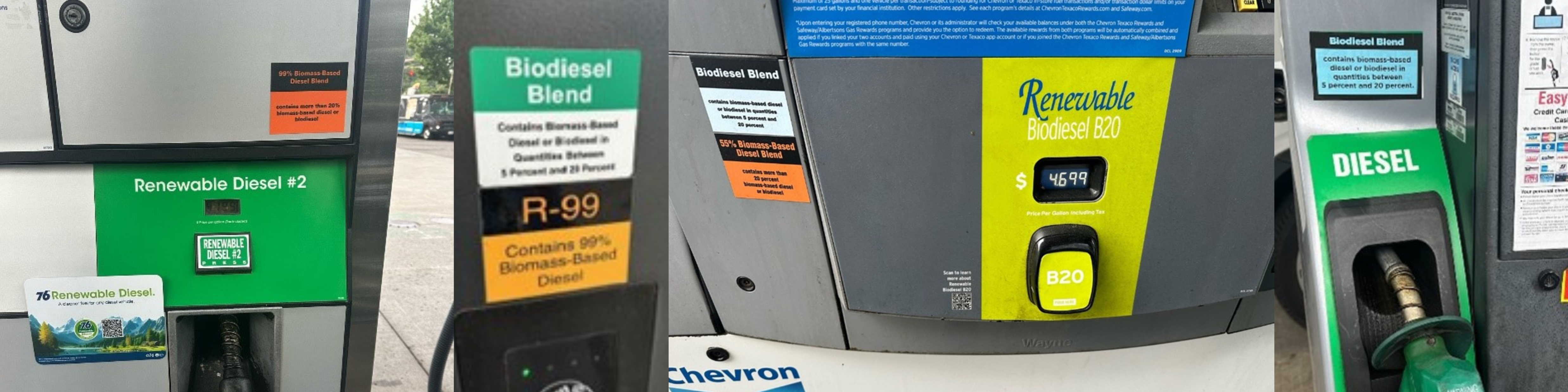
Retail Diesel Pumps with a variety of blends of diesel. Biodiesel, Renewable Diesel, and Fossil Diesel blends shown in Portland, Oregon.

The Future of Diesel is Low CO2 Synthetic Fuels

The stew of molecules your diesel is made of has been changing. A next level technology in chemistry is enabling garbage to be transformed into hydrocarbon fuels like diesel, jet fuel, naphtha, and propane as well as other high value chemicals. These technologies enable petroleum refineries in the United States to retool themselves and move into making biofuels with the very technology used to refine modern gasoline and diesel fuels from crude oil.  Currently oil refineries take crude petroleum and crack the molecules and reform them with a hydrotreater.  This hydrogenation is what makes renewable diesel from fats, oils and greases.

If you have ever worked under your sink at home. Remember the greasy mess inside the pipes below your kitchen sink.  These renewable hydrogenation technologies can turn that trash into a super clean high performance synthetic diesel fuel.  That waste stream along with used deep fryer oil, the animal fats from rendering and other sources is the feedstock for renewable diesel.  It is exciting and this will be the future of our diesel and jet fuels.  These fuels also have a fraction of the CO2 footprint of a fossil fuel equivalent as measured by Oregon, Washington or California’s rules to measure the carbon intensity of fuels.

Diesel Fuel in Oregon and Washington

Star Oilco has been getting questions on the changes of diesel in Portland, Oregon.  If you have not noticed, many diesel pumps at retail gas stations and cardlock have seen changing stickers on the face of the fuel pumps.  As of July 1st, 2024 the City of Portland requires a minimum 15% biofuel content of all diesel sold.  This policy is called the Portland Renewable Fuel Standard.  Portland currently plans to ramp up this requirement to a 50% biofuel blend in May of 2026.  So that every gallon of diesel sold inside the City of Portland must be half biomass based diesel products blended with fossil diesel.

This has caused quite a few changes in what fuel pumps have as their fuel for sale.  Usually people notice this change with teh color of the diesel coming out of the retail nozzle.  Diesel fuel buyers are noticing the bright yellow color of B20 biodiesel, the fully clear color of Renewable Diesel or a mix of several fuels tinting the color of their diesel.  This trend is bigger than just Portland.

Today on the west coast there are a variety of product label stickers you will see on diesel pumps.  These show the variety of diesel fuel specifications that are being sold to diesel vehicles today. Blends of petroleum ultra low sulfur diesel, R99 (99%) renewable diesel, and B99 (99%) Biodiesel are combined to meet the market needs of the diesel we all buy.

This change is because of a combination of pure market forces, government rules and local decisions by fuel haulers.  Today’s diesel not only has a commodity market for the fuel it also has a market for CO2 credit value and a cap of total petroleum diesel fuel that can be sold into a west coast state with a “Cap and Investprogram requiring blends of low CO2 biofuels, the liquid fuels sold for vehicles.

Add on top of these market forces, advances in technology used to make the liquid diesel fuel.  The diesel arriving at truck stops, gas stations, cardlock or out of a hose from a bulk truck has been changing and it’s often in good ways.  Knowing how can be helpful in navigating why diesel may cost one price or another and may have a need or maintenance that another fuel does not.

THE RISE OF RENEWABLE DIESEL

Renewable diesel, also called R99 as in 99% renewable diesel, is a synthetic diesel fuel made from the same feedstock as biodiesel. The big difference though is that renewable diesel’s finished product is hydrocarbon diesel.  Biodiesel chemically is not a hydrocarbon or made up of diesel molecules.  Renewable diesel is a biofuel, but it is also chemically diesel on a molecular level. For fuel regulation they refer to it (as well as biodiesel) as “Biomass Based Diesel” for labeling at the fuel pump.

There have been billions of plant capacity brought online in the United States for renewable diesel.  During the COVID market drop in fuel prices a number of petroleum refineries shut down, then upgraded their technology to make hydrocarbon diesel fuels out of the very biobased fats, oils, and greases biodiesel is made from.  These refineries use hydrotreating technology just like they do with a crude petroleum to make an actual hydrocarbon diesel molecule.   With this technology adoption to make diesel and jet fuels from vegetable oils and animal fats billions of gallons of low CO2 diesel fuels are coming on the market and governments are requiring it’s use, such as Portland’s Renewable Fuel Standard.
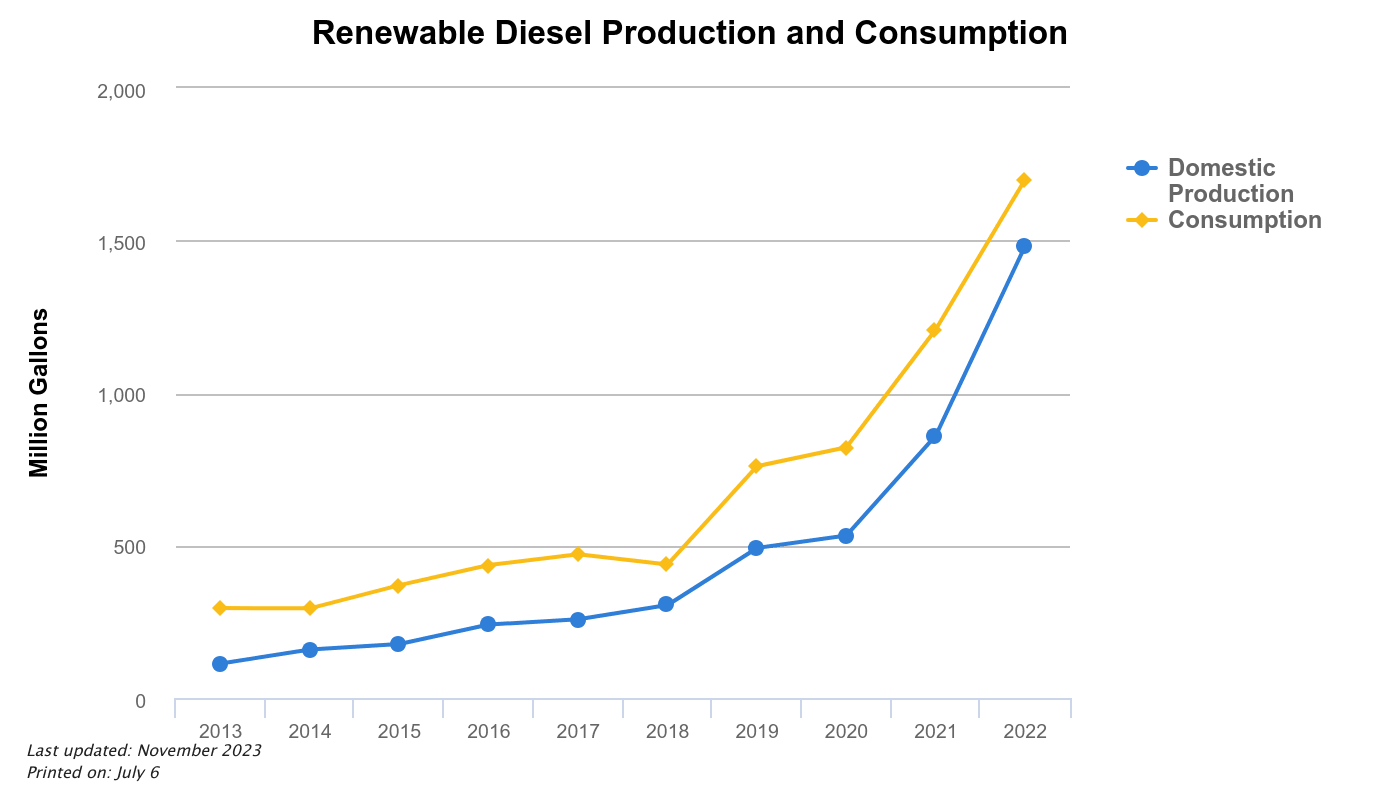
Renewable Diesel Consumption it the US Source: Alternative Fuels Data Center

THE AVAILABILITY OF BIODIESEL

The US makes billions of gallons of biodiesel.  A fuel that’s quality and performance continues to improve.  If you are not a fan of biodiesel in your fuel thinking strategically about the fuel will likely benefit your fleet operation.  The big concern with diesel fuel in a ultra low sulfur world is water and dirt suspended in the fuel affecting the performance of diesel emission systems.  With clean and drier quality specifications of B99 blend stocks today versus a decade ago the use of this fuel has grown substantially especially in the truck stop market.

When crude petroleum prices are high and therefore refined diesel prices are equally as high biodiesel is often an extremely competitive fuel.  Recently changes in Federal subsidies on biodiesel have changed this market dynamic a bit but you can presume that biodiesel will often be sold at a discount against fossil fuel diesel.  If a large seller of diesel (including petroleum refiners) can pick up pennies per gallons on millions of gallons sold they will do so.  Therefore Biodiesel is often seen in diesel in small blends even if you do not see a label on retail pump.  For blends above 5% a label is required for retail fuel sales.

R99 Renewable Diesel label indicating 99% biomass-based diesel content
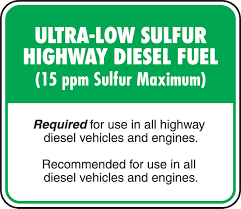
Ultra Low Sulfur Retail Diesel Label
Biodiesel Blend Percentage label for retail diesel dispenser

Above are a variety of labels used to denote what fuel blend is coming out of a retail diesel dispenser. Feel free to call Star Oilco at 503-283-1256 if this confuses you and you want it explained.  We would be glad to do so.

These labels can be found together often at one pump.  All state and Federal standards require ultra low sulfur diesel for any on-road diesel sale.  The Federal standards also adopted by the states require a disclosure at the fuel pump if a blend is above 5% biodiesel.  The max allowable blend of biodiesel for diesel truck manufactures is a 20% blend.  If a truck dealership says that you cannot blend biodiesel up to 20% they need to take that up with the Federal Government because they need to support it.  This is why the label shows a blend may contain between 5% and 20% biodiesel content.

Renewable diesel is a hydrocarbon diesel. 


It is diesel meeting the ASTM D975 specification for diesel. 

Retailers selling blends of R99 in their fuel do not need to label it given this.  They still do label it given the benefits of the fuel’s performance and that customers are seeking that fuel.

Contact Us Today To Schedule Your Next Bulk Fuel Delivery

Many retail places will have stacked labels showing they may be blending 5% to 20% biodiesel as well as may be adding R99 Renewable Diesel to the fuel as market conditions dictate it is the more cost competitive fuel.  When seeing a label like this it can usually be assumed they are blending a R80 (80% Renewable Diesel) and a B20 (20% Biodiesel) blend of fuel.  This blend is actually believed by some to be a higher performing fuel seeing better performance that a R99 or B20 fossil fuel blend.

Fossil fuel diesels are being replaced or blended with biomass based diesels.  Be it Renewable Diesel or Biodiesel.  These blends are driven by more than one industry requirements, government rules, or other market forces. One of these being Portland’s banned on petroleum diesel through the Renewable Fuel Standard (RFS). This is resulting in an increase of low-carbon biofuel blends that will ultimately move to a mix of 99% renewable fuel requirement by 2030.

Renewable Diesel and Biodiesel Blend fuel dispenser label.

The big drivers are industry specification for fuels (both labeling as well as chemical characteristics), state rules on selling these fuels, their quality assurance as well as CO2 content, and of course the market forces.  Market forces being the supply and demand availability of fuel needed to meet customers.  Less fuel available to sell means higher prices for customers.

A decade ago the market for diesel was far simpler. Though you had biofuels and some blend mandates basically you had a diesel specification accepted and the daily price as tracked by a lighted retailers sign, a wholesale market average or spot buying by some customers.   Today this market is far more complicated by government regulation on the west coast.  There are three big programs at state levels impacting this.

State Fuel Rules cause a unique need for one state or another. Whereas twenty years ago if Oregon or Washington fuel was selling for more than the Gulf Coast you might see brokers bring fuel into the region then driving down high prices.  With the creation of various complex and unique rules on diesel, imports of fuel to these low CO2 fuel states has dropped.  The amount of people moving product into west coast states has dropped.  The big rules causing this are the Cap and Invest programs of the West Coast states, the Low CO2 Fuel Standards of the states, and the fuel blend mandates of various jurisdictions of these states. For instance California now requires all off-road diesels but 99% renewable diesel.  Portland, Oregon also has a CO2 requirement and minimum 15% blend of biomass based diesel on all fuel sold in the state.

WHAT ARE THE DIESEL FUELS AND THEIR SPECIFICATIONS

Petroleum Diesel:
ASTM D975 Specification.

The ASTM D975 is a series of tests used to maintain consistent industry standard product performance for diesel fuel.  It includes among several tests cloud point, cold filter plug point (CFPP), several masurements of diesel fuel operability performance, intrained water content, sediment, carbon residue, ash, distillation, viscosity, sulfur, copper corrosion, cetane number, cetane index, aromaticity, and conductivity.

Renewable Diesel:
ASTM D975 Specification.

Renewable Diesel is following the same series of tests as petroleum refined diesel fuels.  It is the same ASTM D975 specification. Though Renewable Diesel has some different properties that exceed the ASTM specification of diesel.  Renewable Diesel is highly prized as a fuel because it typically is a cleaner and drier diesel fuel than petroleum diesel. This being seen by the tests on sediment and water content in a parts per million level.  Renewable Diesel content in diesel fuel can also be tested for looking for a C14 molecule (the chain typically created in a Hydrotreated Diesel process from fats, oils and greases.

Biodiesel (Methyl Esther):
ASTM D6751 Specification.

The ASTM for Biodiesel tests a mono-alkyl esters of long chain fatty acids derived from vegetable oils and animal fats. The testing for quality assurance covers an analysis for flash point, methanol, water and sediment, kinematic viscosity, sulfated ash, oxidation stability, sulfur, copper strip corrosion, cetane number, cloud point, acid number, carbon residue, total and free glycerin, phosphorus, reduce pressure distillation temperature, atmospheric equivalent temperature, combined calcium and magnesium, and combined sodium and magnesium.

For more on Biodiesel Use and Handling the National Renewable Energy Laboratory has a great book on the subject.

THE HISTORY OF DIESEL FUEL SPECIFICATIONS IN THE UNITED STATES

In the 1990’s the US EPA passed rules that demanded a phase out of sulfur in diesel fuel.  The presence of sulfur was very good for the fuel’s storage stability as well as fuel lubricity, but was horrible for air quality.   Additionally the big smog contributor was NOx (nitrous oxide) which was one of the EPA’s reason’s for pulling sulfur out of diesel.  For the EPA to get engine manufacturers to treat the NOx emissions at the tailpipe they needed all the sulfur gone (ultra low sulfur diesel) for modern diesel emission systems to be able to eliminate NOx as well as a host of other pollutants including particulates.

The story of changing diesel fuel standards in the US under the EPA is one of removing sulfur from our diesel fuel.  In 1996 the fuel refiners and sellers of diesel had to move the sulfur content of the fuel sold for on-road purposes to below a 500 parts per million standard. Commonly referred to as Low Sulfur Diesel fuel.   In 2006 the standard moved to a maximum of 15 parts per million of sulfur for all on road fuels.

In 2006 while the sulfur content of fuel was dropping the City of Portland released the first mandated blend of biodiesel content.  This being a 5% biodiesel blend.  The next year, the State of Oregon followed with its own Renewable Fuel Standard requiring this throughout the state.  This began the expectation of biodiesel in most diesel fuel in the Portland, Oregon area.  Washington also passed a similar policy for blending biodiesel but the enforcement and need for the fuel is less specific at Washington fuel pumps.


Sign Up To Receive Our Fuel Market Report For Your Weekly Fill Of Updates!

Name
Golden diesel fuel swirling in abstract motion
Every question Star Oilco has been asked about heating oil 1024 574 Star Oilco

Every question Star Oilco has been asked about heating oil

Heating Oil FAQ (and not so FAQ)

Every Question Star Oilco has been asked about Heating Oil

It’s getting cold again in the Pacific Northwest, so it is time to take a look at some common questions we have been asked about Heating Oil.  If you don’t see an answer to a question you have, please feel free to call, email, or message Star Oilco and we will gladly answer. We especially welcome questions  that require research.

What is Heating Oil in Oregon?

Heating Oil in Oregon is diesel and can have a biodiesel blend as well.  Diesel fuel has several grades either #1 or #2 Diesel.  The number refers to the grade with #1 being called either “stove oil” or “Kerosene” as another term for it.  Typically when someone is requesting or talking about heating oil they are talking about #2 Diesel dyed red to denote there are no on-road fuel taxes associated with the fuel.

How Does a Furnace Work?

There are several types of oil furnaces.  The most common is a vaporizing burner.  These furnaces typically work by taking a liquid combustible fuel, vaporizing it into a fine mist through a fuel oil nozzle, and igniting that mist into fire. That fire heats either air or water for your home’s comfort.

Heating Oil Fired Air Furnaces

Air furnaces usually move the air through a heat exchanger where a blower then moves air over the heat generated by your furnace, and finally the air is pushed through your home’s vents. 

Heating Oil Fired Water Furnaces and Boilers

Boilers and Water furnaces heat a tank of water which is then distributed several different ways to heat your home.  Either by moving hot water to radiators, radiant plumbing under your floor, or to a heat exchanger and blower which transfers the heat from the hot water into vents blown throughout your home. 

Heating Oil System prior to the combustion system

The parts leading up to the Burner of of an oil furnace system are simple. There is a tank to hold a reservoir of oil, a line from that tank (and sometimes a line back to it), a fuel filter, a fuel pump, and a vaporizing burner that combusts the heating oil into fire. Combustion of the fuel takes place in a fire box next to the heat exchanger. The heat exchanger takes on the heat of the flames to heat either air or water. In an oil furnace, the heat exchanger is assisted with a blower that pushes the hot air throughout your home to keep you comfy.

How Do I Check the Volume of Fuel in My Tank?

If you have an above or below ground heating oil tank you can confirm your fuel volume by the inches of fuel in the tank.  If you have an above ground tank there is probably a tank gauge that can tell you an approximate volume in the tank.  If you have an below ground tank you can confirm how many gallons are in the tank by putting  a measuring stick or tape-measure into the tank.

You will want to confirm the size of the tank you have. Your oil provider will probably have an idea of what size your tank is by looking or historic deliveries. Star Oilco has a tank chart which will help.  If you place a stick or tape measure into your tank and see how much fuel is in it you can compare that to a tank chart found on Star Oilco’s website.  When delivering fuel you can “stick” measure the tank before and after the delivery. Compare these volumes with the delivery and you can often figure out your tank size based on the before and after volume lining up with how much fuel filled your tank.

To view Star Oilco’s Tank Chart please click HERE. 

What is “Home Heating Oil” or “Residential Heating Oil?”

Home heating oil can be either a petroleum diesel fuel, bio-synthetic diesel fuel, or biodiesel fuel. In Oregon and Washington, home heating oil is typically ultra-low sulfur diesel fuel often containing between 5% and 20% biodiesel. Star Oilco’s standard home heating oil fuel is B5 dyed ultra-low sulfur diesel. Oregon mandates require that all diesel fuel sold contain a minimum 5% biodiesel. For that reason Star Oilco carries B5 or 5% biodiesel blends in our heating oil.

(NOTE: Kerosene sold by Star Oilco contains no biodiesel due to the reality that wick heaters cannot handle even a minute amount of biodiesel in them.) Star Oilco also carries a 20% biodiesel blend, called B20 Bioheat, for customers who want a cleaner burning low carbon fuel for their home.

What is Kerosene?

Kerosene is a heating oil product that is capable of being picked up and fed consistently by a wick heater. Kerosene is a diesel product that is very similar to the fuel used for over the road trucks. The big difference is that kerosene is a “lighter end” distillate fuel, which means it has a lighter specific gravity. This lighter characteristic means that it also works better in certain systems like wick heaters, pressure washers, and pot burner stoves.

Can Heating Oil be Used in a Kerosene Heater?

It depends on what type of system the kerosene heater is operating with. If you have a wick heater it will not work with heating oil. You will likely have to replace the wick to get it to work again as diesel will not readily drawn into the wick. Even if it does, it will burn far dirtier. If it is a pot burning system like a Toyostove or Monitor heater, then it will burn ultra low sulfur heating oil. Increased maintenance is to be expected on the pot burner, as there is a likelihood of more coking (crusty black soot build up) to occur inside that system.

What is “Bio Heating Oil” or Bioheat?

Bio heating oil and bioheat refer to heating oil products with a blend of biodiesel in them. Typically bioheat is a blend between 5% to 20% biodiesel with ultra low sulfur diesel for a clean burning and low CO2 heating fuel.

For a really in-depth look at biodiesel used as a heating oil check out this article. 

Will Heating Oil Run a Diesel Engine?

Yes, heating oil will run in a diesel engine. Heating oil is diesel. Be aware though that on-road vehicles must only run clear diesel fuels. If caught using heating oil in an on-road vehicle in Oregon and Washington, the fines can run in the tens of thousands of dollars. Heating oil can also be dyed to signify it isn’t for on-road use. 

Also be aware that even many off-road pieces of equipment and generators need ultra low sulfur diesel to operate without very expensive maintenance. Heating oil can have low sulfur or even high sulfur contents that could cause real issues for modern clean diesel engines. Some consideration is needed prior to burning a fuel marked “heating oil” in a diesel engine.

What Fuel Do I Need?

Consult your furnace, stove, boiler or water heater’s factory recommended specification. Typically it’s Number 2 Diesel unless it is a stove pot or wick heated system. If you have a furnace or a boiler in your basement, you can assume it’s heating oil. Call a licensed and bonded heating oil furnace technician to tune up your furnace to confirm for sure. If you do not have one, Star Oilco can refer you to a number of reputable long-time firms who can help.

What Are Additives and Are They Worth it?

Heating oil additives are added to fuel in order to improve it’s long term storage and performance.  They are worth it and most reputable heating oil providers additize their fuel without an extra charge.  This is because most heating oil customers store their fuel for long periods of time.  If you are planning on storing heating oil for years you will need a fuel additive to keep that fuel in the quality needed for your furnace.

Star Oilco provides a premium diesel additive called Hydrotex PowerKleen to every gallon of heating oil we sell.  Beyond this stabilizers, if you are planning on storing fuel for years we recommend ValvTect Plus 6.  You will want to treat your fuel with a biocide like ValvTect Plus 6 to will kill any bacteria, yeast, algae, or other biological organism that can grow inside your heating oil tank.

For more on storing diesel or heating oil for long periods of time please read this article on long term fuel storage.

What Does Heating Oil Smell Like?

Heating oil smells like diesel. It is a diesel product and often, depending on location, it is the same as on-road diesel. It may be dyed to denote that it is an off-road fuel with a untaxed use. Heating oil is dyed red in the Pacific NW to show it is off-road diesel.

What is Heating Oil #2?

Heating Oil #2 is number 2 diesel or the standard diesel sold in most places for on-road diesel use. Heating Oil #2 is a slightly different specification than on-road diesel that allows for more sulfur. That is a big difference as far as the EPA is concerned. On-road and off-road vehicles in the U.S. are required to use ultra-low sulfur diesel. Heating oil systems can use low or high sulfur diesel fuels. Ultra low-sulfur diesel is the most common Heating Oil #2 fuel that is delivered by Star Oilco since it is a superior and cleaner burning fuel, in our opinion.

Where can I buy heating oil at the pump?

In the Pacific NW heating oil is ultra low sulfur diesel. Therefore, you can buy any diesel sold at a retail gas station, truckstop, farm supply or other liquid fuel seller.  Heating oil is dyed red to show that it is not taxed for on-road fuel use.  Other than that red dye, typical auto-diesel will work in your oil furnace if you need to supply it from a diesel can.

At What Temperature Does Heating Oil Freeze?

Heating Oil Gel Point:

In the Pacific NW we expect number 2 diesel heating oils to be operable beyond -10 degrees. The record cold weather in the Willamette Valley is above 0 degrees (recent decades 16 degrees was our record low in Portland). We do test and add additives to our fuels to ensure they meet this specification even if they contain 5% biodiesel blended into heating oil.

Kerosene Gel Point:

Kerosene fuels (Number 1 Diesel, Number 1 Stove Oil, and Kerosene labeled fuels) are expected to be good below -30 degrees and are designed to be used in high altitude applications. (Kerosene and jet fuels are often the same specification in the Pacific NW.)

B20+ Biodiesel Gel Point:

Biodiesel blends of B20 and above are assumed to be good to 20 degrees but if Star Oilco expects below-freezing weather, we highly recommend B5 as your delivered fuel. B99 biodiesel typically gels at 40 degrees, so it’s not a winter fuel unless you have a system designed to keep the fuel warm in the middle of winter.

What do “Oil Heating,” “Oil Fired Heater,” or “Oil Furnace” Mean When Referring to a House?

“Oil Heat” or “Oil Fired” refers to a heating system reliant on burning heating oil. Typically this is by use of a vaporizing burner that takes the combustible liquid that is heating oil and vaporizes it through a nozzle into an igniter that causes it to burn.  This system burns the heating oil, creating a great deal of heat that can warm air, water, or both to heat a home or commercial space.

Can Heating Oil Fumes Make You Sick?  Are the Fumes Harmful, Dangerous, or Toxic?

NOTE: IF HEATING OIL HAS BEEN INGESTED PLEASE SEE A MEDICAL PROFESSIONAL!

Heating oil by itself is not dangerous or toxic if it come in contact with your skin.  It is easily washed off with soap and water.  A small amount of diesel spilled on the surface of the ground, typically will break down on it’s own in the presence of the environment.  A small amount spilled on concrete or asphalt can be cleaned up easily with dish soap and water. If your tank leaks and heating oil is soaked below ground this will not break down easily and will take professional help to treat.

The exhaust from heating oil systems contains carbon monoxide and carbon dioxide as well as particulates.  Heating oil and other diesel exhausts are very dangerous and toxic and should be avoided.  Do not allow exhausts of any kind to collect in an enclosed space.

Can Heating Oil Evaporate?

Heating Oil’s vapor point (the temperature it turns to vapor and evaporates) is around 140 degrees Fahrenheit.  Heating oil ignites at 160 degrees.  Typically in the Pacific NW the temperature (especially outside) is well below the vapor and flash point of diesel fuels including heating oil and kerosene. If spilled it will not usually evaporate. You can clean heating oil and diesel up with regular dish soap and water.

Can Heating Oil Vapor Explode? Can They Ignite?

Heating oil ignites at 160 degrees.  So unless the temperature is that high an explosion is not a risk.  Fire Code regulating heating oil tanks and placement takes this concern into account.  So typically except in extreme scenarios heating oil vapor does not pose an explosion risk.

If you drop a match into a cup of heating oil at room temperature it will go out.  If you hold a match to the surface of the heating oil in that cup the flame will get large and bright but the heating oil itself will not ignite.  Heating oil needs to be vaporized before it will ignite. It is a combustible fuel so it must be in a vapor form to light.  The vaporizing nozzle of your heating oil furnace turns diesel into a vapor mist easily ignitable.

Can Heating Oil Go Bad?  How Long Can I Store Heating Oil?

Yes, heating oil can go bad. If you are planning to store heating oil for longer than a year, you should use a diesel additive that stabilizes fuel for long term storage. If you are storing the fuel as a back-up where you might go years without using it, you should also consider adding a biocide to ensure nothing grows in your tank. The two biggest threats to your fuel staying in specification are water and biological growth. Biological growth occurs inside the water that can collect in your tank bottom naturally through condensation over time.

Star Oilco treats 100% of our dyed fuels with Hydrotex Powerkleen to ensure that it is stable for storage for over a year. If you need to store it longer than that, we further recommend adding a desiccant breather to scrub moisture out of the air when your tank breaths, which protects it from additional water.

  For more on additizing your heating oil for long term storage please follow THIS link.

Can a Heating Oil Tank be Outside?

Yes, heating oil tanks properly installed outside are perfectly safe and capable of ensuring your fuel stays clean and dry.

Are Oil Tanks Regulated?

Yes, at several different levels. With residential use, there are local jurisdictions’ building permit requirements for installation and safety. With commercial use, there is the same building permit regulation and usually an added level of Fire Marshall sign-off for siting of any tanks. In rural areas, regulations are different if the tank is associated with an agricultural use.

In Oregon and Washington, a 90 day temporary tank for construction purposes (to move from one tank to another in a formal process) is usually allowed, but you should ensure the temporary tank is a double wall tank and is in a safe place. If your tank leaks (or even if there is a suspicion of a leak), the Oregon Department of Environmental Quality and Washington Department of Ecology have an involved process to close out a leaking oil tank.  

Do I Need to do Maintenance on My Furnace? How Often?

Yes, you need to ensure you maintain your oil furnace. Star Oilco recommends getting a tune up annually or at least every other year.  If you are seeking a referral to a HVAC company that specializes in oil heat, call Star Oilco’s office 503-283-1256 and ask for a list of qualified license and bonded companies we recommend. You also want to check your oil furnace for water annually. Star Oilco can stick your tank for water at no charge upon request with a fuel delivery.

One of the great benefits of oil heat is that oil furnaces are known to last for over fifty years if maintained properly. Natural gas and propane furnaces typically wear out every ten to twenty years dependent on their construction. The primary wear consideration on any furnace is the heat exchanger. The heavy steel part takes the flame of burning fuel, transmits this heat to the air, and is then pushed to heat your home. Oil furnaces must be tuned up every year or two to ensure the heat exchanger is cleaned.

If you do not service the heat exchanger, it will collect soot. Soot insulates the heat exchanger unevenly and causes wear that will eventually lead to a crack. If a heat exchanger is cracked, the furnace is no longer safe to operate. Additionally, an annual tune-up will pay for itself by ensuring your furnace is burning at peak efficiency. You will want to replace your furnace air filter regularly on an annual basis.  

How Do I Reduce My Consumption of Heating Oil?

Tuning your furnace annually or every other year is highly recommended. Adjusting the fuel air mixture for the most efficient combustion goes a long way to ensure you use as little heating oil as possible. Star Oilco has witnessed fifty and even seventy year oil furnaces operate at modern efficiencies when maintained regularly over their lives. Today, there are a host of high efficiency oil furnaces manufactured and supported to reduce your cost of fuel.  Additionally, confirming the envelope of your home is not drafty or needlessly wasting heat can go a long way in reducing your heating expenses.

How Can I Reduce the Cost of My Heating Oil?

The price of heating oil fluctuates frequently due to market conditions. Comparison shopping is your best way to ensure you pay the best possible price. One web based tool we have heard customers like to use to save time while shopping for heating oil is Fuelwonk.com.  It is free and easy to use.

Best Practices with a Fuel Tank

Even though the cost of fuel is dependent on the market and out of our control, there are best practices to reduce the amount of oil you’ll need. The temperature you keep your house will affect how much oil you go through. Keeping your temperature higher will lead to more oil burned during the winter months. How insulated your home is will also affect the amount of oil you burn. Having poor insulation will result in having your furnace running hotter for longer periods of time, increasing fuel use. Annual maintenance of your furnace will keep your furnace operating at top efficiencies. Having a well working and operating furnace will keep costs down by not wasting oil on an underperforming unit.

Discounts

Star Oilco also has a number of discounts and programs for price reduction. We offer $.05/gallon veteran and senior citizen discount. We frequently have discounts on Google and our social media pages so make sure to check those out. Mention where you saw it to receive the discount.

Heating oil customers at Star Oilco have the opportunity to enroll in our Equal Pay program. The program allows you to make equal monthly payments on future heating oil deliveries. As an Equal Pay customer, you will receive a discount of .20 cents per gallon on all heating oil deliveries. We also have an Autofill program which dictates you receive our best price as well as automatic deliveries. You don’t have to keep track of your fuel or when you need a delivery. We do the work for you!

If you do not like our price and someone else is cheaper let us know.  We will match their price.

Will Heating Oil be Phased Out?

Heating Oil is a modern fuel that uses today’s heating oils and biofuels.  The investments in research and development for heating oil furnace by the National Oil Research Alliance to use a wider variety of biofuels in higher lower CO2 blends have kept heating oil relevant in many applications.  As a heating fuel, it’s use will become more rural than urban rather than a phase out. As it is today, the use of heating oil will be used where natural gas is not available especially if the temperatures get below zero. Urban adoption of natural gas has increased, as it’s cheaper than heating oil due to increased fracking development of petroleum.

What are “Degree Days?”

Star Oilco uses a Degree Day system for our customers on Automatic Keep-Full Service.  We fill your tank before it needs it automatically. A statistical regression analysis correlates your typical use of heating oil in your home and the weather.  Our systems will track your usual fuel usage and we automatically schedule delivery to keep your tank full.

What is The Energy Content or “BTU’s”?

The technical term “BTUs” refers to “British Thermal Units” which is a measure of energy content of a fuel. The energy content of diesel fuels can vary slightly by regions and specifications of those regions.  In the Pacific Northwest, heating oil is typically Ultra Low Sulfur Diesel with a blend of biodiesel content. This can range from 5% to 20% biodiesel added to the fuel. This means the exact BTU measured for a gallon of heating oil an slightly vary.

Source: US Alternative Fuel Data Center Fuel Properties Comparisons
Ultra Low Sulfur Diesel: 128,488 BTUs to 138,490 BTUs per gallon.
B5 Biodiesel is presumed to be about the same BTUs as ULS Diesel.
B100 Biodiesel: 119,550 BTUs to 127,960 BTUs per gallon.
B20 Biodiesel: 126,700 BTUs to 136,384 BTUs per gallon.

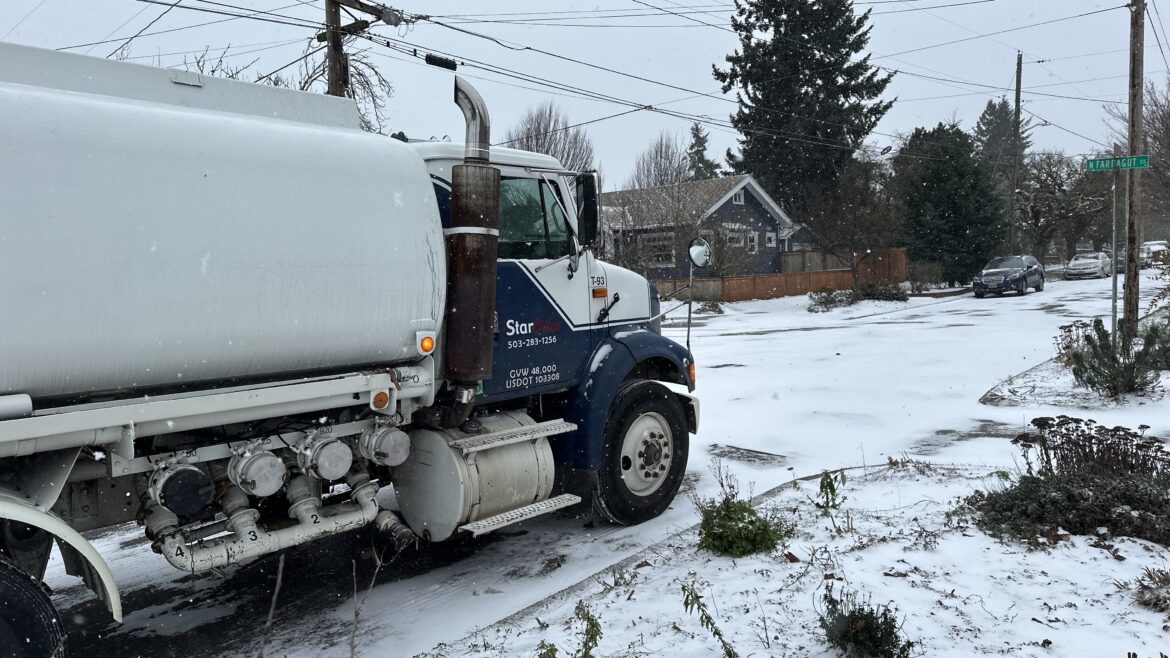
Star Oilco heating oil delivery truck operating in snowy residential neighborhood
In-depth look at Biodiesel as a heating fuel 1024 768 Star Oilco

In-depth look at Biodiesel as a heating fuel

Can you Bio diesel as a Heating Oil Fuel?

In a recent study, the viability of biodiesel – also known as bioheat – and its use as a heating oil was examined.Star Oilco an experienced provider of BioDiesel Heating Oil

TL:DR Biodiesel up to B20 and beyond do not require equipment changes or settings. Home heating systems have used biodiesel since 2000 and have shown no significant issues compared to standard fuel.

The study reviews pump seal performance, metal interactions, burner combustion and even reviews in-the-field users of biodiesel.

Use of biodiesel reduces GHG (Greenhouse Gas) by 50% – 86% compared to petroleum diesel, according to NORA.


In a study from Brookhaven National Laboratory that was submitted to the National Oilheat Research Alliance (NORA), Dr Thomas A. Butcher and Rebecca Trojanowski studied the use of Biofuels in Heating Oil and any possible issues that could result from usage.

Biodiesel mixtures are labeled as B* where the * is the percentage of biodiesel. For example B20 would be 20% biodiesel and 80% petroleum diesel.

By breaking it down into 5 separate studies and a review of actual field use for nearly 20 years, they set out to evaluate the possible fail points of using B20 and higher heating oil blends.

Bio Diesel and Pump Seal Material Evaluation

From the start, the pump shaft seals were identified as the area with the most concern of failure. So, this is where the study began. They identified the most common seals in pumps for North America were nitrile material. The study then focused on this material.

For this part of the study, they took the nitrile material and immersed it in different biodiesel and No.2 fuel blends. They soaked these for 670 hours at 125 °F.  The samples were than checked to see if the hardness changed, looked at swelling, tensile strength, and compression deformation.

Results: There were no significant changes for the nitrite for fuels meeting ASTM standards. This includes biofuel up to B100. The one concern was fuel that had acid numbers above 2 could lead to accelerated degradation. B100 standards call for acid numbers 0.5 and below.

Biodiesel and the Evaluation of Oil Burner Pumps Under Operating Conditions

This second test also dealt with the same seals. The difference in this test was that the pumps were in continuous action. They set up 42 pumps to run for 11 months. A pump would run for 5 minutes and then turn off for a minute. This resulted in 80,000 on/off cycles in a period of 8,030 hours. During this time no leaks were observed in any of the pumps.

Result: There wasn’t any difference in degradation between using B0 and B20.

Exposure of "Yellow Metals" at low temperature with biodiesel

Copper fuel lines are installed in many older oil heating homes. This was due to lower cost and the fact they were easy to manipulate during installation. This could be a problem because No.2 fuel and biodiesel could accelerate the oxidative degradation of the fuels when exposed to copper.

This experiment consisted of using 10 inch tubes filled with different levels of biofuels: B0, B20, and B100. These would be stored at 70 °F  for 6 months in 3 types of tubes: stainless steel, old copper (a fuel line that had been in service for 30 years), and new copper. Most systems only would expose the copper pipes for a very limited time, so 6 months for any exposure is an extreme amount of time.

Results: An acid value of 2 was shown to degrade nitrile material in the earlier experiments. None of the fuel crossed this mark. The closest was B0 in the stainless steel. This fuel got to 1.5 from .04 (where all the fuel started). These tests were considered to represent summer shutdown of a heat-only boiler or furnace.

Exposure of "Yellow Metals" and biodiesel at high temperature

In addition to copper fuel lines, the other major source of yellow metal would be the brass nozzles. Most fuel isn’t in the nozzle long enough to cause any changes, but the fuel left unburned between firings is exposed to higher temperatures then those in the lines. It was decided to try and see if there was changes for this exposure.

The experiment was open top glass beakers with brass and stainless steel nozzles stored in B0, B20, and B100 levels of fuel. This setup was stored in an oven at 175 °F for a week.

Result: The result was a relatively small increase during this time. Even after the experiment was continued for another 4 weeks the numbers represented no significant differences.

Biodiesel Combustion Performance and Flame Sensor Response

The goal of this experiment is to evaluate the proper atomization and combustion performance of biodiesel blends in heating oil systems and to see if there was any issues with flame sensor operation and effectiveness.

The fuel for a home heating oil system requires the fuel to be pushed through a 10 micron filter and then pushed into a fire box at 100 – 150 psi and ignited. This is compared to a diesel engine that have a nominal pore size between 2 and 30 microns and then injected into the system at 20,000 psi.

According to the study, “In comparison to the… diesel engine, heating oil systems are open flame systems and excess air is used to ensure complete combustion. The amount of excess flue gas oxygen is generally between 3% and 6% excess O2 or 15% and 40% excess air to minimize smoke and ensure very low levels of carbon monoxide.” These are usually set by a technician and then re-checked on service calls every 1 or 2 years. “Since properly operating home heating oil systems burn the fuel completely in excess air and emissions are low… Due to this clean combustion, heating oil emissions are typically not measured or monitored, with the exception of smoke and CO.”

The testing was set up first for conventional No. 2 fuel and then adjusted for B100 fuel.

Result: Showed that B20 performed at the same level as regular No. 2 fuel and the bio blend could go all the way up to 50% before the need to adjust the airflow. So, the conclusion was that if the unit is running higher levels of biofuel, the air input needs to be adjust to optimize fuel combustion and reduce CO or smoke.

Review of Field Experience with BioDiesel Blends

Biodiesel blends have been used in the field for heating oil with some using B20 and above since 2005. Part of the study was reviewing customers that have been using B20 above. Of the surveyed providers, none reported a change of any burner or system components.

The report continues to talk about the levels of biofuel that was being used and the condition the fuel was in. Basically it was found that there was no difference from the standard petroleum only fuel.

Conclusion and results of BioDiesel study

  1. Fuels above a certain level of acid content can compromise seals, none of the bio blends reached this and they were statistically similar to petroleum only fuels.
  2. Long term cycling pump showed no leakages with biofuels.
  3. No impact on fuel stored in copper tubing at room temperature was found.
  4. No significant difference on fuel stored with copper at high temperatures and conventional No. 2 fuel.
  5. At higher than B50 concentrations it was found that the burner needed adjusted for best efficiency. B20 will operate at the same level as standard No. 2 fuel.
  6. Finally there appears no real difference in functional use of biofuel vs the use of No. 2 fuel.

So the good news, according to this report, is that if you want to use biodiesel up to B50 there appears no difference in settings or maintenance. As long as a reputable dealer that uses biodiesel that uses ASTM D675 for its B100.

Using biodiesel blends for heating oil reduces greenhouse gases. For more information on this see the NORA report.

B20 Biodiesel Heating oil provider

How to order biofuel as your home heating oil.

Every question Star Oilco has been asked about Heating Oil.

If you want to know a little it more about Bio-fuels and what feedstocks can be used.


Dense cluster of green leaves representing microbial growth
BioGuard Plus 6 Stabilize Your Diesel Tank 1024 683 Star Oilco

BioGuard Plus 6 Stabilize Your Diesel Tank

Fight Humbug in your Diesel Tank!

Fall weather is around the corner and moisture is depositing in your diesel tank.

Treat your diesel; keep things from growing in your diesel.

Prepare your diesel fuel, heating oil, kerosene, or boiler fuel for storage.

Make sure your fuel works when you need it. If you have a bulk diesel tank, stop stuff from growing in your diesel before it starts.

Star Oilco provides complementary diesel fuel quality testing for tanks in our service area.

Valvtect BioGuard Plus 6

Valvtect Plus 6 – Stabilizer and Biocide

Use every spring and winter to guarantee your tank is not providing a habitat to fuel system spoiling microbes.

Water in diesel is a fact of life these days. Biological growth spoiling your fuel quality does not have to be. Ultralow sulfur diesel and biodiesel have water in them. Over time, water entrained in your diesel fuel can fall out of solution. Add to that they condensation that will natural develop in your fuel tank and you have an environment for hum-bug to grow in your heating oil, diesel, or boiler fuel storage tank.


If you are storing diesel for longer than six months you want to stabilize that fuel.

In the summer when temperatures swing at night, your tank is breathing air in and out.  If it is raining, your tank is likely also breathing in the water. With the rainy season and long after it passes, be aware that water is everywhere unless you work to seal it out of your fuel storage system.  You can use a desiccant breather as a way to filter moisture from the atmosphere from getting into our tank.

If your tank does not have a desiccant breather on it, your fuel tank can collect condensation. As air moves in and out of the tank with temperature changes, moisture will collect on the wall of the tank. Yeasts, bacteria, fungi, and algae can grow in that water which collects on the bottom of the tank. Make sure your tank is not a habitat for growing bugs every spring and winter.

Microbiological growth in diesel fuel, also known as “humbug” in fuel, can start growing and if unchecked, will wreak havoc with your fleet. Once it starts in your fuel tank it will spread throughout your fleet. If you see a random need to spin filters between services or odd fuel-related maintenance issues, you likely have bugs growing in your fuel tanks.

Star Oilco recommends BioGuard Plus 6 as a regular biocide for routine maintenance.  

BioGuard Plus 6 is the only EPA certified biocide product that has both a biocide as well as a fuel stabilizer with detergent in one product. This detergent stabilizer acts as an aggressive tank cleaner (NOTE: BioGuard available without Plus 6).

When using Valvtect BioGuard, treat first with a kill, done in your bulk diesel storage. That will spread and kill the growing bugs in your fleet. Maintenance will clean up any remaining bacteria. If you do not have a known or seen problem, a kill twice a year is a great way to guarantee it does not appear and treat the individual tanks of your fleet.

ValvTect BioGuard™ PLUS 6Valvtect BioGuard Plus 6

BioGuard® Plus 6™ is the ONLY EPA registered diesel additive that combines a biocide with a multi-functional diesel additive to prevent bacteria, algae and all other major diesel related problems.

BioGuard Plus 6 is the perfect solution for ultra low sulfur diesel and biodiesel problems; such as bacteria, algae, excess water, sludge, filter plugging, injector wear & deposits, poor fuel economy and unstable fuel.

Only BioGuard Plus 6 prevents bacteria and algae growth, plus:

  • Stabilizes fuel for up to 2 years
  • Prevents rust and corrosion
  • Lubricates pumps and injectors
  • Cleans-up injector deposits
  • Disperses moisture
  • Increases cetane

ValvTect BioGuard Plus 6
“It’s ALL Your Diesel Fuel Needs!”

32 oz Bottle treats 375 Gallons
1 Gallon Bottle treats 1500 Gallons
Also available in 2.5 Gallon Plastic Bottles, 55 Gallon Drums and 300 Gallon Totes

BioGuard ULS Fuel Microbiocide

BioGuard is an EPA registered dual soluble (fuel & water) microbiocide that effectively kills bacteria and fungi that grow in diesel fuel, heating oil and gasoline. It prevents bacteria caused filter plugging and bacteria caused corrosion of the fuel system.

BioGuard typically works in 2-3 hours versus 24-36 hours needed by other biocide products. BioGuard has also been found to be up to twice as effective as other biocides.

This additive can be used in all diesel and gasoline bulk tanks and vehicle tanks, including marine, farm, truck fleet, home heat, generators, and railroad storage tanks.

  • Kills bacteria and other biocontamination quickly
  • Twice as effective as other biocides
  • Breaks up sludge and slime
  • Prevents bacteria plugged filters
  • Prevents bacteria caused corrosion
  • Bottle contains easy measuring spout

16 oz. container treats 460 gallons of diesel fuel at the initial kill treat rate.
16 oz. container treats 920 gallons of diesel fuel at the maintenance treat rate.


For a more in depth description of Valvtect BioGuard Plus 6 please click here.

If you have any questions about routine tank maintenance or to order Valvtect BioGuard products, please don’t hesitate to contact Star Oilco directly by email, message, or phone.

Contact Form

  • This field is for validation purposes and should be left unchanged.

For more information on storing diesel fuel please see the following articles from Star Oilco:

If you are interested in getting a Diesel Storage tank Star Oilco can help.

For a great document on everything diesel we recommend this Diesel Technical Review.

For best practices on storing generator fuel we recommend reading this Emergency Back Up Generator Fuel Storage.

If you are trying to keep your stored diesel dry here is an article we wrote on Desiccant Breathers for your fuel tanks.

If you are looking at getting serious about Diesel Fuel Quality Assurance here is an article we wrote about keeping your diesel cleaner and drier.

Lush farmland with homes and rolling hills in rural Oregon
Farm diesel and gasoline fueling delivery service 1024 417 Star Oilco

Farm diesel and gasoline fueling delivery service

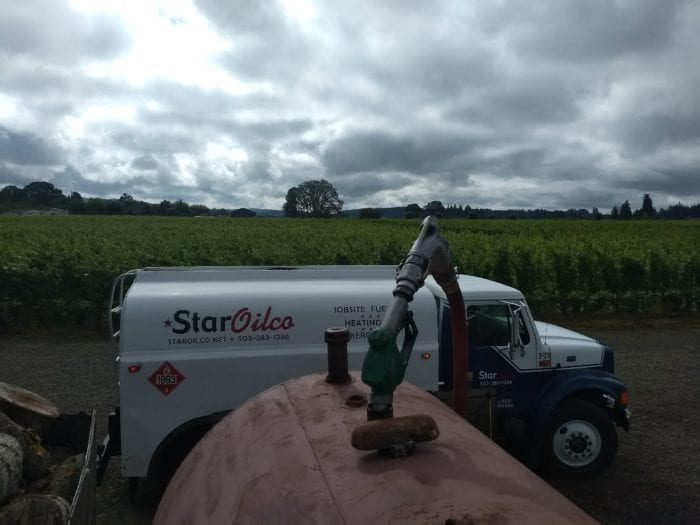
Fueling of a Farm Tank with a Star Oilco Truck.

Diesel and Gasoline Rural Fuel Delivery Service.

Fill your farm, nursery, or homestead fuel tanks now.

Now is the time to order gasoline or diesel for your rural operation.  In Oregon and Washington diesel and gasoline prices risen to a recent high.  Off-road diesel and farm gasoline prices in particular can benefit from a bulk delivery order before the upcoming hurricane season causes fuel price volatility.  Hurricane season usually spikes prices in the Pacific Northwest because they cause national petroleum supply interruptions going into Fall.  Get ahead of the need for fuel.

This is the time to fill your farm fuel tank.

If you have a bulk tank now is the time to order as we are seeing stable prices for diesel and gasoline in the Pacific Northwest.  Order your fuel now, and get a great price before the market changes.  Call us and discuss your need.   We are here to help and make keeping your equipment going when you need the fuel there without a hassle.

Rural Gasoline and Diesel delivery.

Agricultural fuels for farm use.

Call Star Oilco to keep your farm’s tank full.  Whether it’s a 100 to 500 gallons of gasoline and dyed diesel or a 25,000 order of B20 biodiesel.  We are there to serve you to make things easy.  With what is going on, you will not regret having plenty of fuel next to your barn at these market prices.

Star Oilco Crest

Star Oilco is a locally owned Oregon business serving Willamette Valley farms and businesses since 1936.  Veteran owned, locally operated, and committed to your needs here in Oregon and Washington. 

Contact Form

  • This field is for validation purposes and should be left unchanged.

Please see these other posts if you are curious about off-road fuels:

If you have questions about Off Road or Dyed Diesel please see our FAQ

What you need to know about long term diesel storage 

How to fight “Humbug” growing in your diesel tank.

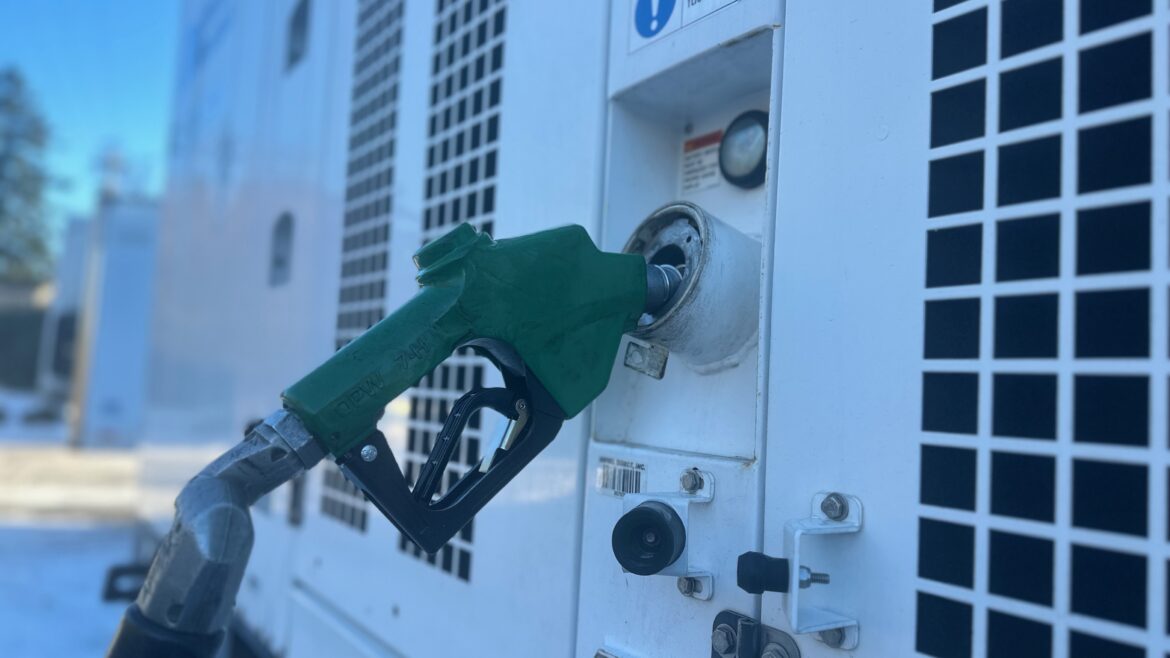
Diesel fuel nozzle filling a refrigerated trailer in winter
Every Question We Have Been Asked About Biodiesel 1024 768 Star Oilco

Every Question We Have Been Asked About Biodiesel

Every Question We Have Been Asked About Bio-diesel

What is biodiesel?

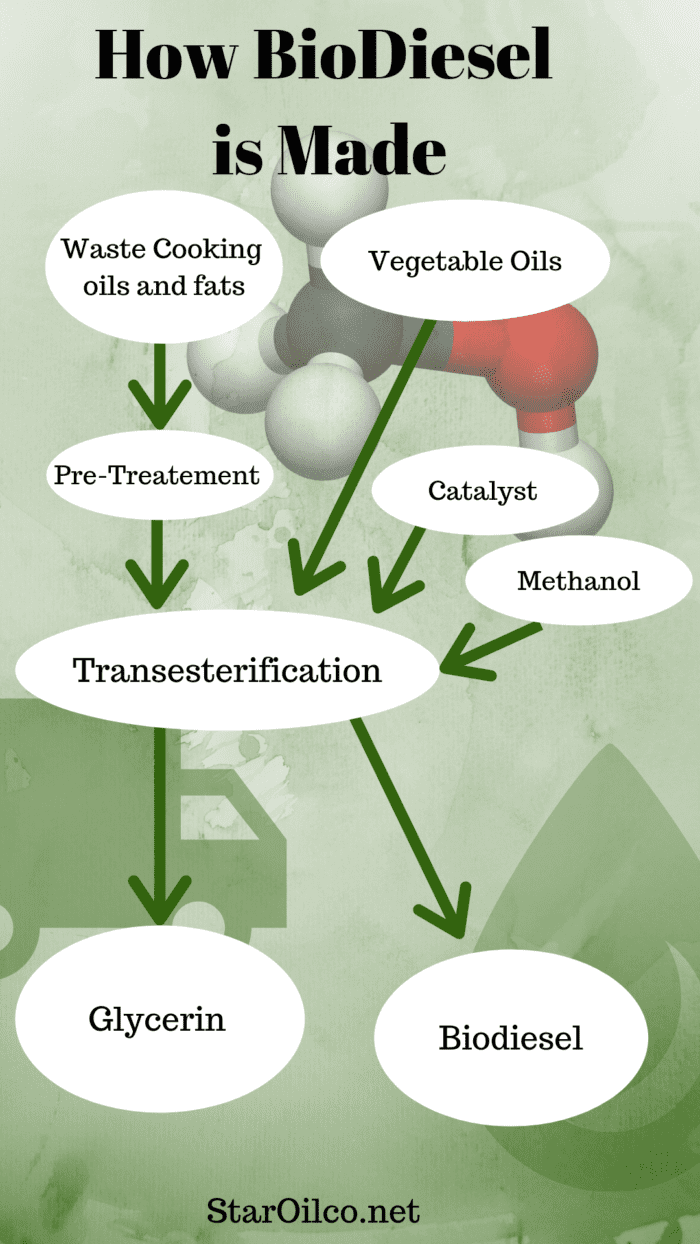
Biodiesel is a renewable, clean-burning diesel replacement that is reducing U.S. dependence on foreign petroleum, creating jobs and improving the environment. Biodiesel is commonly blended in a 5% to 20% component with petroleum diesel and can be found available at retail around North America as a blended fuel.  Biodiesel is a low CO2, net energy positive fuel which depending on the feedstock it is made from can vary from a 30% to 80%+ reduction in CO2 emissions compared to petroleum diesel.  Biodiesel is made from a diverse mix of feedstocks including recycled cooking oil, industrial non-food grade spent oils, animal fats, as well as virgin vegetable oils such as canola, soy, and corn oil. For more information see the National Biodiesel Board’s “Biodiesel Basics” page.Simple Bio-diesel chart showing how to make

How is biodiesel made?

Biodiesel is most commonly made from taking an animal fat, used cooking oil, or a virgin vegetable oil and mixing it with an alcohol (such as methanol). This process is called transesterification and it creates two products glycerin and esters (usually methyl esters or alkyl esters which is the chemical name for most biodiesel).  The crude biodiesel is then further processed to remove excess water and other impurities. The standards for commercially sold biodiesel in the US is ASTM D6751.

What does ASTM D6751 mean?

Biodiesel to be sold in the United States must meet an industry standard which is ASTM D6751.  ASTM (American Society for Testing and Materials) D6751 is the specifications for B100 or 100% Biodiesel.  Biodiesel is usually blended with diesel fuel for retail sale.  This specification defines the properties of the biodiesel from the refiner prior to sale to the public. The properties include things like flashpoint, water content, oxidative stability, sulfur ppm (parts per million), and other specifics that this biodiesel needs to be at in order to hit these standards (Source).

Once a fuel is within all these properties it can be blended with diesel, which has its own ASTM standards, for more about ASTM D975 and other fuel specification concerns please see the Changes in Diesel Fuel – Technicians Guide for more and very in depth information.

Can biodiesel be used in normal diesel engines? / Which cars use biodiesel?

Regardless of where you are in the United States there is a reasonable expectation of purchasing biodiesel in your diesel fuel.  Formally, B5 is supported by all major OEMs selling diesel engines in the U.S. In 2016, at least 78 percent of diesel vehicles supported B20 (Source).  Regardless of what your owner manual says about biodiesel fuel, B20 biodiesel is a proven fuel and is automatically presumed for any new diesels on the road. In many parts of the United States B20 is a commonly found fuel at retail stations, commercial cardlocks, and national truck stop chains.

In the Pacific Northwest, where low CO2 emission policy is front and center, biodiesel can be expected to be found in every gallon of diesel sold in some form.

Oregon law says “All diesel fuel sold in the state must be blended with at least 5% biodiesel (B5) if that fuel is going to be used in vehicles. For the purpose of this mandate, biodiesel is defined as a motor vehicle fuel derived from vegetable oil, animal fat, or other non-petroleum resources, that is designated as B100 and complies with ASTM specification D6751. Renewable diesel qualifies as a substitute for biodiesel in the blending requirement” (Source).  Oregon and Washington has plenty of retail and commercial cardlock locations selling above 5% biodiesel as the defacto fuel given the incentives as well as low CO2 mandates in Oregon.

Can biodiesel be used for heating oil?

Yes. Biodiesel has been effectively used as a heating oil for over 20 years. In fact an in-depth report by the Sustainable Energy Technologies Department Energy Conversion Group shows that blends up to B50 can be used without needing to change or adjust your settings. Read our blog for a summary of this report.

Can biodiesel be mixed with conventional / regular diesel?

Most biodiesel that is sold is as a blended form with petroleum diesel. In a blend, the “B” stands for the amount of biodiesel that is included in the product. For example, B20 would be 20 percent biodiesel and 80 percent petroleum diesel. Biodiesel can also be combined with renewable diesel – a blend of B20 would be called B20/R80 diesel.

Can biodiesel be used in diesel generators?

Yes. In fact, Oregon is one of several states that require biodiesel be blended into all diesel fuels. That means this fuel has been used successfully in the fuel supply for years. As with any fuel that can sit for extended amounts of time, we recommend you take proper precautions, such as using additives, to ensure your fuel is ready to be used when needed. If this is a concern, please contact us – we would love to talk to you about your storage needs.

Can biodiesel be made from animal fat?

Yes, biodiesel refers to (according to the National Biodiesel Board) a methyl ester made from chemically reacting lipids with an alcohol to produce fatty acid esters. This is called transesterification. The lipids could be sourced from many different types of oils, such as vegetable, soybean or animal fat based oils/tallows. For a deeper dive into some of the different types of feedstocks, read our blog.

Can biodiesel be used in airplanes?

Yes and no. There have been several tests using biofuels but fuel for aircrafts is different than regular diesel. Fuel gels at a plane’s flying altitude so aircrafts can’t use regular diesel or biodiesel. Several tests with biofuels have proven successful. Read more about the use of biofuels in the future.

Can biodiesel freeze?

Gelling is the term used for diesel fuel starting to freeze. The paraffin present in diesel starts to solidify and at lower temperatures, it can start to solidify and crystallize. Some blends of biodiesel at B20 and higher will gell at a higher temperatures than petro diesel. During the winter months, it’s important to use additives that combat this or use lower percentages of biodiesel for your fuel. In low enough temperatures, even petro diesel will freeze.

Can biodiesel replace oil? / Can biodiesel replace diesel / fossil fuels?

At this time, no. While the quality of the fuel for biodiesel and renewable diesel is as high as the petrodiesel we have today, the production of these fuels can’t meet the demand that is needed. This has to do with available feedstock and infrasturcture to recycle usable wastes.

The long answer to this question, though, is YES. As technology advances, there may be a time that all fuel is derived from waste and plant crops instead of petroleum.

For an idea where the market is going and how much fuel we are using here is a little bit more information on current usage.

In the early 2000’s, the biodiesel market was about 25 million gallons. In 2016, the market had grown to 2.8 billion and it’s still increasing. The on-road diesel demand is 35 billion to 40 billion gallons. The industry goal is to be producing 10 percent of the transportation market by 2022 (Source).

Which biodiesel is best?

Biodiesel that meets the ASTM D6751 is the best. While making your own biodiesel isn’t hard, keeping the fuel filtered and free of excess water is challenging. Finding a reputable provider that uses fuel that meets specs and also filters and treats your fuel like Star Oilco helps ensure you’re using the best fuel possible.

Which is biodiesel plant/crop? What crop/plant produces/yield biodiesel?

Any plant that produces an oil can be used to produce biodiesel. The plants and crops that are most likely to be used, would produce a lot of oil for the amount of work that goes into growing them. Some of the experimental crops are ones that grow in areas that don’t produce quality food, like Camelina sativa. A member of the mustard family, it grows well in poor soil and harsh conditions and doesn’t displace crops that produce food.

Here are the blogs we have posted so far about some of the biodiesel feedstocks that have been tested and used.

Feedstock: Babassu oil & Beef Tallow
Feedstock: Borage Oil & Camelina Oil
Feedstock: Algae Oil & Canola Oil
Feedstock: Castor Oil and Choice White Grease
Feedstock: Coconut Oil and Coffee Oil
Feedstock: Evening Primrose Oil and Fish Oil
Feedstocks: Hemp Oil & High IV and Low IV Hepar
Feedstocks: Jatropha Oil, Jojoba Oil, & Karania Oil
Feedstocks: Lesquerella Oil & Linseed Oil
Feedstocks: Moringa Oil & Neem Oil
Feedstocks: Palm Oil & Perilla Seed Oil
Feedstocks: Poultry Fat & Rice Bran Oil

Which is better: biodiesel or diesel?

Biodiesel has advantages of producing lower emissions, providing lubricity to the moving parts and being produced in the United States.

Diesel is more abundant, is easily created from crude oil, and has a lower gel point.

Which is better depends on what you are looking for.

Which states mandate biodiesel?

According to AFMP (American Fuel & Petrochemical Manufacturers):

  • Minnesota: Has a B2 requirement year round (September 2005) and a summer requirement of B20 (May 2018).
  • Oregon: Requires a B5 reguirement year round (July 2007).
  • Washington: Requires 2% of the diesel sold in Washington to be biodiesel (December 2008). This can be substituted with Renewable Diesel (July 2009).
  • Pennsylvania: According to AFMP, “2% biodiesel for on-road compression ignition engines one year after annualized in-state production reaches 40 million gallons, 5% biodiesel (100 million gallons), 10% biodiesel (200 million gallons), and 20% biodiesel (400 million gallons)” (July 2008). Renewable diesel can substitute for up to 25% of this requirement, in addition to heating oil and off-road diesel (May 2011)
  • New Mexico: Requires B5 for all diesel vehicles (July 2012).

Which countries produce biodiesel? / Which countries use biodiesel?

global biodiesel production by country
Biodiesel is produced around the world, led by the U.S., Brazil and Germany.

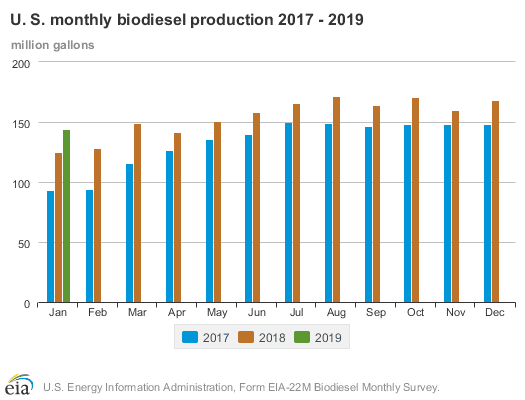
The US produced 6 billion liters in 2017 or about 1.6 billion gallons. This website has the exact numbers for 2017, 2018 and some of 2019 production of biodiesel in the U.S.

Biodiesel in the US is largely made from soybeans at this time.

United States Month Biodiesel Production 2017 to 2019

Will biodiesel damage my engine? / Will biodiesel damage my car?

Biodiesel can be used in any car or engine that is using diesel. Biodiesel is a solvent this means that it may start cleaning the tank or pipes that previously just used petroleum fuel, for this reason fuel filters may clog initially.

How will biodiesel help save money?

It depends! If the price of a barrel of crude rises to a high level, biodiesel can be cheaper. In addition, if RIN’s are available (basically a credit for using biodiesel), they can lower the price of biodiesel and make it less expensive to use and purchase.

How will biodiesel help reduce pollution?

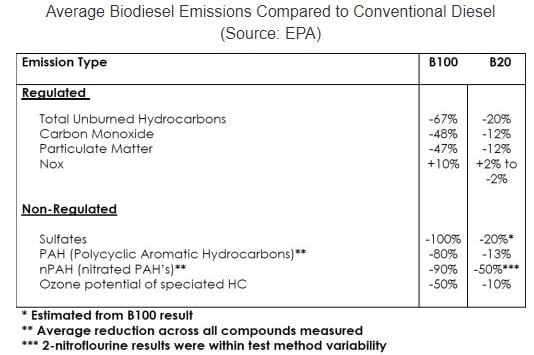
Petrodiesel uses crude oil, which is trapped CO2 from ages past. When it is burned, it releases this CO2 back into the air.Average Biodiesel Emissions Compared to Conventional Diesel When you use biodiesel, you’re using CO2 that is being captured by the growing plants or the waste. This is current CO2 you aren’t adding to the net sum in the environment.

As for regular pollutants, here is a chart that shows what using biodiesel does compared to conventional diesel. There is a significant reduction to pollutants that are expressed through the exhaust.

How long will ecodiesel last? / How long can biodiesel be stored?

Diesel, including biodiesel, does go bad after awhile. Diesel fuels adhering to ASTM specification should be safe for storage up to a year without additional treatment and testing. If you are storing diesel for long term use, it is a good best practice to treat the fuel with a biocide and oxidative stabilizer to ensure that the fuel stays within specification and nothing will begin to grow in your fuel tank. The biggest enemy of long term diesel storage is water and dirt entering the fuel through a tank vent. As temperatures change, a tank will breath, pulling in air and moisture from outside. Keep your fuel within specification by ensuring there is no water in the tank and that outside contaminants can’t get into a tank.

Where biodiesel is used? / Where is biodiesel used in the world?

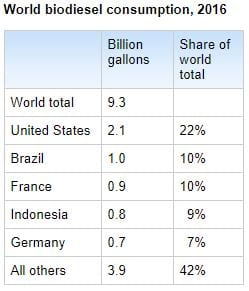
Biodiesel use is encouraged by many countries and usage has increased greatly since 2001. This graph from the U.S. Energy Information Administration shows that the U.S. used 2.1 billion in 2016 or about 22% of the total amount of biodiesel used that year. Wikipedia lists 31 countries and explains the amount of biodiesel they use each year. World biodiesel consumption, 2016

Where to buy biodiesel?

If you live in Oregon, every gas station has at least 5% biodiesel. Cardlock locations throughout the states have stations with biodiesel blends. For other locations, this site is a great resource.

Where can biodiesel be used?

Legally, it can be used anywhere although some biodiesel derived from palm oil is restricted in certain countries.

When / where was biodiesel invented?

The definition of diesel is a liquid that uses compression and oxygen to ignite without the use of a spark. Rudolf Diesel created the diesel engine in Germany. The design for engines first used coal dust suspended in water and later vegetable oils, such as peanut oil. These fuels were later abandoned when petroleum became abundant and cheaper to produce.

Where does biodiesel fuel come from?

In the United States, the primary source for biodiesel is soy beans. According to the U.S. Energy Information Administration, the feedstocks break down as such:

  • Soybean Oil – 52%
  • Canola Oil – 13%
  • Corn Oil – 13%
  • Recycled feedstocks – 12%
  • Animal Fats – 10%

Even with Soybean oil as the primary source, the remaining meal is used to produce food for animal feed. For more information on feedstocks of biodiesel, here is an ongoing blog we have been working on to examine the resulting fuels produced by the various feedstock.

Where are biodiesel plants?

Here is a list of sites in the United States.

When did biodiesel begin?

The original diesel engine ran on peanut oil, so technically biodisesel was first used in the 1890s. Most oils in the 1800s were from bio stocks. It wasn’t until petroleum became abundant and thus cheaper that biofuels and oils were abandoned for this cheaper source.

When does biodiesel gel?

The feedstock determines when biodiesel will gel. The most common feedstock is soy, which has a cloud point of 0°C (32°F) for B100. Petroleum diesel has a cloud point of -45°C (-49°F) to -7°C (19°F) (Source). Cloud point refers to when the paraffin begins to crystallize and the fuel looks a little cloudy.

Biodiesel and petrodiesel is usually blended and this lowers the cloud point of biodiesel in the fuel considerably. In addition, additives are frequently added during cold weather that further lowers the cloud point.

When is biodiesel day celebrated?

National Biodiesel Day is March 18th, which is also Rudolf Diesel’s birthday. August 10th is International Biodiesel Day, a celebration of Rudolf Diesel’s prime model running for the first time on August 10, 1893.

Who invented biodiesel?

The diesel engine is defined by “any internal-combustion engine in which air is compressed to a sufficiently high temperature to ignite diesel fuel injected into the cylinder, where combustion and expansion actuate a piston.” Until petroleum was developed as a cheaper alternative, animal and vegetable oil was used. One of the first fuels used in the diesel engine was peanut oil, and thus biodiesel was born.

Can you use 100% Biodiesel even in the winter?

The answer is YES.  While biodiesel has a lower cloud point then petroleum diesel there is a technology by Optimus Technologies called the Vector System. This allows a truck to start on regular diesel until it gets up to temp and switch over to run on up to 100% biodiesel.  The City of Ames, Iowa is one success story of this technology. (Story Here)


Field of bright yellow sunflowers grown for biodiesel feedstock oil
Biodiesel Feedstocks – Sunflower Oil & Tung Oil 1024 683 Star Oilco

Biodiesel Feedstocks – Sunflower Oil & Tung Oil

We are nearing the end of our journey, as there is only one more blog after this one. If you would like to look back and see all of the feedstocks we have covered start here with our first post.  In this post we explore the feedstocks Sunflower Oil and Tung Oil as we continue our look into different types of feedstock that Renewable Energy Group (REG) studied in 2009 in the Feedstock and Biodiesel Characteristics Report.

Sunflower Oil

The Sunflower oil in this project was purchased from Jedwards, International, Inc.  The common sunflower scientific name is Helianthus annuus. Sunflowers at late afternoon. Flowerheads facing East, away from the Sun.

First domesticated in the Americas the plant was exported to Europe in the 16th century and has become a staple as a cooking ingredient.  According Wildflower.org the common sunflower prefers full sun and well-drained soil. The plant grows up to 8 feet tall and has coarse hairy stems and leaves. The flowers are bright yellow surrounding a central maroon disk, that as it matures, holds the seeds and produces the oil.

The most known uses for sunflower seeds and its oils include; foods, cooking oils and butters. The pressed seed oil is useful for food and the resulting cake (matter left after the oil is harvested) is commonly used as animal food. One of the more interesting uses for the plant is, that it can produce a natural latex in its leaves. This latex can be used to produce hypoallergenic gloves.  The purpose of this post though is to discuss the possibility of biofuel created from sunflower seeds. Biodiesel magazine talks about both the pros and cons for this plant as a feedstock option:

“Because sunflower oil is priced higher than soybean and canola oils, its use as a feedstock for commercial biodiesel refining may be hindered in the U.S. market, according to the National Sunflower Association (NSA). However, there is an interest in the tall golden flowers because the seeds yield about 600 pounds of oil per acre, considerably more than soybeans, which produce a little over 500 pounds per acre.”

Because of the high value of the oil in other areas, using the oil for biodiesel can be cost prohibitive.  Higher concentrates of oil per acre can be vital as more efficiency in  biofuel production becomes necessary. According to Farm Energy, 15,000 to 25,000 plants per acre can be grown.  This means that a small or large farm can use this crop profitably or simply in the production of fuel for that farm.

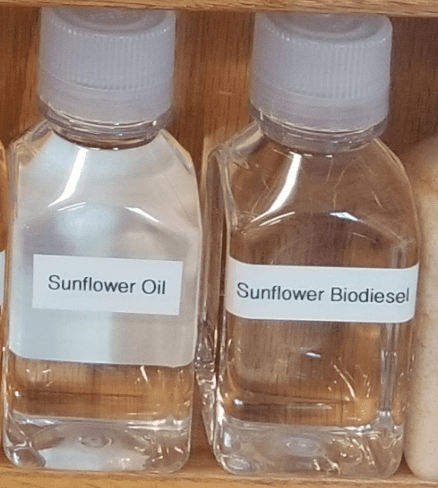
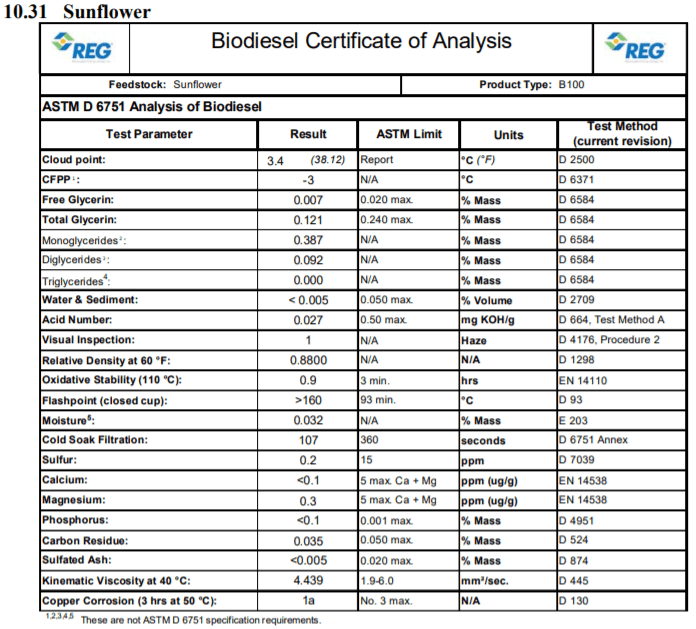
Sunflower Oil and Sunflower biodiesel


Tung Oil

The Tung oil from this study was purchased from Sigma-Aldrich Co. The Tung tree, Vernicia fordii, is native to China and Vietnam.  This tree can be over 60 feet in height and is deciduous. Tung Tree at the Botanical Gardens Faculty of Science Osaka City University, Osaka, Japan According to Texas Invasive Species Institute:

“The bark is smooth, thin, and exudes white sap when cut. The leaves are simple, heart-shaped or with three lobes, and 6-10 inches long. The white flowers have 5 petals with red veins, and they bloom before the leaves emerge. The toxic fruits can grow up to 3 inches in diameter and are reddish green when fully developed.”

This tree is valued for its oil from the seeds.  Traditionally this oil was used in lamps and even as waterproofing on boats.  In more contemporary time this oil is used in varnishes and paint.  This value encouraged the importation of this tree. According to Texas Invasive Species Institute there was over 10,000 acres planted in the United States in 1927.  Cultivation of this tree has waned in the US after frosts and hurricanes destroyed many of the plantations.

This is one feedstock that isn’t part of the food vs fuel controversy.  The Tung tree and its oil is poisons to humans.  Even one seed from the fruit can be fatal, with symptoms including slowed breathing, vomiting and diarrhea.


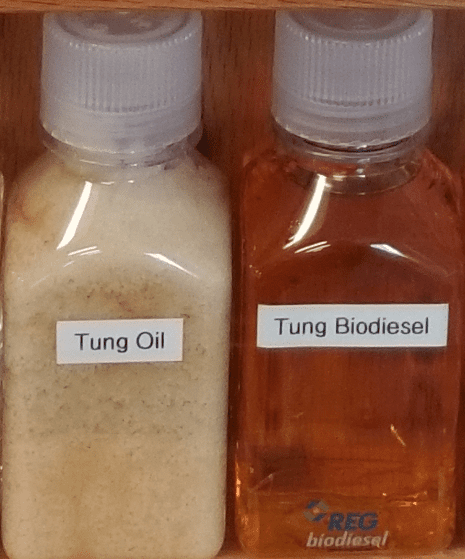
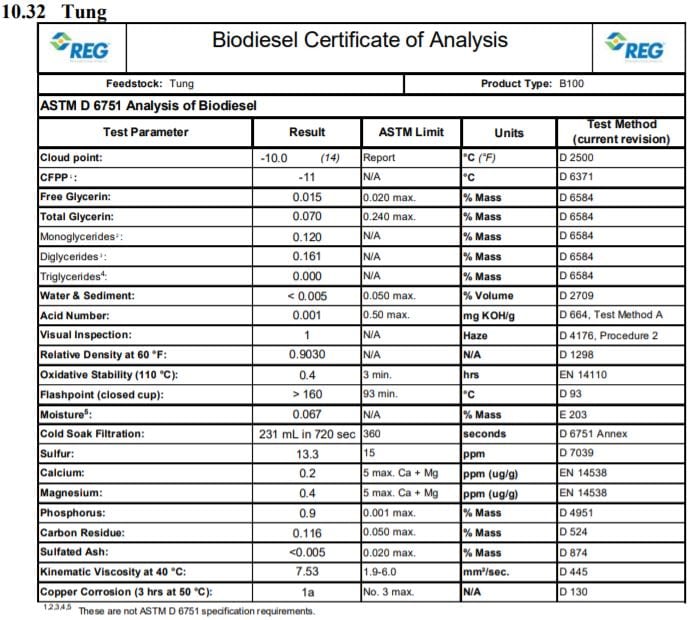
Tung Oil and Tung Biodiesel

Tung Oil/Bio-diesel Certificate of Analysis


Last article for biodiesel feedstocks was – Soybean Oil & Stillingia Oil

If you would like to learn more about bio-diesel you can check out this post Every Question We Have Been Asked About Biodiesel

Portland city skyline with Mount Hood in the background
Diesel Fuel in Portland, Oregon 1024 683 Star Oilco

Diesel Fuel in Portland, Oregon

What is the difference between diesel fuel in Portland, Oregon and the rest of the Pacific Northwest?

Oregon Diesel Fuel

Star Oilco delivers and sells diesel fuel in Portland, Oregon.

We are ready for your diesel needs be they off-road, on-road, biodiesel, renewable diesel, or anything else you want.

Star Oilco has simple fuel solutions to keep your business moving.

On the West Coast, expect biodiesel blends to be in all diesel fuel. B5 biodiesel being the most commonly found fuel. Be aware though, in Oregon,  B20 biodiesel (a 20% blend of biodiesel mixed with petroleum diesel) is extremely common at retail throughout the state. B5 through B20 blends of biodiesel are becoming more common as Oregon’s legal framework regulates CO2 emissions requiring diesel sellers to blend biodiesel or charge substantially more for every gallon they sell.

On top of that, Oregon has a 5% biofuel blend mandate that can include a number of fuels, most commonly biodiesel and renewable diesel. Washington state also has a mandate for 5% biodiesel though it isn’t as specific as the Oregon mandate.

That’s Oregon Diesel. What about Portland?

The city of Portland has a stand-along city fuel tax due to its policy goals (which cause it to codify rules for low CO2 fuels and the sources of diesel in particular), as well as its own budget needs.

Portland, Oregon Diesel Fuel Mandates

A little known fact is that Portland, Oregon has its own biofuels mandate and fuel tax structure on diesel. This mandate affects all diesel equipment both on and off-road use. It does not affect boilers or HVAC systems though most people selling heating oil and boiler fuel are still handling a 5% biodiesel product to ensure they don’t cross fuel in violation of the law.

Functionally, the city of Portland’s mandate and Oregon’s specific mandate do not make a huge difference. Your biggest noticeable difference is the higher price due to the diesel fuel tax, given that Portland’s biofuel mandate now overlaps with Oregon state’s fuel mandates.

For more on the actual code for biofuel mandates in Portland, see the Portland City Code.

Until 2019, Portland had a 5% biodiesel “methylester” mandate. This meant that Portland mandated that all diesel fuel sold inside the city must contain 5% of biodiesel or sellers of fuel inside city limits would face a fine. For years, Portland actually checked every seller of diesel for a 5% biodiesel blend in person annually. This mandate also included feedstocks and did not allow for palm oil sourced biodiesel, as palm oil is responsible for a large amount of deforestation in Indonesia and other places. The Portland mandate required that half of all biodiesel blended to meet the 5% mandate must be derived from canola and waste vegetable oil sources, as Oregon can produce them.

In 2019, the city of Portland suddenly lined up their mandate to match the state of Oregon’s, which allows for renewable diesel to be used as a feedstock. Anything derived from palm is still a barred feedstock for the fuel to meet Portland mandate requirements (which is distinctly different than Oregon’s biofuel mandate).

Onsite Diesel wethose service Portland
Portland, Oregon Diesel Fuel Taxes

(NOTE: Read this article by Star Oilco for more on Oregon Fuel Taxes Explained.

In 2016, the city of Portland, Oregon created its own diesel tax of $.10 a gallon. This tax is on both gasoline and diesel fuels sold at retail or commercially.  If you are operating vehicles over 26,000 GVW that are exempt from Oregon road tax, Portland also has a weight mile for those tax exempt vehicles.

If you are fueling inside the Portland city limits, that diesel tax will be charged at the pump when you fill up unless you are a P.U.C. tax exempted vehicle in Oregon.

Find a list of every diesel and gasoline tax by city and municipalities in Oregon see the Oregon Fuel Tax Group.

If you have any questions about Portland, Oregon diesel fuel standards please feel free to call or message Star Oilco for more information.

Star Oilco is here to be your Bulk Fuel Supplier in Portland, Oregon.

Contact Form

  • This field is for validation purposes and should be left unchanged.


For more on the subject of Diesel fuel please read these other posts by Star Oilco on the subject:

Every Question Star Oilco has been asked about Biodiesel

Every Question Star Oilco has been asked about Off Road Diesel

About Diesel Fuel – Star Oilco’s Diesel Fuel FAQ

Oregon Biodiesel Tax Breaks for Retail Stations