

• 232 NE Middlefield Rd, Portland, OR 97211

Diesel Fuel Quality

A diesel fuel’s cetane rating tells you the ignition quality of the solution — the higher the cetane rating, the easier commercial trucks can start cold. Choosing 1-D fuel gives you more cetane within the mixture, which ends up leaving less room for wear and tear on engine batteries.

Field of bright yellow sunflowers grown for biodiesel feedstock oil
Biodiesel Feedstocks – Sunflower Oil & Tung Oil 1024 683 Star Oilco

Biodiesel Feedstocks – Sunflower Oil & Tung Oil

We are nearing the end of our journey, as there is only one more blog after this one. If you would like to look back and see all of the feedstocks we have covered start here with our first post.  In this post we explore the feedstocks Sunflower Oil and Tung Oil as we continue our look into different types of feedstock that Renewable Energy Group (REG) studied in 2009 in the Feedstock and Biodiesel Characteristics Report.

Sunflower Oil

The Sunflower oil in this project was purchased from Jedwards, International, Inc.  The common sunflower scientific name is Helianthus annuus. Sunflowers at late afternoon. Flowerheads facing East, away from the Sun.

First domesticated in the Americas the plant was exported to Europe in the 16th century and has become a staple as a cooking ingredient.  According Wildflower.org the common sunflower prefers full sun and well-drained soil. The plant grows up to 8 feet tall and has coarse hairy stems and leaves. The flowers are bright yellow surrounding a central maroon disk, that as it matures, holds the seeds and produces the oil.

The most known uses for sunflower seeds and its oils include; foods, cooking oils and butters. The pressed seed oil is useful for food and the resulting cake (matter left after the oil is harvested) is commonly used as animal food. One of the more interesting uses for the plant is, that it can produce a natural latex in its leaves. This latex can be used to produce hypoallergenic gloves.  The purpose of this post though is to discuss the possibility of biofuel created from sunflower seeds. Biodiesel magazine talks about both the pros and cons for this plant as a feedstock option:

“Because sunflower oil is priced higher than soybean and canola oils, its use as a feedstock for commercial biodiesel refining may be hindered in the U.S. market, according to the National Sunflower Association (NSA). However, there is an interest in the tall golden flowers because the seeds yield about 600 pounds of oil per acre, considerably more than soybeans, which produce a little over 500 pounds per acre.”

Because of the high value of the oil in other areas, using the oil for biodiesel can be cost prohibitive.  Higher concentrates of oil per acre can be vital as more efficiency in  biofuel production becomes necessary. According to Farm Energy, 15,000 to 25,000 plants per acre can be grown.  This means that a small or large farm can use this crop profitably or simply in the production of fuel for that farm.
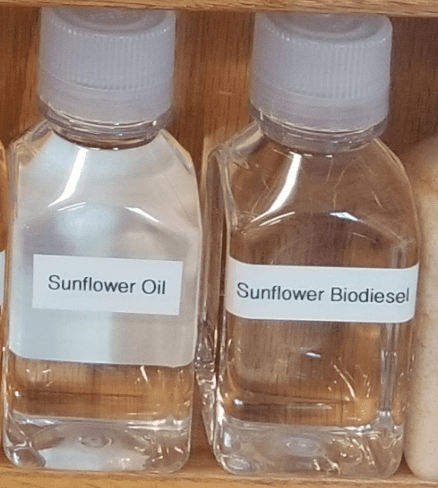
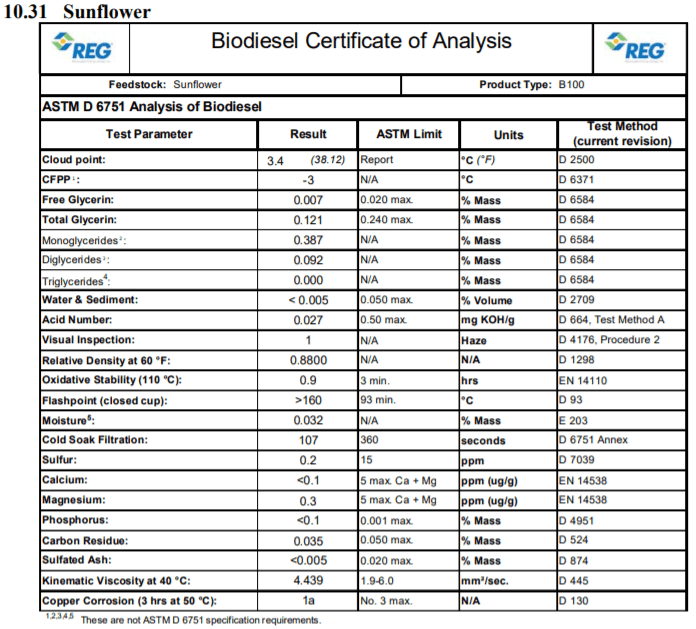
Sunflower Oil and Sunflower biodiesel


Tung Oil

The Tung oil from this study was purchased from Sigma-Aldrich Co. The Tung tree, Vernicia fordii, is native to China and Vietnam.  This tree can be over 60 feet in height and is deciduous. Tung Tree at the Botanical Gardens Faculty of Science Osaka City University, Osaka, Japan According to Texas Invasive Species Institute:

“The bark is smooth, thin, and exudes white sap when cut. The leaves are simple, heart-shaped or with three lobes, and 6-10 inches long. The white flowers have 5 petals with red veins, and they bloom before the leaves emerge. The toxic fruits can grow up to 3 inches in diameter and are reddish green when fully developed.”

This tree is valued for its oil from the seeds.  Traditionally this oil was used in lamps and even as waterproofing on boats.  In more contemporary time this oil is used in varnishes and paint.  This value encouraged the importation of this tree. According to Texas Invasive Species Institute there was over 10,000 acres planted in the United States in 1927.  Cultivation of this tree has waned in the US after frosts and hurricanes destroyed many of the plantations.

This is one feedstock that isn’t part of the food vs fuel controversy.  The Tung tree and its oil is poisons to humans.  Even one seed from the fruit can be fatal, with symptoms including slowed breathing, vomiting and diarrhea.
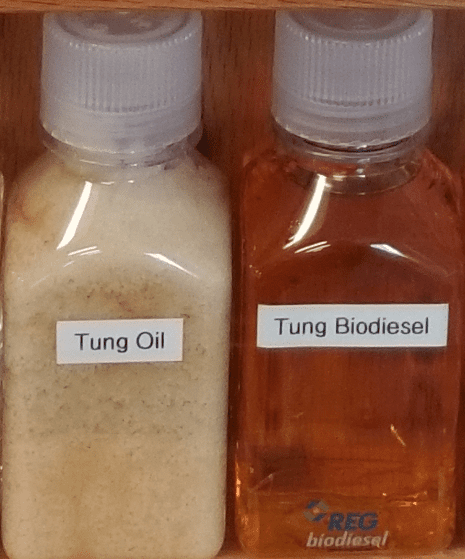
 

Tung Oil and Tung Biodiesel

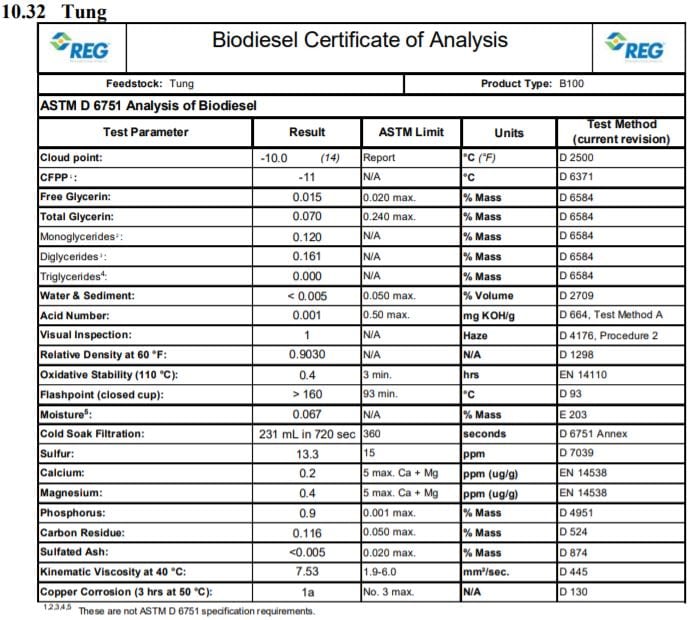
Tung Oil/Bio-diesel Certificate of Analysis


Last article for biodiesel feedstocks was – Soybean Oil & Stillingia Oil

If you would like to learn more about bio-diesel you can check out this post Every Question We Have Been Asked About Biodiesel

Portland city skyline with Mount Hood in the background
Diesel Fuel in Portland, Oregon 1024 683 Star Oilco

Diesel Fuel in Portland, Oregon

What is the difference between diesel fuel in Portland, Oregon and the rest of the Pacific Northwest?

Oregon Diesel Fuel

Star Oilco delivers and sells diesel fuel in Portland, Oregon.

We are ready for your diesel needs be they off-road, on-road, biodiesel, renewable diesel, or anything else you want.

Star Oilco has simple fuel solutions to keep your business moving.

On the West Coast, expect biodiesel blends to be in all diesel fuel. B5 biodiesel being the most commonly found fuel. Be aware though, in Oregon,  B20 biodiesel (a 20% blend of biodiesel mixed with petroleum diesel) is extremely common at retail throughout the state. B5 through B20 blends of biodiesel are becoming more common as Oregon’s legal framework regulates CO2 emissions requiring diesel sellers to blend biodiesel or charge substantially more for every gallon they sell.

On top of that, Oregon has a 5% biofuel blend mandate that can include a number of fuels, most commonly biodiesel and renewable diesel. Washington state also has a mandate for 5% biodiesel though it isn’t as specific as the Oregon mandate.

That’s Oregon Diesel. What about Portland?

The city of Portland has a stand-along city fuel tax due to its policy goals (which cause it to codify rules for low CO2 fuels and the sources of diesel in particular), as well as its own budget needs.

Portland, Oregon Diesel Fuel Mandates

A little known fact is that Portland, Oregon has its own biofuels mandate and fuel tax structure on diesel. This mandate affects all diesel equipment both on and off-road use. It does not affect boilers or HVAC systems though most people selling heating oil and boiler fuel are still handling a 5% biodiesel product to ensure they don’t cross fuel in violation of the law.

Functionally, the city of Portland’s mandate and Oregon’s specific mandate do not make a huge difference. Your biggest noticeable difference is the higher price due to the diesel fuel tax, given that Portland’s biofuel mandate now overlaps with Oregon state’s fuel mandates.

For more on the actual code for biofuel mandates in Portland, see the Portland City Code.

Until 2019, Portland had a 5% biodiesel “methylester” mandate. This meant that Portland mandated that all diesel fuel sold inside the city must contain 5% of biodiesel or sellers of fuel inside city limits would face a fine. For years, Portland actually checked every seller of diesel for a 5% biodiesel blend in person annually. This mandate also included feedstocks and did not allow for palm oil sourced biodiesel, as palm oil is responsible for a large amount of deforestation in Indonesia and other places. The Portland mandate required that half of all biodiesel blended to meet the 5% mandate must be derived from canola and waste vegetable oil sources, as Oregon can produce them.

In 2019, the city of Portland suddenly lined up their mandate to match the state of Oregon’s, which allows for renewable diesel to be used as a feedstock. Anything derived from palm is still a barred feedstock for the fuel to meet Portland mandate requirements (which is distinctly different than Oregon’s biofuel mandate).

Onsite Diesel wethose service Portland
Portland, Oregon Diesel Fuel Taxes

(NOTE: Read this article by Star Oilco for more on Oregon Fuel Taxes Explained.

In 2016, the city of Portland, Oregon created its own diesel tax of $.10 a gallon. This tax is on both gasoline and diesel fuels sold at retail or commercially.  If you are operating vehicles over 26,000 GVW that are exempt from Oregon road tax, Portland also has a weight mile for those tax exempt vehicles.

If you are fueling inside the Portland city limits, that diesel tax will be charged at the pump when you fill up unless you are a P.U.C. tax exempted vehicle in Oregon.

Find a list of every diesel and gasoline tax by city and municipalities in Oregon see the Oregon Fuel Tax Group.

If you have any questions about Portland, Oregon diesel fuel standards please feel free to call or message Star Oilco for more information.

Star Oilco is here to be your Bulk Fuel Supplier in Portland, Oregon.

Contact Form

  • This field is for validation purposes and should be left unchanged.


For more on the subject of Diesel fuel please read these other posts by Star Oilco on the subject:

Every Question Star Oilco has been asked about Biodiesel

Every Question Star Oilco has been asked about Off Road Diesel

About Diesel Fuel – Star Oilco’s Diesel Fuel FAQ

Oregon Biodiesel Tax Breaks for Retail Stations

Downtown Portland street view with iconic Portland sign
Oregon Biodiesel and Ethanol Fuel Mandates 1024 640 Star Oilco

Oregon Biodiesel and Ethanol Fuel Mandates

Oregon Biofuel Blending Requirements for Gasoline and Diesel.

Oregon law has a 5% Biodiesel and 10% Ethanol fuel blend mandate.


In Oregon, you can expect to buy a biofuel with every gallon of gas or diesel, whether you are buying at a retail pump or commercially delivered bulk fuel. Unless you are expressly seeking out a ethanol-free premium unleaded or off road heating oil expressly free of biodiesel, you can expect the fuel will have a low carbon blend of biofuel in it.

Why does Oregon have biofuel blended in every gallon of fuel?

There are several layers of rules, requirements, and incentives placing a minimum of 5% biodiesel blend in diesel and a 10% ethanol blend in gasoline. The City of Portland’s Bureau of Development Services provides information and resources on the background of both Portland and Oregon’s requirements.

Oregon state has a 5% blend mandate for all diesel fuels sold statewide. Portland has its own standard of for 5% biofule in diesel, which is slightly different but functionally the same as the states. Oregon’s standard requires B5/R5 if it’s sold into  machinery (dyed off road or clear on road diesel), which requires a 5% biofuel component. In the  formation of this Oregon statewide mandate, renewable diesel was considered acceptable.

Oregon also has a 10% ethanol blend mandate for all gasoline fuels with a few exceptions. Portland has this same rule as it mandated ethanol blends prior to Oregon state. Oregon has exceptions for ethanol-free premium unleaded.  (Warning: the City of Portland has no exemption for non-oxygenated premium fuels) though there are some sellers of it. Oregon state’s exceptions being premium gasoline for aviation and non-ethanol premium gasoline sold at retail gas stations. This was adopted later after the initial Renewable Fuel Standard mandates. Portland did not follow Oregon with this flexibility for small engine or classic car enthusiasts seeking non-ethanol fuel.

The rules that drive biofuel use in Oregon’s fuel:

The City of Portland has its own Renewable Fuel Standard (RFS) which is seen in Portland City Code Chapter 16.60 Motor Vehicle Fuels. This RFS requires all diesel sold (either commercial or retail fuel) to contain a minimum 5% biodiesel (specifically methyl-ester molecule). The RFS also requires all gasoline sold (either commercial or retail gas stations) to contain a 10% blend of ethanol. In addition to this fuel blend requirement, Portland also has requirements for the original feedstock biodiesel is made from. Portland requires that 50% of the biodiesel feedstock be sourced from recycled vegetable oil, canola oil, and a few other types available in the Pacific NW.

The State of Oregon has its own Renewable Fuel Standard. It is less restrictive than Portland’s, allowing renewable diesel or biodiesel to meet its 5% blend requirement. You can find the law in Oregon Revised Statute 646.922. The Oregon RFS also requires a 10% ethanol to be blended with gasoline. There is an exception for premium gasoline to be ethanol-free.  This fuel is commonly called “Non-Oxy Premium” or “Clear Premium” by those seeking to order it.

If you want more information on successfully using Biodiesel and Ethanol in your fleet.

If your fleet is seeking to succeed with biofuels, here are some great resources to learn more about biodiesel, ethanol,  and renewable diesel fuels.

If you have questions about biofuels, Star Oilco can help. Do not hesitate to reach out if you have questions, even if you are not in our market. We want you to be successful in your fleet.  We are here to help.

Contact Form

  • This field is for validation purposes and should be left unchanged.
Close-up abstract image of diesel fuel with suspended droplets and fluid motion
Fixing the problems with bugs growing in your diesel 1024 512 Star Oilco

Fixing the problems with bugs growing in your diesel

What to do about Biological Growth in Diesel Fuel.

Fuel Marketer News has two great articles on biological growth in fuel tanks. Star Oilco as a diesel fuel delivery provider in Oregon and Washington is all to familiar with this emerging problem with ultra-low sulfur bio-diesel blend fuels.

Where there is water, bugs can grow in diesel.

The Fuel Marketer News articles below:

Fuel System Bugs Drain Revenue, and
Bugs Cause Fuel System Damage (part 2)

These articles in a nutshell are about the costs, impact, and ongoing effect of bugs growing in fuel as a real industry issue. If you have filters clogging in your fleet–much like a heart attack–it’s not a symptom, it’s a late-stage problem. Clogged filters slow down your fleet fueling and add serious cost to your vehicle maintenance. Lost power on the highway also slows your drivers down, escalating the drain on efficiency fuel that bugs may be causing.

Star Oilco can cure these problems, both with stopping hum-bug growing in your diesel tanks, as well as ensuring that the water those fuel bugs live in stops migrating into your tank. We will help you solve diesel fuel quality issues.

The first step is for Star Oilco to test the bottom of your fuel tank, as well as take a representative nozzle sample that would go into your trucks. We will show you where your fuel quality is today and come up with a collaborative way to move that into exceeding ASTM diesel specification, as well as aligning with engine manufacturer’s ISO specifications for diesel fuel cleanliness.

If you have questions about fuel quality assurance, Star Oilco has solutions. Left unattended, your diesel fuel will grow bugs, alga, yeasts, and other biological active destroyers of fuel quality. If you need to treat your fuel to kill humbugs like these, Star Oilco recommends Bioguard Plus 6 as your go-to solution. It is both a biocide that kills the bugs growing in fuel, as well as a heavy duty detergent to clean up other deposits as well.

Star Oilco Precision Fuel Management tank test request form below:

Tank Testing Form

  • This field is for validation purposes and should be left unchanged.
Close-up of clean diesel fluid stream with light reflections
Tier 4 Engines and Diesel Contaminants – Donaldson White Paper 683 1024 Star Oilco

Tier 4 Engines and Diesel Contaminants – Donaldson White Paper

Managing bulk diesel fuel storage has become more complex in recent years. Especially in Oregon and Washington the chance of water finding it’s way into your fuel tank is a real concern. If water gets in your bulk fuel biological growth or “hum bug” won’t be far behind.  Donaldson has positioned itself with real concrete solutions for for fuel quality.

With the extremely tight tolerances of today’s clean diesel engines and the expansion of sour crudes from tar sands, oil shale, and other source being hydrocracked into today’s ultra low sulfur diesel we have all seen it.  Fuel quality has stayed the same while the tolerance engine manufacturers build to have gotten tighter.

To help fleets solve the fuel quality issues fleet’s are dealing with these days Donaldson Filters has put out an intensive white paper on the what clogs filters.

Titled “Analysis and Identification of Contaminants in Diesel Fuel Filtration and Storage Systems” it goes into a level of depth of what the causes of filter spinning in your fleet is. If you are seeing clogged fuel filters this can help you diagnose and begin to problem solve for your fleet.

Usually diesel engine maintenance costs spin out of control around injector failure, DPF maintenance down time, and recurring regen cycles at the most inconvenient times blowing white smoke everywhere.  Usually this fleet management pain point revolves around dirt and water in diesel fuel.  Problems that Donaldson Filtration is the industry leader in solving.  Aggressive filtration and desicant breathers on tanks will polish your fuel beyond the low standards of petroleum standard ASTM and will exceed the ISO cleanliness standards the OEM’s made your engines to run.

This document is designed as and essential review of diesel contamination as it’s seen from the perspective of a filtration company guarding your diesel engine systems from problems.

This matters as the current generation of clean diesel technology commonly called “Tier 4” engines have a tighter specification need than industry standard diesel specification will meet in practice in the field.


The Donaldson Filters White Paper can be seen here: http://www.mycleandiesel.com/Resources/IFC10_FuelContaminants.pdf