
Star Oilco

3D illustration of a gas pump icon made from green leaves symbolizing biofuel
Renewable Diesel or Biodiesel for Trucks? 1024 753 Star Oilco

Renewable Diesel or Biodiesel for Trucks?

The Fuel Revolution

In the realm of sustainable energy, the race for cleaner and more efficient fuels is a top of mind priority for the majority of the industry. As heavy-duty trucks continue to dominate our highways and play a pivotal role in transporting goods across the country, the choice of fuel is paramount. The two most common fuels used throughout the PNW for greener transportation are: Renewable Diesel and Biodiesel. In this blog, we’ll take a deeper look into the power generation of these fuels, highlighting the key differences between them and citing relevant studies that illuminate their qualities. 

3D illustration of a gas pump icon made from green leaves symbolizing biofuel

Renewable Diesel: The New Age Wonder Fuel 

Renewable Diesel, often referred to as “green diesel,” or R99 is a high-quality alternative fuel that shares many characteristics with traditional diesel. However, it is derived from renewable feedstocks, such as vegetable oils, animal fats, and waste greases, through a process called hydrotreating. This process not only produces a cleaner-burning fuel but also eliminates impurities and aromatics found in traditional diesel. The result is a fuel with significantly lower emissions and enhanced performance. 

Lower Emissions:

Perhaps the most significant advantage of renewable diesel is its environmental footprint. Studies, like the one conducted by the National Renewable Energy Laboratory (NREL), have shown that renewable diesel can reduce greenhouse gas emissions by up to 80% compared to standard diesel. This drastic reduction in emissions makes it a vital fuel in the efforts to combat climate change. 

Better Fuel Economy:

Renewable diesel boasts a higher energy content than biodiesel, allowing vehicles to travel more miles per gallon. A study by the California Air Resources Board (CARB) demonstrated that renewable diesel can improve fuel efficiency by 5-7% compared to biodiesel. For the trucking industry, this translates to significant cost savings. 

Compatibility:

One of the standout features of renewable diesel is its compatibility with existing diesel engines and infrastructure. Heavy-duty trucks can make the switch to renewable diesel seamlessly, without requiring any engine modifications or special storage facilities. 

Reduced Maintenance:

Studies like the one from the University of California, Riverside, have indicated that renewable diesel can lead to reduced engine wear and lower maintenance costs. The fuel’s superior lubricity and cleaner combustion help extend the lifespan of engine components. 

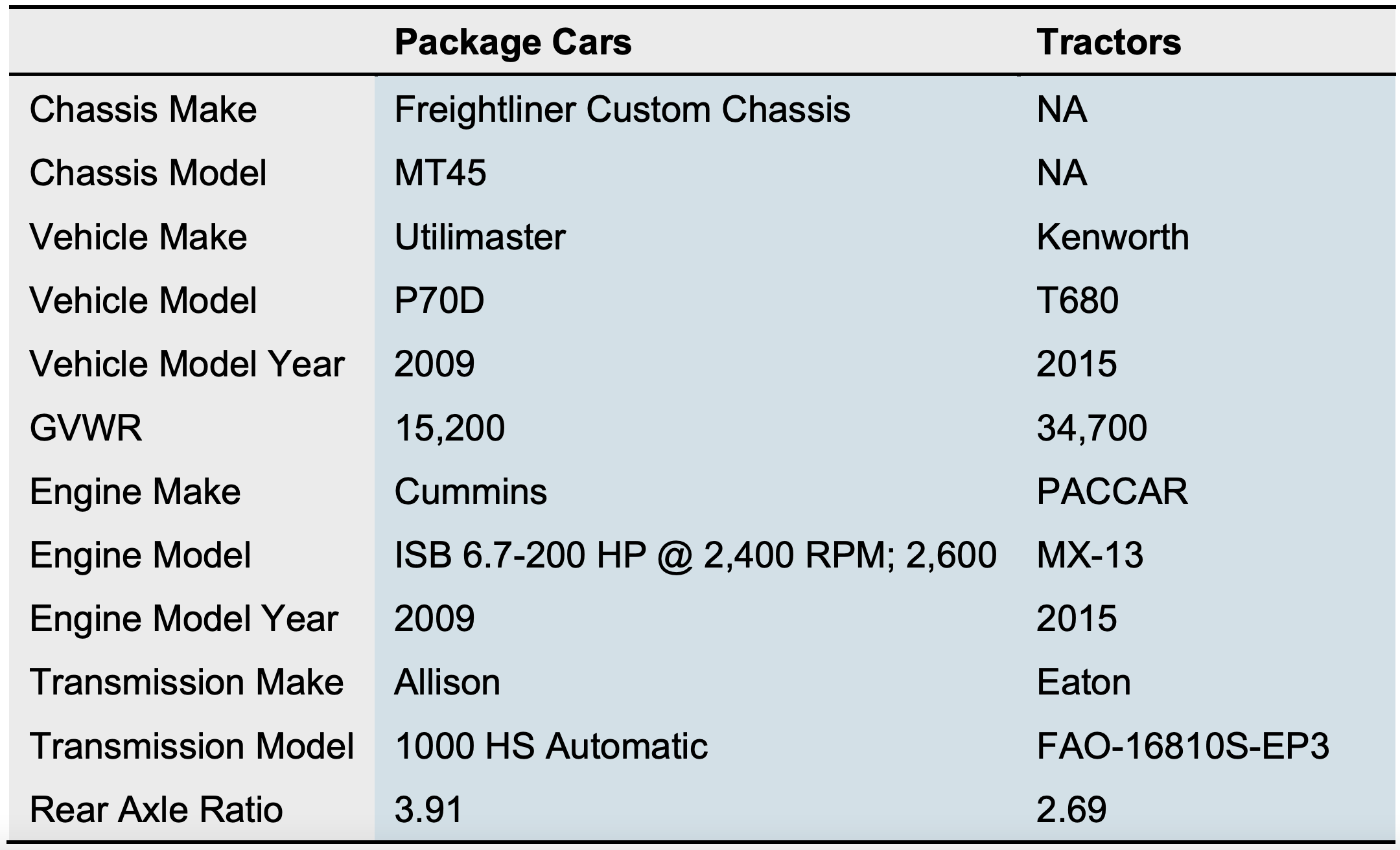
In 2015, NREL ran a study in partnership with the UPS and the Clean Cities Coilation to compare the fuel economy and overall impact of renewable diesel compared to petrelem diesel in 12 USP delivery vehicles operating out of Houston. The results of this study were that renewable diesel reduced carbon emissions by 4.2% comparatively to petroleum diesel. This finding is a result of the properties of renewable diesel given its higher mass-based heating value and lower carbon-hydrogen ratio. 

The UPS is one of the largest user of renewable diesel in the world. In 2015 UPS announced their plans to purchase over 40 million gallons of the sustainable fuel over the next three years (2015-2018). UPS was supplied this renewable diesel by Solazyme (now known as TerraVia).  

Below is a breakdown of the vehicles used in the study.

https://www.nrel.gov/docs/fy18osti/68896.pdf

BIODIESEL

Biodiesel, often derived from vegetable oils or animal fats through a process called transesterification, has been around for a while and has made significant strides in reducing emissions compared to traditional diesel. However, when pitted against renewable diesel, there are some critical differences.

The Limitations of Standard Biodiesel

Emissions:

While biodiesel is undoubtedly cleaner than traditional diesel, studies like the one published in the Journal of Environmental Science and Technology show that its greenhouse gas reduction potential is not as remarkable as that of renewable diesel. The production process of biodiesel also consumes substantial energy, offsetting some of its environmental benefits. 

Performance:

Biodiesel’s energy content is lower than that of renewable diesel, resulting in decreased fuel efficiency. Research from the University of Nevada, Reno, indicates that biodiesel can lead to a 3-10% reduction in fuel economy compared to renewable diesel. 

Cold Weather Performance:

Biodiesel has a higher cloud point and gel point than renewable diesel, making it less suitable for cold-weather operations. Trucks operating in regions with harsh winters may encounter issues with fuel gelling, potentially causing operational disruptions. 

Compatibility Challenges:

Biodiesel’s higher viscosity can lead to filter plugging and injector coking in some older diesel engines. This issue necessitates additional maintenance and potentially costly modifications. 

Close-up of green, yellow, and blue fuel nozzles at a diesel pump station

The Road Ahead: Renewable Diesel’s Triumph 

In the comparison of Renewable Diesel vs. petroleum diese for heavy-duty trucks, renewable diesel emerges as the clear winner. Its lower emissions, superior fuel economy, compatibility with existing infrastructure, and reduced maintenance requirements make it a game-changer in the transportation industry’s quest for sustainability. 

Studies across the board indicate that renewable diesel outperforms standard biodiesel in terms of environmental benefits and cost savings. For heavy-duty truck operators looking to reduce their carbon footprint and improve their bottom line, renewable diesel is undoubtedly the fuel of the future. 

In the quest for a greener future, renewable diesel has firmly taken the lead. Its remarkable reduction in emissions, better fuel economy, and seamless integration into existing diesel infrastructure make it the go-to choice for heavy-duty truck operators. While standard biodiesel has made commendable progress in reducing emissions, renewable diesel emerges as the winner in the arena of cleaner and more efficient fuels. 

The studies quoted in this blog are just the tip of the iceberg, illustrating the overwhelming evidence in favor of renewable diesel. As we move forward in our pursuit of sustainable transportation, it’s clear that renewable diesel will play a pivotal role in driving us toward a cleaner, more environmentally friendly tomorrow. 

Sign up for our newsletter to stay up to date

Name(Required)

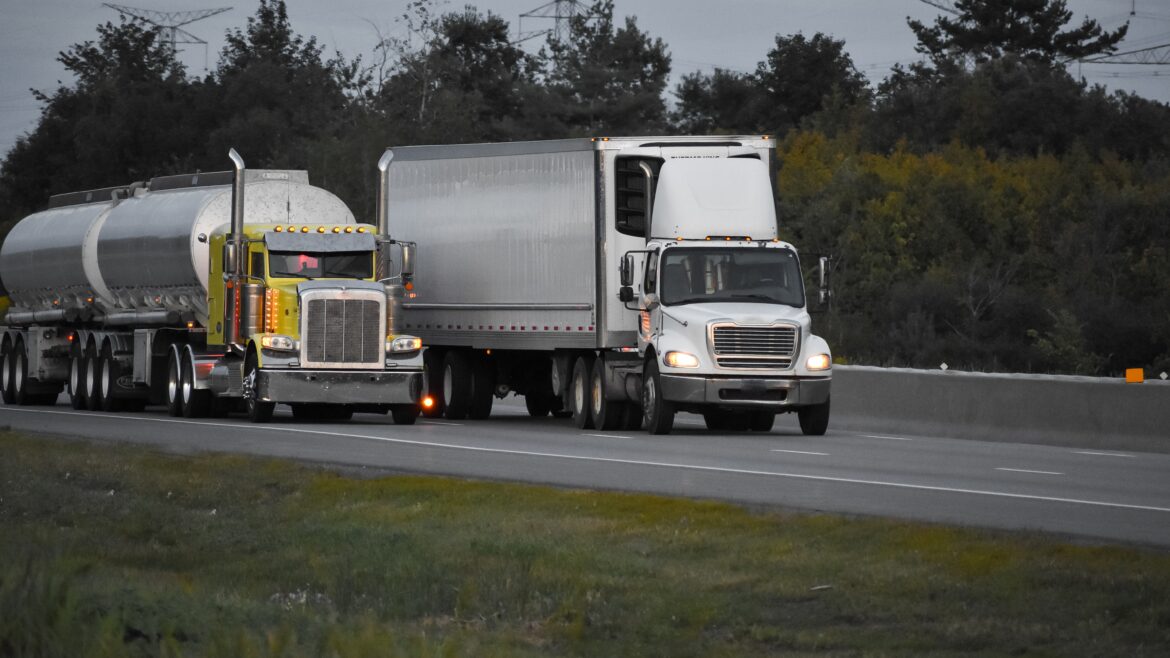
Two semi-trucks driving on a highway with trees in the background
Weekly Fuel Market Report – July 12-18, 2026 1024 683 Star Oilco

Weekly Fuel Market Report – July 12-18, 2026

fuel-market-report-star-oilco
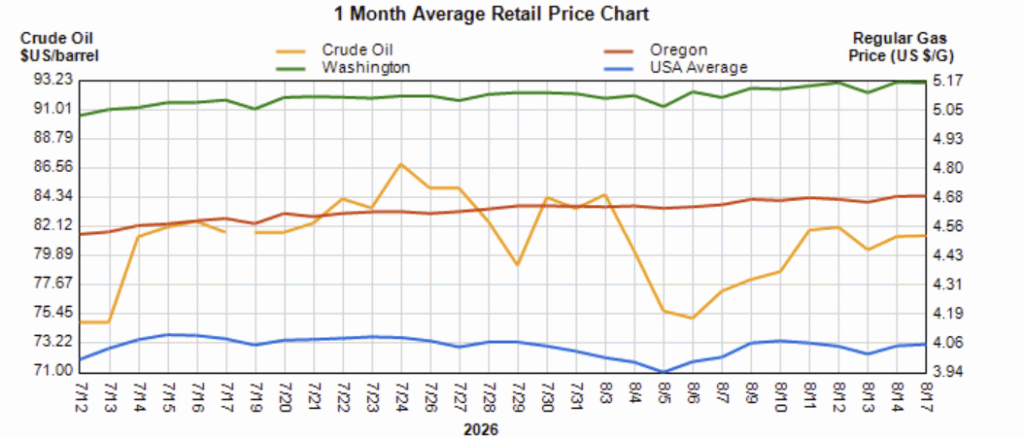
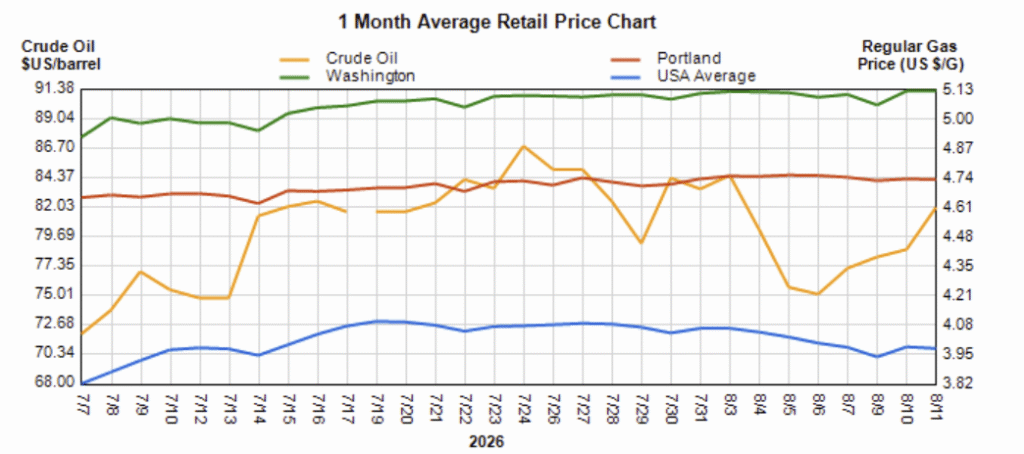
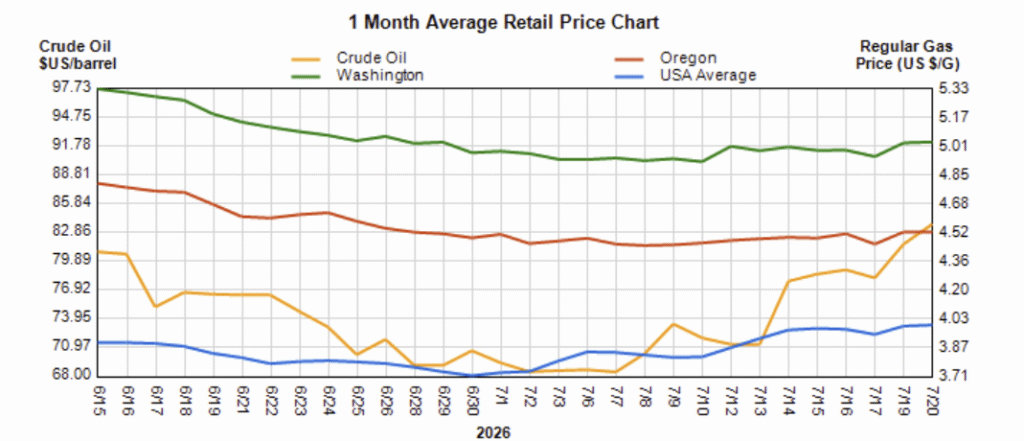
Line chart titled '1 Month Average Retail Price Chart' showing trends for crude oil, Washington and Oregon gas prices, and US average regular gas price from May to July 2026. Left axis shows crude oil and gas price levels; right axis shows regular gas price in US$/gal.

Did You Know That R99 Is The Same Cost As Diesel Currently?

Call to set up R99 Mobile Fueling Onsite Service in Portland at the same cost of retail diesel. Dyed untaxed R99 is also available. Give us a call today to schedule your delivery.

Wholesale Price Average 7/18/26

Wholesale LowWholesale Avg
E10$3.29$3.48
B5$4.06$4.24
B20$4.02$4.19
R99$3.67$3.75

Average Retail Prices 7/18/26

NationalOregonWashington
E10$4.00$4.65$5.11
B5$5.11$5.49$6.05

Taxes

FederalState: ORLocalState: WA
Gas$0.184$0.40$0-.13$0.494
Diesel$0.244$0.40$0-.13$0.494

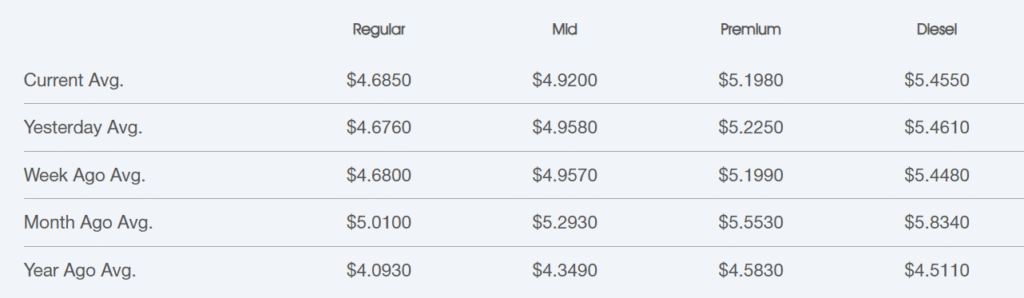
Portland Retail Fuel Price Variance

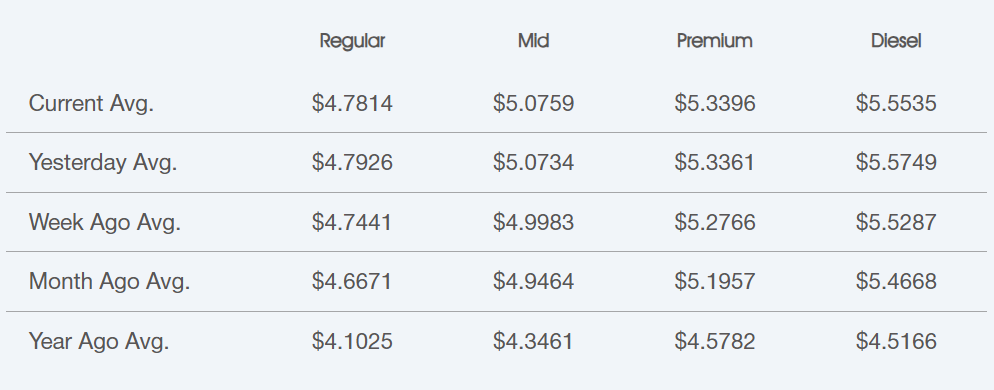
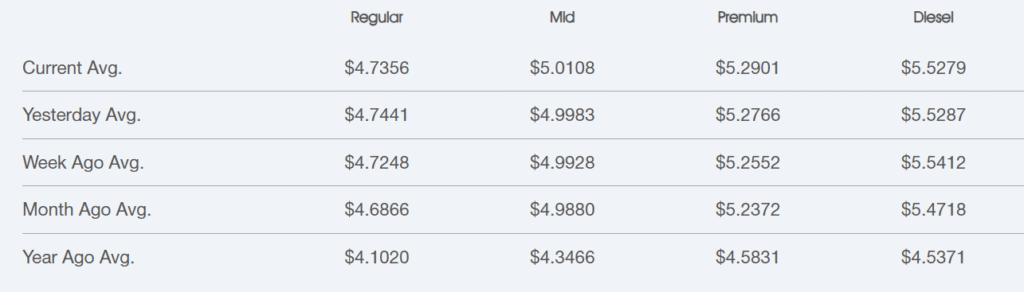
Table of average gas prices by type (Regular, Mild, Premium, Diesel) across times: Current, Yesterday, Week Ago, Month Ago, Year Ago

Fuel Market News

Fuel prices soared this past week again as the U.S & Iran peace agreement has entirely collapsed. The most recent military strike by Iran hit U.S bases in Jordan, killing multiple US service men/women. This war has no end in sight, and the general public in the U.S remains very uninformed as to why the peace agreement continues to be violated. The national average gas price is yet again over $4.00/gal. As fuel prices climb once again and the average American struggles with continued inflation, the US government has spent over 3 trillion dollars of taxpayers’ money fighting an unexplained war in the Middle East.

Retail gas prices in Portland are just under $5/gal, averaging around $4.85/gal, while the Seattle area is currently $5.56/gal.  Retail diesel prices in Portland are just under $6/gal at a current average of $5.59/gal, while the Seattle area is over $6.37/gal. Crude oil is up $20/barrel in the last 12 days.

fuel-market-report-star-oilco-5-18-24

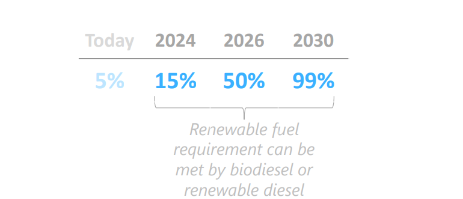
Important Note: Per the City Of Portland, “Distributors in the City of Portland are required to meet the minimum biofuel content requirements for all fuel they distribute beginning on May 15, 2024. All diesel fuel distributed to retail stations, non-retail dealers, or wholesale purchaser-consumers must include a minimum of 15% biofuel content, from either renewable diesel or biodiesel. This requirement increases to 50% on May 15, 2026, and 99% on May 15, 2030”.

Crude oil has jumped over $15/barrel and is currently hovering just above $90/barrel, at a current price of  $90.81/barrel.

Crude oil is the main ingredient for gasoline and diesel. Per AAA, on average about 50% of what you pay at the pump is the price of crude oil, breaking down as 25% refining, 11% distribution & marketing, and 14% taxes – a helpful breakdown for consumers wondering why they are paying the prices that they pay. Crude Oil is currently trading at $90.81/barrel compared to $83.57/barrel last week and $73 a year ago.

It’s essential to recognize that fuel prices result from a complex interplay of the factors mentioned above and other regional factors. Additionally, prices may vary by specific regions within Oregon and Washington. For the most precise and up-to-date information on fuel prices and the causes for these price changes within your area, use the links below for AAA & GasBuddy.

If you have any questions, feel free to contact Star Oilco and speak to one of our fuel market advisors to discuss how the market can impact your business.


Set up your R99 Mobile Fueling Onsite Service in Portland Today Including Dyed Untaxed R99.

Give Us A Call Today

For other news in the fuel market:

https://gasprices.aaa.com/?state=OR

https://www.gasbuddy.com/charts

Join the Fuel Market Report newsletter for your weekly fill of updates!

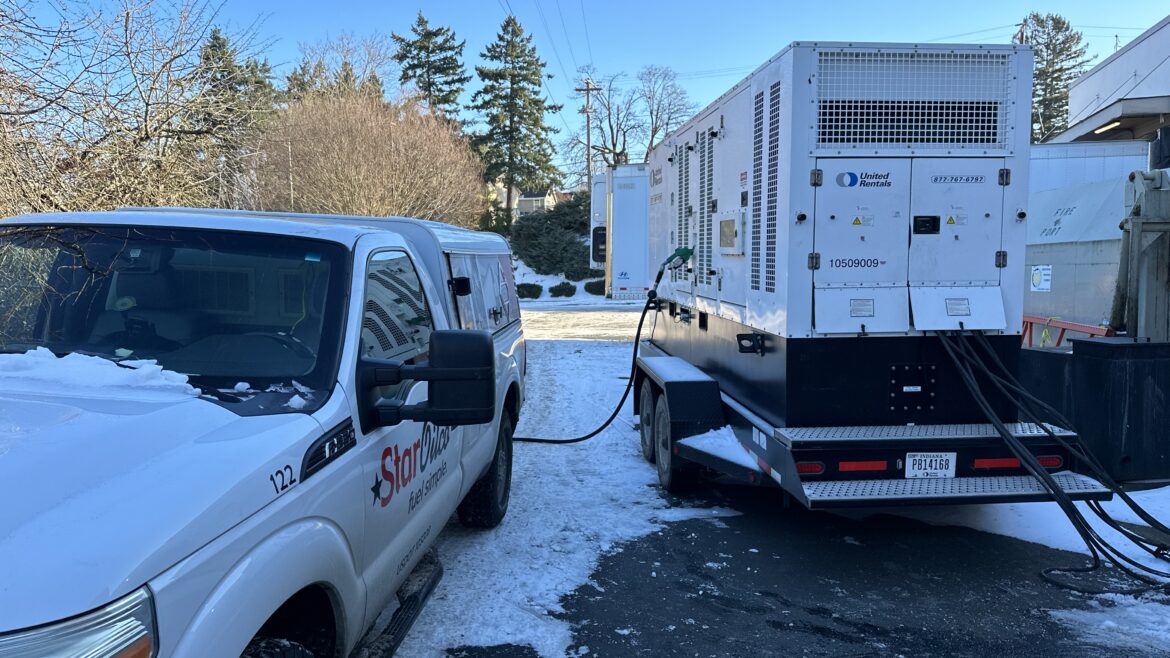
Star Oilco truck fueling a large generator during winter conditions
Diesel Backup Tanks – Treating and Refilling 1024 768 Star Oilco

Diesel Backup Tanks – Treating and Refilling

Here’s good advice if you are relying on diesel as a back up fuel in the Pacific NW.

Now is the time to refill and treat your back up fuel tanks.

Diesel as a back up fuel

Quite a bit of our business at Star Oilco is fueling back-up generators, emergency water pumps, refrigerated trailers and other long term off-road diesel storage requirements. In the Pacific Northwest, biodiesel blending is required by state laws and you need to take an extra duty of care when storing diesel as a back-up fuel.

This means that most off-road diesels and heating oils are ultra low sulfur diesel containing a small quantity of biodiesel.  That means long term storage requires a proactive approach.  You can’t just hope and wait to see what the fuel begins to look after years of storage.

Technical advice from Government Fleet Magazine to help you with storing diesel fuel.

Here is an article from Government Fleet Magazine on the subject which runs through the specifics of long term storage and what causes fuel to degrade when stored.  Government Fleet Magazine – How to Maintain Stored Diesel Fuel.

Star Oilco has also worked up a PDF check list on how to verify if your fuel is in need of freshening or is still in emergency ready shape.  If you are a customer of ours, we will deliver a laminated card version to keep next to your back up generator. If you are not a customer (or outside of our service area) drop us a message below and we will gladly email you the PDF.

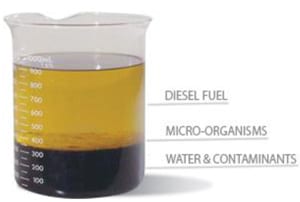
For our customers, we recommend that you check the tank bottom fuel quality on an annual basis to make sure the product looks good. If the tank has sat for years and is dark in color (good diesel is bright and transparent – you will notice if it is in bad shape), we recommend pumping the tank out at least partially and replacing with fresh fuel. Often you can also hugely improve the quality of the fuel by polishing the fuel. Polishing is when you circulate fuel from the bottom of the tank through a pump, filter repeatedly in order to remove any sediment or growth from the fuel, and then place this fuel back in the same tank.

Look at your fuel for a bright and clear color.

For stored fuel, you also want to make sure it is stabilized and contains a biocide. Stabilizers prevent the oxidation of the fuel and prevent the effect of metals like lead, copper and zinc, which can react and degrade fuel. For heating oil systems with a return line, for instance, the fuel is flowing through a copper line to the furnace and then back to the tank in a return line.

Use additives designed to prolong the life of your emergency diesel fuel.

Biocides prevent the growth of biological activity in the tank. In scenarios whcontaminated_dieselere micro-organisms like algae, bacteria, yeasts, and other bugs are growing in your fuel, biocides can kill this growth. It is still important to remove the residual grit and other contaminants that are the hallmark of bugs growing in your tank. Usually you remove them by filtration or total turn over of the fuel. If your tank absolutely has to be clean, you can contract a tank professional to enter the tank and physically clean the tank bottom or reline the tank with either fiberglass or an epoxy resin.

Water in diesel destroys fuel quality rapidly. Check your tank for water every fall and spring.

In events where water finds its way into your storage tank, that can also be corrected by pumping the tank bottom. Additionally, you want to put in an absorbent material designed to absorb water and not fuel. If your long term storage tank has water and you are not planning to burn 100% of the fuel in the near future, DO NOT add anything that removes water by distributing into the fuel. Adding a “fuel drier” that actually pushes the water into solution with the diesel will worsen the long term quality of your fuel, not improve it. That water is where bugs find their home to grow in fuel.

Star Oilco will test your fuel at no charge if you have an open account.

Feel free to call us with any questions you may have about long term storage of diesel. Star Oil can also deliver treated diesel ready for long term storage complete with Hydrotex PowerKleen Premium Diesel additive to improve the long term storage quality of your fuel. For biocide, we use Valvtect BioGuard fuel microbiocide to kill any possible biological activity and prevent any chance of it starting.

Diesel Testing and Storage in Portland

If you have a long term diesel storage tank and you are in the Portland, Oregon area, we are here to test your fuel.  Make sure your diesel is there for you when disaster strikes.

Tank Testing Form

  • This field is for validation purposes and should be left unchanged.


For more reading on diesel fuel quality assurance:

Fight Humbug in your Diesel Tank (using Valvtect Bioguard Plus 6 to stabalize your stored diesel)

Diesel Fuel Technical Review (an easy to read and free text book on diesel fuel)

Emergency Back Up Generator Fuel Quality (designed to provide a checklist to help Facility Managers keep those back up generators ready for emergency action)

Using Desicant Breathers to keep diesel fuel dry and clean (an introductory primer on desicant breathers and how they can be used to keep long term diesel storage drier and cleaner)

Using Diesel Filters to clean up your diesel fuel quality (an introductory primer on using aggressive filtration in line with diesel fuel dispensing for fuel quality assurance)

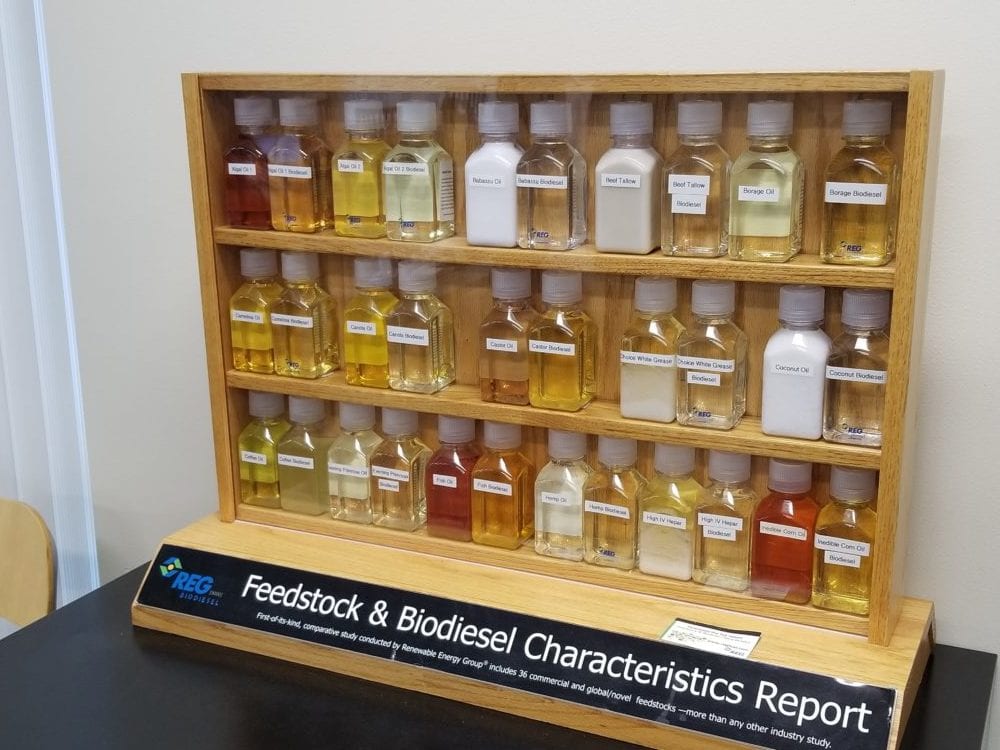
Bio-diesel and Feed-stock samples at REG
What Types of Feedstock Can Be Used To Make Biodiesel? 700 525 Star Oilco

What Types of Feedstock Can Be Used To Make Biodiesel?

               What Types Of Feedstock Can Be Used To Make Biodiesel?

        To answer what feedstocks can be used to make biodiesel we need to first answer:  What is Biodiesel?

Biodiesel is created through a process called transesterification.  Transecterification is when an alcohol such as methanol or ethanol is added to an oil or fat.  This creates methyl esters and glycerin.  Methyl esters is the scientific name of Biodiesel.  Because biodiesel needs a fat or an oil to start with, this fuel can can be created with any number of feedstocks.  If you would like to learn more about Biodiesel check out this for more questions about biodiesel.

According to the U.S. Office of Energy Efficiency & Renewable Energy:

“A feedstock is defined as any renewable, biological material that can be used directly as a fuel, or converted to another form of fuel or energy product. Biomass feedstocks are the plant and algal materials used to derive fuels like ethanol, butanol, biodiesel, and other hydrocarbon fuels. Examples of biomass feedstocks include corn starch, sugarcane juice, crop residues  such as corn stover and sugarcane bagasse, purpose-grown grass crops, and woody plants. “

Renewable Energy Group (REG) performed a study in 2009 with the support of the Iowa Power Fund Board and the Iowa Office of Energy Independence that tested 36 individual feed-stocks.  Star Oilco will be spotlighting these feedstocks through our blog and our social media. The full report can be found on their site if you would like to read ahead or explore the results in more depth. We hope you find these as interesting as we did!

Bio-diesel and Feed-stock samples at REG

Above photo taken at REG headquarters in Ames, Iowa.

This first blog highlights the following 2 types of feed-stock:

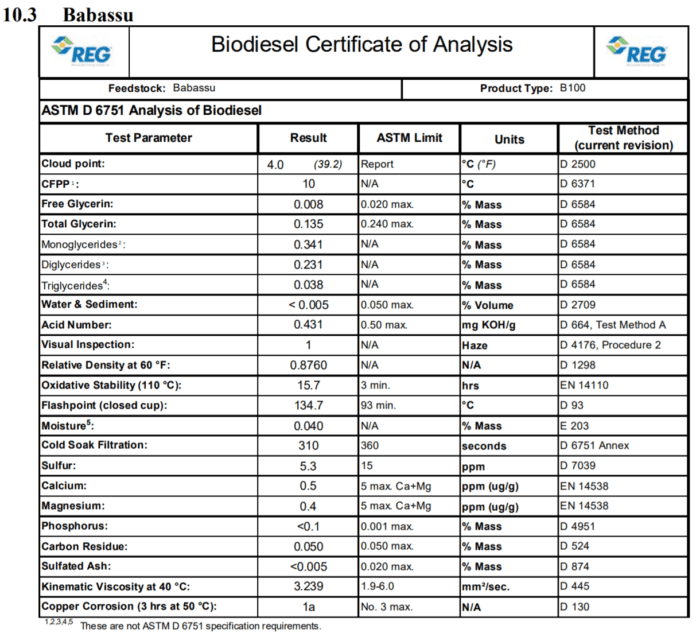
                                                            Babussa Oil & Beef Tallow

Babassu Oil

Attalea speciosa

Babassu oil is extracted from the seeds of the babassu palm tree, Attalea speciosa, an evergreen tree growing to 30 m (98ft) by 20 m (65ft) at a slow rate. It is hardy to zone (UK) 10 and is not frost tender. The flowers are pollinated by bees and other insects. The tree is common in Brazil, Mexico, and Honduras; it grows well in areas typically cultivated for coconut or palm. The kernels contain 60-70% oil, appear transparent, and smell like walnuts. In its natural form the oil is liquid at 20-30°C (68 – 86°F). The seeds are edible and the oil is used in margarine, soaps, detergents, lamp oil and skin products. Oil extraction results in a cake containing 15-25% protein (depending on the shell content), which is a valuable feedstuff.

In February 2008, Babassu palm oil and coconut oil were blended with jet fuel to power a Virgin Atlantic Boeing 747 during a test flight from London’s Heathrow to Amsterdam.

Babassu oil is extracted from the seeds of the babassu palm treeBabassu Oil Chart

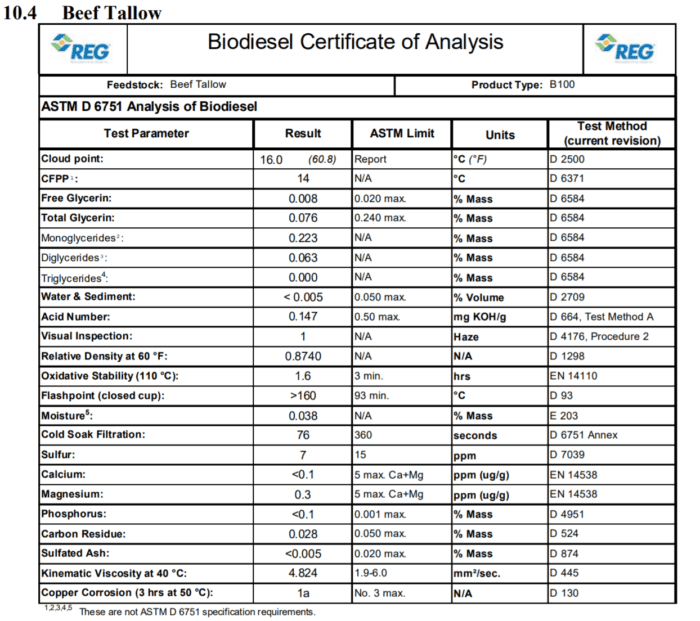
Beef Tallow

Tallow is a rendered form of the waste fats and greases from processing beef. Rendering is a process by which lipid material is separated from meat tissue and water under heat and pressure. Beef tallow is primarily made up of triglycerides and it is solid at room temperature. The B100 that is created from this source has a very high cloud point. “Cloud point is the temperature at which wax (paraffin) begins to separate when oil chilled to a low temperature, and it serves as an important indicator of practical performance in automotive applications in low temperatures.”  (Source)  The other uses for tallow include animal feed, soap, cooking and in the past, candles.

Beef Tallow Animal tissue is converted to tallow using rendering; a process by which lipid material is separated from meat tissue and water under heat and pressure.Beef Tallow Chart


Article 2 Feedstock : Borage Oil & Camelina Oil

Article 3 Feedstock : Algae Oil & Canola Oil.

Article 4 Feedstock : Castor Oil and Choice White Grease

Article 5 Feedstock : Coconut Oil and Coffee Oil

Article 6 Feedstock : Evening Primrose Oil and Fish Oil

Article 7 Feedstocks : Hemp Oil & High IV and Low IV Hepar

Article 8 Feedstocks : Jatropha Oil, Jojoba Oil, & Karania Oil

Article 9 Feedstocks : Lesquerella Oil & Linseed Oil

Article 10 Feedstocks – Moringa Oil & Neem Oil

Article 11 Feedstocks – Palm Oil & Perilla Seed Oil

Article 12 Feedstocks – Poultry Fat & Rice Bran Oil

Article 13 Feedstocks – Soybean Oil & Stillingia Oil

Article 14 Feedstocks – Sunflower Oil & Tung Oil

Two semi-trucks driving on a highway with trees in the background
Weekly Fuel Market Report – July 5 – July 11, 2026 1024 683 Star Oilco

Weekly Fuel Market Report – July 5 – July 11, 2026

fuel-market-report-star-oilco
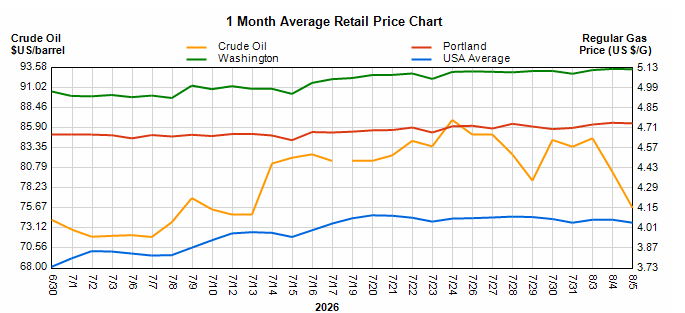
Line chart titled '1 Month Average Retail Price Chart' showing price trends for Crude Oil (orange), Washington (green), Oregon (red), and USA Average (blue) over time. Left axis shows crude oil price per barrel, right axis shows regular gas price per gallon. Communicates how crude oil and regional fuel prices change month to month in 2026.

Did You Know That R99 Is The Same Cost As Diesel Currently?

Call to set up R99 Mobile Fueling Onsite Service in Portland at the same cost of retail diesel. Dyed untaxed R99 is also available. Give us a call today to schedule your delivery.

Wholesale Price Average 7/11/26

Wholesale LowWholesale Avg
E10$3.03$3.12
B5$3.54$3.75
B20$3.59$3.72
R99$3.02$3.24

Average Retail Prices 7/11/26

NationalOregonWashington
E10$3.87$4.60$5.09
B5$4.88$5.39$5.83

Taxes

FederalState: ORLocalState: WA
Gas$0.184$0.40$0-.13$0.494
Diesel$0.244$0.40$0-.13$0.494

Portland Retail Fuel Price Variance

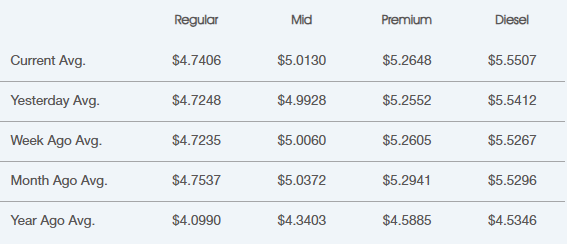
Table of current and historic average fuel prices by type: Regular, Mid, Premium, Diesel (e.g., Regular $4.68, Mid $4.96, Premium $5.20, Diesel $5.45).

Fuel Market News

Fuel prices jumped up this week as the U.S & Iran peace agreement has yet again proven to be extremely unstable, as military strikes have been re-initiated within the region, causing crude oil to shoot up 8% in 5 days. A very real problem that nobody seems to be talking about is the depletion of the federal oil reserve, which is at its lowest level since August 1983 at about 45% capacity. This should be much bigger news than it is, with no end in sight to the war with Iran

Retail gas prices in Portland are just under $5/gal at a current average of around $4.75/gal, while the Seattle area is at $5.45/gal.  Retail diesel prices in Portland are just under $6/gal at a current average of $5.55/gal, while the Seattle area is over $6.20/gal. Crude oil prices have jumped back this week as the U.S & Iran have once again started to bomb one another’s strategic assets. The doubters of the peace deal between the US & Iran were right yet again, as the peace agreement has gone to the wayside and military action and bomb strikes have resumed. This conflict truly has no end in sight, and the general public remains grossly uninformed by the U.S government about what is going on and what the timeline is.

fuel-market-report-star-oilco-5-18-24

Important Note: Per the City Of Portland, “Distributors in the City of Portland are required to meet the minimum biofuel content requirements for all fuel they distribute beginning on May 15, 2024. All diesel fuel distributed to retail stations, non-retail dealers, or wholesale purchaser-consumers must include a minimum of 15% biofuel content, from either renewable diesel or biodiesel. This requirement increases to 50% on May 15, 2026, and 99% on May 15, 2030”.

Crude oil is jumped over $10/barrel and are currently hovering just above $80/barrel, at a current price of  $83.57/barrel.

Crude oil is the main ingredient for gasoline and diesel. Per AAA, on average about 50% of what you pay at the pump is the price of crude oil, breaking down as 25% refining, 11% distribution & marketing, and 14% taxes – a helpful breakdown for consumers wondering why they are paying the prices that they pay. Crude Oil is currently trading at $83.57/barrel compared to $71.88/barrel last week and $73 a year ago.

It’s essential to recognize that fuel prices result from a complex interplay of the factors mentioned above and other regional factors. Additionally, prices may vary by specific regions within Oregon and Washington. For the most precise and up-to-date information on fuel prices and the causes for these price changes within your area, use the links below for AAA & GasBuddy.

If you have any questions, feel free to contact Star Oilco and speak to one of our fuel market advisors to discuss how the market can impact your business.

Set up your R99 Mobile Fueling Onsite Service in Portland Today Including Dyed Untaxed R99.

Give Us A Call Today

For other news in the fuel market:

https://gasprices.aaa.com/?state=OR

https://www.gasbuddy.com/charts

Join the Fuel Market Report newsletter for your weekly fill of updates!

Green diesel nozzle fueling refrigerated trailer in Portland snow
Do you have questions about Renewable Diesel in Oregon? 1024 768 Star Oilco

Do you have questions about Renewable Diesel in Oregon?

Renewable Diesel delivered in Oregon

Renewable Diesel vs Petroleum Diesel Burn Test

Imagine a superior next generation renewable diesel direct to your fleet.

___________________

Star Oilco is delivering R99 Renewable Diesel to fleets now.

Renewable Diesel delivered to your fleet by mobile onsite fueling or in bulk.

Imagine a fuel that is cleaner and drier than your typical diesel fuel bought in Oregon.  Now imagine that this dry and clean characteristic means a better performing fleet.  A fuel that causes less maintenance and increased performance benefits as it relates to your modern Tier 3 Diesel Emission systems.  Fewer DPF (particulate trap) regens and other post engine maintenance issues in your fleet while more power and up time reported by the drivers behind the wheel.  Now add to that a more than half reduction in CO2 emissions and Oregon has incentives for the adoption of this fuel because it is a biofuel.  A biofuel that outperforms traditional diesel in performance, emissions, and in lifecycle analysis.

That next generation biofuel is her, Renewable Diesel!

Star Oilco can deliver Renewable Diesel to your tank in Oregon and Washington.  If you are looking at this fuel we will work hard to make it easy for you regardless of how small or large your fleet. It is immediately available for bulk customers.   If you are interested in mobile on-site refueling, wet-hosing, construction job site fueling, or a retail option for the fuel we can work with you as well to make that happen.

Renewable Diesel: A Next Generation low CO2 Diesel Fuel.

This product is available in Oregon and we are excited to make getting this fuel simple.  Star Oilco is a proud seller Renewable Diesel product. If decarbonizing your fleet is your goal  while reducing the total cost of maintenance on your fleet, Star Oilco is ready to serve your needs.

Renewable Diesel is available from several manufacturers of Renewable Diesel shipped to Oregon, Washington and California.  This product being made available given it’s lower than petroleum CO2 emissions meeting the Low Carbon Fuel standards created by California, Oregon, and expected in Washington state.

Renewable Diesel clean burning

For more on Renewable Hydrocarbons, please check out the US Department of Energy’s Alternative Fuels Data Center page on the subject. 

Call Star Oilco with any questions you may have about Renewable Diesel, Biodiesel, Ethanol or other emerging alternative fuels.  We have a track record of making alternative fuels easy for those wanting to use them. Call 503-283-1256 or email OrderDesk@Star Oilco.net and we can get you in conversation with our team about a future fuel available today.

Star Oilco Crest

Star Oilco is delivering R99 Renewable Diesel to fleets in bulk and by mobile onsite fueling.

Contact Form

  • This field is for validation purposes and should be left unchanged.

For more on Renewable Diesel please also see the following:

Renewable Diesel as a major Transportation Fuel in California

Every Question Star Oilco has been asked about Renewable Diesel

Renewable Energy Group’s Ultra Clean Diesel (Renewable Diesel fuel blends)

Map of the United States showing 65,000 Pacific Pride cardlock locations with fuel card in foreground
Use Pacific Pride Cardlock to Fuel your Portland, Oregon Fleet 1024 593 Star Oilco

Use Pacific Pride Cardlock to Fuel your Portland, Oregon Fleet


Seize Control of Your Fuel Spending with Pacific Pride Cardlock

A Pacific Pride Cardlock Card gives you the ultimate control over when and where fuel is purchased. Plus, we guarantee the highest level of control by offering human support to make it easy for a small business. You have enough to manage and don’t need another website to log into! Know who bought what, when, and where — in real time — to better manage the buying decisions by your drivers.

Pacific Pride, CFN, WEX, Voyager and other fleet cards all have similar tools. But with Pacific Pride Cardlock, you’ll benefit from stand alone commercial fuel sites that are available 24 hours a day, 7 days a week, 365 days a year.

In Oregon, the minimum wage is rising and that means the retail price of fuel is rising to pay for those wages.  While other cards require you to wait in line and pay someone to fuel your vehicle in Oregon, Pacific Pride stand alone cardlock locations avoid that needless labor and allow your business to serve itself around the clock. Get out of fuel lines and save on your total cost of fuel.

Beyond the time and money savings of avoiding retail fuel lines, Pacific Pride cardlock also is far more secure to protect you from someone stealing fuel with your fleet card. Star Oilco’s Pacific Pride cardlock offering has a single simple tool for you: a human being on the other side helping make sure the total program is working. We help you grab control of every drop, dollar and driver.

            We are your partner in Fleet Card and Cardlock Card success.

Star Oilco goes one step further than our competitors by keeping things simple and easy for you. This is done with the obvious human element and best practices that complete the full value that a secured fuel card offers.

Call us and have us take care of that for you. You tell us what you want, we’ll consult with you and you’ll get a working card program.

This is what we recommend for your non-management cards:

  1. Secure your fleet card to a vehicle (attached to the license plate on the bill or place the fleet card on the key ring of the vehicle).
  2. Designate your vehicle cards to only work in the state’s zip codes that you service during the times of day you operate as a business.
  3. Give each driver a unique and secret PIN attached to their name (so when they use a card, their name appears on the bill next to the transaction).
  4. Implement a “No Tolerance Fuel Theft Policy” with your Human Resource policy. Have every employee sign a contract with your business that they own their personal secret PIN and it is only for them to use. Star Oilco can provide a recommended policy for you to use. Then, if they share their PIN with someone else, they will be responsible for anything that happens. If theft is happening, it is a “No Tolerance” dismissal offense on the first occurrence.
  5. Use the e-receipts to see in real-time fuel purchases. An electronic receipt is emailed to your Controller or Dispatcher to watch for off-policy fuel usage in real time, which allows your Dispatch or Management to respond the same day to questionable decisions around fuel cards.

                  Imagine how this works for your business in practice

You can set up restrictions by days of the week, hours of the day or even by zip codes. If your business does not operate on weekends, turn off the fuel cards during the times you do not operate. If your fleet is never on the road before 7am and is back at home by 7pm every night, set up those time restrictions to make it that much harder for fuel theft to occur. If you need to update this, change something, order cards, etc., just call our office and we take care of that update for you.

With our e-receipts, your Dispatch will get an email every time fuel is purchased. You will see where, what, when and with whom this occurs. You can reinforce your company fuel policies at the local level the same day — No more waiting for the bill to see if a driver did something that cost you money. By seizing control of your fuel, your drivers will also respond to your new level of control as well. By having control and transparency of what your drivers do, they will require less management as they know you are watching.

Often the most controllable expense related with fuel is the fuel that might slip through a business due to unethical employees or outside theft. Fuel slippage is the industry term for unauthorized fuel taking. With Pacific Pride cardlock fuel, you can take control over fuel purchases and avoid the loss up front with card controls. Contact Star Oilco for a total fuel security solution for your business.

       Seize control with Star Oilco’s corporate fleet card solutions.

If you have further questions about Pacific Pride and control of your fleet fueling, call us at 503-283-1256 or contact us using the form below.


Contact Form

  • This field is for validation purposes and should be left unchanged.

Star Oilco is a proud Independent Franchisee of Pacific Pride

Pacific Pride Cardlock Fuel Security

Two semi-trucks driving on a highway with trees in the background
Weekly Fuel Market Report – June 28 – July 4, 2026 1024 683 Star Oilco

Weekly Fuel Market Report – June 28 – July 4, 2026

fuel-market-report-star-oilco
1 Month Average Retail Price Chart: trends May–early July 2026 for crude oil (orange), Washington (green), Oregon (red), USA average (blue), and regular gas price (blue/gal). Left axis: crude oil $/barrel (roughly 68–103); right axis: gas price $/gal (roughly 3.71–5.62). Green line gradually declines; orange drops after mid‑June; red remains steady; blue USA average hovers near the gas price axis.

Did You Know That R99 Is The Same Cost As Diesel Currently?

Call to set up R99 Mobile Fueling Onsite Service in Portland at the same cost of retail diesel. Dyed untaxed R99 is also available. Give us a call today to schedule your delivery.

Wholesale Price Average 7/4/26

Wholesale LowWholesale Avg
E10$3.01$3.18
B5$3.43$3.61
B20$3.43$3.58
R99$2.84$2.92

Average Retail Prices 7/4/26

NationalOregonWashington
E10$3.85$4.68$5.16
B5$4.85$5.50$6.02

Taxes

FederalState: ORLocalState: WA
Gas$0.184$0.40$0-.13$0.494
Diesel$0.244$0.40$0-.13$0.494

Portland Retail Fuel Price Variance

Table of fuel prices by type (Regular, Mid, Premium, Diesel) with rows for Current Avg., Yesterday Avg., Week Ago Avg., Month Ago Avg., and Year Ago Avg.

Fuel Market News

Fuel prices were mostly stagnant this week, with fuel prices only moving a few cents while crude oil still hovered just above $70/barrel. The peace agreement between the US & Iran has continued to be shaky, with the US striking Iran on the 27th of June after Trump preached of peace and a “deal being done” on Truth Social. The continued murkiness has led the US public to begin to question what is actually going on and why this “3-week” operation is now entering its fifth month of conflict. The conflict has cost US consumers approximately $45 billion due to higher fuel and oil prices and inflation across the board.

Retail gas prices in Portland are just under $5/gal at a current average of around $4.85/gal, while the Seattle area is at $5.48/gal.  Retail diesel prices in Portland are just under $6/gal at a current average of $5.87/gal, while the Seattle area is over $6.25/gal. Crude oil prices have continued to tumble upon the renewed talks of a peace agreement between the U.S & Iran. Many doubt the legitimacy of peace agreements with continued military action and missile strikes occurring over weekends on more than one occasion. Much remains unclear about the current situation in Iran to the general public in the U.S.

fuel-market-report-star-oilco-5-18-24

Important Note: Per the City Of Portland, “Distributors in the City of Portland are required to meet the minimum biofuel content requirements for all fuel they distribute beginning on May 15, 2024. All diesel fuel distributed to retail stations, non-retail dealers, or wholesale purchaser-consumers must include a minimum of 15% biofuel content, from either renewable diesel or biodiesel. This requirement increases to 50% on May 15, 2026, and 99% on May 15, 2030”.

Crude oil is hovering just above $70/barrel, at a current price of $70.11/barrel.

Crude oil is the main ingredient for gasoline and diesel. Per AAA, on average about 50% of what you pay at the pump is the price of crude oil, breaking down as 25% refining, 11% distribution & marketing, and 14% taxes – a helpful breakdown for consumers wondering why they are paying the prices that they pay. Crude Oil is currently trading at $71.88/barrel compared to $70.11/barrel last week and $76 a year ago.

It’s essential to recognize that fuel prices result from a complex interplay of the factors mentioned above and other regional factors. Additionally, prices may vary by specific regions within Oregon and Washington. For the most precise and up-to-date information on fuel prices and the causes for these price changes within your area, use the links below for AAA & GasBuddy.

If you have any questions, feel free to contact Star Oilco and speak to one of our fuel market advisors to discuss how the market can impact your business.
Set up your R99 Mobile Fueling Onsite Service in Portland Today Including Dyed Untaxed R99.

Give Us A Call Today

For other news in the fuel market:

https://gasprices.aaa.com/?state=OR

https://www.gasbuddy.com/charts

Join the Fuel Market Report newsletter for your weekly fill of updates!

Close-up of calculator and printed fuel cost audit spreadsheet
What’s in a “Keep it Simple Fuel Audit” 1024 683 Star Oilco

What’s in a “Keep it Simple Fuel Audit”

How do you compare different fuel card vendors?

You audit your fuel bill.

We will help you clarify your bill by showing what you pay, what’s in that cost of fuel, and how you can save going forward. We do this by concentrating on one fact: there are only three fees in the total cost of a gallon of gas or diesel.

The three verifiable costs in a gallon of fuel are:

  1. The commodity cost of fuel (the wholesale and verifiable fuel cost itself),

  2. The fuel taxes charged by the feds, state, and local governments on top of that, and;

  3. The margin your fuel vendor puts on top of those two very transparent costs.

Fuel bill audit best practices

Tax time is a good time to revisit your policies and systems.

Let us audit your bill and catch inconsistencies and over charges.

We have a transparent way to analyze your fuel expense that breaks it down in an easily understood format. Our approach will demystify what you’re paying in fuel so you can grab control of your gasoline and diesel bills. Our mission is to ‘Keep it Simple’ and make fuel make sense. There are several types of expenses that get added to your cost of fuel.

Pacific Pride Fuel Security

At Star Oilco, we ‘Keep it Simple’ when analyzing fuel bills.

Today, two trends can be witnessed in the Pacific Northwest: fuel prices are all over the place, and wages are rising against that trend. This makes managing for a low cost of gasoline or diesel extremely hard given the labor that might be involved in chasing that price.

Add to that the fact that retail gas stations are keeping more margins than ever in retail fuel history. With minimum wage at $15 in parts of the Pacific NW, the cost of retail gas stations is rising faster than inflation.

Stand-alone commercial cardlock locations such as Pacific Pride and CFN help you save on your own labor, as well as avoid the higher retail cost. One additional feature is you can audit a commercial cardlock fuel seller against the commercial wholesale rack price. Retail sellers promising discounts are discounting from a posted price that is based solely on what they decide a good price can be. Today, that’s a historically high margin above wholesale cost price.

Dig into your bill for an understanding of what you are paying and what you are paying for. Let us demystify the fees, charges, and hard-to-understand line items of our competitors. It seems that many of our competitors, much like cell phone companies, want to give you a bill that is as complex as possible so it’s difficult for you to understand your cost of fuel.

We can clarify your bill by showing what you pay, what’s in that cost of fuel, and how you can save going forward. Commodity cost of the fuel, fuel taxes and the margin of the vendor make up every fuel bill.

Wholesale Fuel Cost + Taxes + Margin = Total Fuel Cost

These three costs can be audited and confirmed. When we quote a prospective customer, we take their existing fuel bill and break it down into a spreadsheet that is easy to understand thanks to these definable costs. Take your existing fuel bill. Choose a few locations that are most commonly used by your fleet. Usually just the two most-used sites are enough to gauge if savings can be gained by changing vendors. Focus on the cost there, as this simplifies your focus as a representative sample of your fuel expenses.

In a spreadsheet, make easy-to-read tabs for each fuel and location. Then gather the dates fuel was bought at each location. Place the date and the price per gallon paid in their own columns. Now you know your cost. In the next column, enter the wholesale price of fuel to compare. This is going to be pretty close to what your fuel vendor was paying for it on that day give or take a few pennies.

The commodity cost of fuel is established in the market. Though different size players have discounts, these discounts are usually pennies per gallon and aren’t substantial overall. You can request a 30 day free trial of the Oil Price Information Service or “OPIS” for your local wholesale market for fuel. Government bids often use this service as a transparent bid price for fuel. NOTE: If you are buying with a Pacific Pride or CFN fleet card that uses stand-alone 24-7 commercial cardlock sites, the price will be based on OPIS as well. If you want help with this, Star Oilco can provide you with a copy of OPIS.

After that, the next column is the fuel taxes on that fuel. In another column next to the wholesale cost of fuel, you place the local taxes associated with that fueling site. Your state will usually have a “Fuel Tax Group” or some variation of that name where the state’s website will list all state and municipal taxes.

After seeing the wholesale cost and fuel taxes charged, all that remain is the margin. Many fuel sellers will try to complicate this by passing costs through, but at the end of the day, this is still their markup regardless of what they call it. This enables you to really have a discussion on what price you are charged to use their fleet card.

Our next step is to determine the typical margin you are being charged. Take the real price you paid on a day. Your next column on the spreadsheet will be the following formula:
NOTE: Margin Charged is the result that should be in your new column.

(Cell with the ACTUAL PRICE PAID) – (Cell with the WHOLESALE COST) – (Cell with FUEL TAXES) = MARGIN CHARGED

If you line up all the days for MARGIN CHARGED and average those (select a cell at the bottom of the column and type “=AVG” and select the data in the MARGIN CHARGED column), you will find the average margin. Usually this is about the same on every one of the sheets for the type of fuel you are buying. Diesel and gasoline margins are typically different. Retail gas stations, in particular, will treat diesel like a premium product so don’t be surprised if those margins are over $.40 a gallon in some places.

If you want help with this, call us!

We will empower you with the knowledge of what your vendor is charging you and determine if it is a fair price for the service. Beyond that, there should be no other costs. If your vendor has other costs (fees, invoice charges, etc.), we’ll show you what those really cost per gallon so you understand your true cost fuel.

Star Oilco makes this clear and easy to understand. Let us know if we can help.

Contact Form

  • This field is for validation purposes and should be left unchanged.


Call for service.


Two semi-trucks driving on a highway with trees in the background
Weekly Fuel Market Report – June 14th-20th, 2026 1024 683 Star Oilco

Weekly Fuel Market Report – June 14th-20th, 2026

fuel-market-report-star-oilco
Line chart titled '1 Month Average Retail Price Chart' showing prices over 2026: Crude Oil per barrel (orange, left axis) and Regular Gas Price (right axis) for USA Average (blue), Washington (green), and Oregon (red). Trends show gas prices gradually decline across all regions; crude oil fluctuates with an overall downward trend.

Did You Know That R99 Is The Same Cost As Diesel Currently?

Call to set up R99 Mobile Fueling Onsite Service in Portland at the same cost of retail diesel. Dyed untaxed R99 is also available. Give us a call today to schedule your delivery.

Wholesale Price Average 6/20/26

Wholesale LowWholesale Avg
E10$2.99$3.14
B5$3.39$3.57
B20$3.42$3.53
R99$2.84$2.90

Average Retail Prices 6/20/26

NationalOregonWashington
E10$3.85$4.68$5.16
B5$4.85$5.50$6.02

Taxes

FederalState: ORLocalState: WA
Gas$0.184$0.40$0-.13$0.494
Diesel$0.244$0.40$0-.13$0.494

Portland Retail Fuel Price Variance

Table of average fuel prices by type (Regular, Mid, Premium, Diesel) showing current and historical averages.

Fuel Market News

Fuel prices dropped for the second straight week rolling into July. As peace negotiations continue between the US & Iran, the Strait of Hormuz has been partially opened and traffic is flowing through the area slowly. Although the conflict is still in arms with much left unclear, the markets have responded positively to the peace negotiations and current ceasefire between the US and Iran. Crude oil prices have dropped over $15/barrel over the past 2 weeks since the announcement of a peace treaty between the US & Iran. The past few months have taught us to expect the unexpected regarding the conflict in the Middle East, so there is still a lot of skepticism surrounding the legitimacy of a long-lasting peace agreement and true ending to the war between the US & Iran.

Retail gas prices in Portland are just under $5/gal at a current average of around $4.95/gal, while the Seattle area is at $5.48/gal.  Retail diesel prices in Portland are just under $6/gal at a current average of $5.85/gal, while the Seattle area is over $6.31/gal. Fuel prices have dropped over $0.30/gal since the US/Iran peace announcement. With many wondering if this agreement will last into the future, the market has responded positively for the time being.

fuel-market-report-star-oilco-5-18-24

Important Note: Per the City Of Portland, “Distributors in the City of Portland are required to meet the minimum biofuel content requirements for all fuel they distribute beginning on May 15, 2024. All diesel fuel distributed to retail stations, non-retail dealers, or wholesale purchaser-consumers must include a minimum of 15% biofuel content, from either renewable diesel or biodiesel. This requirement increases to 50% on May 15, 2026, and 99% on May 15, 2030”.

Crude oil is hovering just above $70/barrel, at a current price of $70.11/barrel.

Crude oil is the main ingredient for gasoline and diesel. Per AAA, on average about 50% of what you pay at the pump is the price of crude oil, breaking down as 25% refining, 11% distribution & marketing, and 14% taxes – a helpful breakdown for consumers wondering why they are paying the prices that they pay. Crude Oil is currently trading at $70.11/barrel compared to $77.05/barrel last week and $75 a year ago.

It’s essential to recognize that fuel prices result from a complex interplay of the factors mentioned above and other regional factors. Additionally, prices may vary by specific regions within Oregon and Washington. For the most precise and up-to-date information on fuel prices and the causes for these price changes within your area, use the links below for AAA & GasBuddy.

If you have any questions, feel free to contact Star Oilco and speak to one of our fuel market advisors to discuss how the market can impact your business.

Set up your R99 Mobile Fueling Onsite Service in Portland Today Including Dyed Untaxed R99.

Give Us A Call Today

For other news in the fuel market:

https://gasprices.aaa.com/?state=OR

https://www.gasbuddy.com/charts

Join the Fuel Market Report newsletter for your weekly fill of updates!