
• 232 NE Middlefield Rd, Portland, OR 97211

Star Oilco

Buying A Home Heated With Oil? Get The Facts! 150 150 Star Oilco

Buying A Home Heated With Oil? Get The Facts!

Buying a Home Heated With Oil? Get the Facts!

Portland, Oregon – For many people, buying a new home is among life’s most stressful events. It ranks high with getting married and welcoming a new baby into the family. The process can become more complicated when the house being considered for purchase is heated with oil.  After months of active searching, Kimberly and Alex Gorham1 found a home in Southwest Portland that met their desired criteria with a single exception—the house was heated with oil.  “Neither of us had ever lived in a home that had oil heat,” explained Kimberly. “We both had negative associations with heating oil tanks and assumed that the underground tank on the property would have to be decommissioned. It was a foregone conclusion that we’d convert to natural gas.”

Addressing Common Misperceptions

According to Rhonda Lehr, it is not uncommon for homeowners to be confused about heating oil. Misperceptions abound, from “It’s illegal to put a heating oil tank back in the ground” to “They don’t make oil furnaces anymore” or “Heating oil is dirty.” Lehr knows because she’s a customer service manager for the Oregon Oil Heat help desk, a phone line that the Oregon Petroleum Association administers to address the needs and concerns of heating oil customers as well as the industry as a whole. The help desk is a place for heating oil customers, real estate agents and potential home buyers to get answers to questions ranging from where to get equipment to how to find a reputable soil tester.

When it comes to helping potential new home buyers decide whether to keep a heating oil system or convert to another source of energy, however, Lehr doesn’t get nearly as many calls as she would like. “By the time homeowners have made a real estate decision, they’ve already been convinced that they need to convert away from heating oil,” notes Lehr. What many people don’t know is that the most practical, economical and environmental solution for many homeowners is to stick with heating oil. Indeed, the Consumer Energy Council of America Research Foundation concluded that in 95% of all cases, it makes economic sense for a homeowner to stick with heating oil. After 18 years of taking customer service calls, Lehr understands why homeowners who choose to stay with heating oil do so, including:

  • Competitive prices. Small independent heating oil dealers compete with one another to keep prices as low as possible. Customers are free to choose the dealer that best meets their needs.
  • Peace of mind. A heating oil storage tank on one’s own property provides a level of security, control and price protection that other home heating options can’t offer.
  • Heating oil is a very safe fuel; it is a liquid so it cannot explode. It also has an extraordinarily low risk for carbon monoxide poisoning.
  • According to the Environmental Protection Agency (EPA), modern oil burners are one of the cleanest combustion sources available, releasing near zero levels of smoke. Moreover, a good working heating oil system doesn’t release any odor or soot into a living space.
  • Heating oil provides even, ambient warmth and burns very hot, thus warming your home quickly and completely.
  • Personal relationships. Many heating oil dealers are multi‐generational, family‐owned businesses whose employees are committed to providing the best customer service possible.

The Tank Issue

None of this is to say that heating oil tanks are not an issue. “Anyone buying or selling a home that has an old heating oil tank in the ground needs to inform him or herself of the tank’s condition,” says Greg Brennan, an equipment specialist who trains heating oil technicians at Portland Community College. Brennan is also co‐owner of Universal Applicators, a tank and environmental services company that works throughout the Pacific Northwest.   “The reality is that older heating oil tanks can leak,” observes Brennan. “Nonetheless, many homeowners choose to continue using oil heat even after a cleanup is completed because they prefer it over other energy sources.” Fortunately, the oil heat industry has been working for decades to design tanks that withstand the most severe conditions. Replacements for older storage tanks range from aboveground tanks that are designed to fit into small basements and garages, to underground tanks made of ultra‐strong, corrosion‐resistant fiberglass and steel.

So what do you need to know if you are buying a home with a heating oil tank? According to the Oregon Department of Environmental Quality (DEQ), homeowners/sellers who know of any tanks on the property that are no longer in use must ensure that the tank has been emptied of oil and must give the buyer documentation that it has been emptied. (Note: This is not the same thing as a tank that has been “decommissioned,” a generic term for taking a tank out of service by cleaning it, then removing it or filling it in place with an inert material. If a homeowner stops using an underground tank, DEQ only requires that it be emptied. Decommissioning is entirely voluntary.)

If a seller or realtor can’t tell you whether there is an oil tank on the property, Universal Applicators’ Brennan suggests looking for visual clues, such as a vent pipe (usually attached to the side of the house) or a fill pipe (normally located in the ground, near the house). He also recommends looking on the basement floor or walls for concrete patches where oil lines once were. In the absence of visual clues, he tells homeowners to check with the Department of Environmental Quality (DEQ) for any reported releases or hire a qualified expert to check for a tank on the property.

Once a tank is discovered, the next step is soil sampling. According to Oregon state law, soil samples or tank tests are only required when an underground tank is suspected of leaking, or if oil is known to have leaked into the ground. Nevertheless, soil sampling is now a routine request during property transactions. Anyone borrowing money to purchase a home is likely to be required by their lender to conduct soil testing to determine whether there has been any contamination on the property.

When it comes to hiring a contractor to conduct soil sampling, home buyers and sellers are encouraged to do their homework. Many companies that do soil samples also make money on the cleanup, and there have been isolated cases of fraud. (For example, some companies have been caught selling a cut‐rate, single‐sample service in which they collect the two samples required but send only the most obviously impacted sample to the lab for analysis. The seller is then presented with a bid for the cleanup, without the benefit of full representative information.) The Oregon Oil Heat help desk can provide homeowners with a list of tank testers that have demonstrated good business practices, and consumers are encouraged to check with consumer ratings agencies such as the Better Business Bureau and Angie’s List. Of course, any time a homeowner is concerned about the integrity of a heating oil tank, he or she should have it checked or have it emptied and replaced. It is always in the best interest of both buyers and sellers to be sure that a tank is sound, and a replacement tank is much less expensive than allowing a known or suspected problem to continue.

The Lowdown on Leaks

So what to do if an underground tank is found to leak? Brennan’s first advice to homeowners is “don’t panic.” That’s because a tank leak is not the environmental catastrophe that most people believe it to be. The days of soil clean ups running tens of thousands of dollars and entailing huge excavation projects are gone, in large part because environmental experts recognize that heating oil in soil usually has a limited impact to humans or animals. In addition, DEQ’s requirements for soil clean ups have been modified so many projects require very little soil removal. Instead, a series of soil samples can be taken that document the contamination, and verifies there is no threat to ground water. This information is compiled and submitted to DEQ who then will close the file on the site. Leaking tanks are also not the financially devastating accidents that they are purported to be. In Oregon, the average clean‐up cost from a leaking tank is under $4,000. As Lehr from the Oregon Oil Heat help desk points out, tank service contracts offered by oil heat dealers cover much of the cost of the tank replacement and cleanup.

“If a homeowner has an old tank that is in good working condition, with no evidence of oil ever having leaked out or water having leaked in, it can be covered for up to $4,000 for operational or structural failure with a tank replacement,” explains Lehr. “There is a phase‐in period over a year, and an automatic delivery schedule to monitor usage is required for coverage. That’s because when customers order 100 gallons here and 100 gallons there, nobody is proactively monitoring for oil loss. Full-service programs keep tanks full via an automatic delivery schedule and are better able to detect a problem early.” Greg Brennan at Universal Applicators admits that the idea of having an old tank in the ground is unsettling to some people. “But as with anything, regular and proper maintenance is the key to keeping an oil heat system running safely and efficiently.” In fact, when it came to building his own 3,000 square foot home, Brennan chose oil heat for its superior efficiency. “A heating oil tank is like the roof on a house—with proper installation and ongoing care and maintenance, its lifespan can be extended for many, many years.”

Making an Informed Decision

For new homeowners Kimberly and Alex, sticking with heating oil was a logical choice. The house they had purchased had a brand new, high‐efficiency oil furnace. The underground tank was not leaking, yet there was plenty of available space if they decided to install an aboveground tank in the future. They also liked the idea of controlling their own heating supply, and being able to balance out the highs and lows of oil prices without being tied to a large public utility. Last but not least, they had their hearts set on an oil‐fired hot water heater, which provides unlimited supplies of hot water at a fraction of the cost of a gas or electric water heater.

Still, Kimberly and Alex needed additional assurance. “As consumers who just want to do the right thing in terms of cost and comfort, we needed additional data points.” With input from friends, colleagues and their home inspector, they learned that conversion is an extremely expensive, long‐term investment. In some cases, the thousands of dollars it costs to convert to natural gas are never recovered once you consider the costs to remove the old system, run the gas line, prepare the new gas system, do the plumbing and wiring and buy the equipment that will only last about 15 years (heating oil equipment, in contrast, lasts up to 30 years). Moreover, people who’ve spent the time, money and effort to make the switch often complain that they are simply not as warm and comfortable as they had been with heating oil.

The Bioheat Benefit

Lastly, for Kimberly and Alex, there is also the issue of the environment.  “oil has a huge environmental benefit—especially as biofuels become a better option.”   Indeed, many homeowners who once considered converting to natural gas are opting to stay with their oil heat systems as biodiesel heating oil becomes more readily available throughout the country. “Biodiesel heating oil is a well‐tested and renewable fuel made from vegetable oils like soy and canola grown domestically,” explains Tyson Keever, Co‐Founder of SeQuential Biofuels. “When used for heating, biodiesel is mixed with regular heating oil to produce a new energy source that has the highest BTU content of any alternative fuel and is extraordinarily clean‐burning.”

In Oregon, the most common blends of biodiesel heating oil are B20 (20% soy or canola oil mixed with 80% regular heating oil) and B5 (5% soy or canola mixed with 95% regular heating oil. And while 5% may not seem like a lot, if everyone using heating oil used a B5 blend, more than 400 million gallons of regular heating oil could be conserved. For homeowners like Kimberly and Alex, that’s a major selling point.

Another selling point is that homeowners don’t have to make any modifications to their existing heating oil systems to begin using blends of B5 or B20. In fact, biodiesel naturally cleanses and lubricates a heating system, potentially lowering cleaning costs and extending the life of equipment that has been properly cared for. “For homeowners who keep up with regular system maintenance, there are no problems using low blends of bioheat,” assures Keever. (To use higher biodiesel blends, up to and including B99, homeowners will need to make certain modifications to their heating oil system, depending on the materials in their tanks, pumps and fuel lines.) “Most people don’t associate heating oil with alternative energy,” concludes John Huber, President of the National Oilheat Research Alliance which focuses on consumer and professional education, as well as research and development in the oilheat industry. “Yet home heating oil has reduced its carbon footprint by nearly 40% over the last three decades. Thirty years ago, the average oil heat consumer used 1,300 gallons of oil per year. Today, that number has been reduced by nearly 500 gallons thanks to new technology and high‐efficiency equipment. Homeowners owe it to themselves to get the facts for themselves before making the decision to convert.”

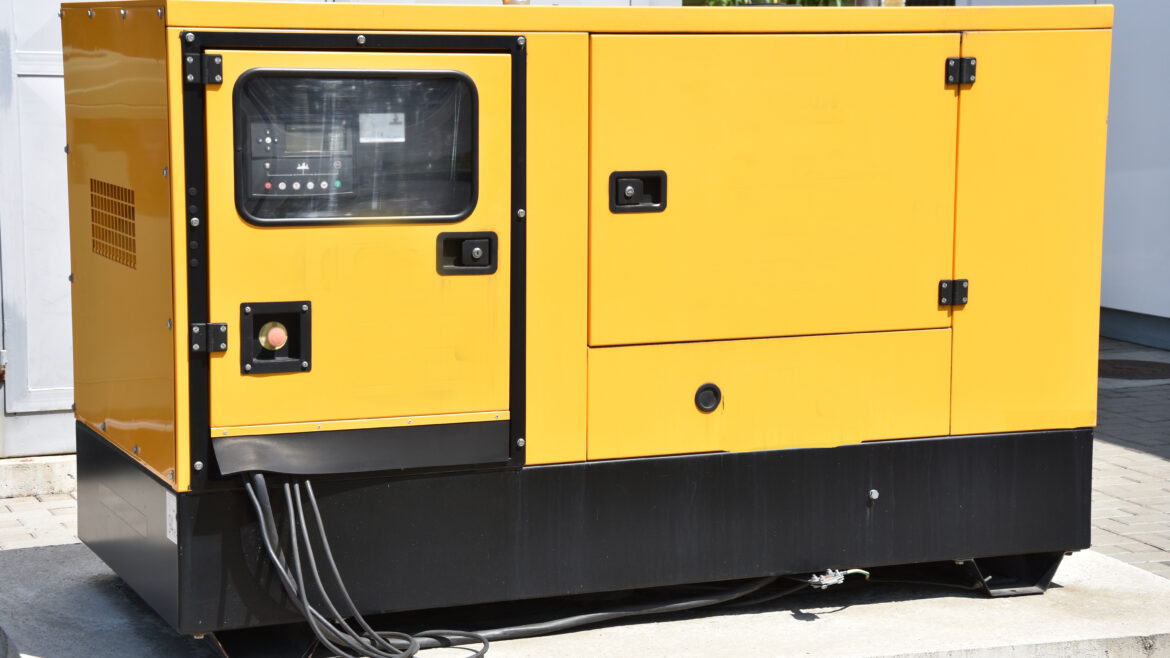
Yellow diesel backup generator for emergency power
Fuel Quality In An Emergency Back-Up Generator Matters – Find Out Why 1024 683 Star Oilco

Fuel Quality In An Emergency Back-Up Generator Matters – Find Out Why

                      Emergency Back Up Generator Diesel Fuel Quality

The fuel in your generator is the single most overlooked item in maintaining a back up generator.  Be prepared and know your back up generator diesel fuel quality is ready with these best practices.

When the power goes out, don’t let a decade old tank of diesel be your weak link.


Diesel Generator Fueling Service

As a provider of back up generator fueling services we know how critical fuel is in an emergency.

Back up generators are everywhere when you start looking for them.  Rarely needed but when a storm or disaster strikes their failure to fire will be extremely conspicuous. In the Pacific Northwest where resilience planning around a major subduction zone earthquake is a monthly subject of talk.  Back up diesel will be the only immediately power source after a quake.  Diesel generators are taking center stage for emergency preparedness, placing those who maintain them in some high level policy discussions.

Avoid a double emergency when the back up power isn’t there for your need by focusing on the diesel fuel quality.

The worst case scenario for fuel quality is water getting into your diesel fuel reservoir as well as biological growth occurring in that water logged diesel. If water is present in diesel, and that diesel is in a warm dark place, bacteria will start growing in your tank. So first preventive step is watch for water.  The most likely problem with fuel you will see is the fuel aging and degrading in place over years of not being used.  That can be addressed with your routine maintenance on the tank.

CIM-TEK water absorber

NOTE: To get a small amount of water or to ensure a dryer tank of fuel, CIM TEK makes a Tank Dryer which absorbs a small amount of water in a tank. Handy similar to adding a desiccant into a closet with a slight condensation issue. 

Back up power generator diesel fuel quality.

The big rule for storing back up generator fuel is to make sure the diesel you use is clean and dry.

First ensure you are testing the generator by running it once a month.  Move fuel through the system and ensure the generator is starting right up. Run the generator for a while to use up fuel and be prepared to order a regular top off when you get below 3/4th of a tank. When checking the fluids on the generator prior to start up see if the fuel filter has a visual transparent bottom where you can see what the fuel looks like there. If it looks like dirty fuel or there is evidence of water take notice.  After cycling the generator take a peek and make sure the fuel it’s pulling into the generator is bright (not dark and degraded).  If you are seeing any water (even a small drop) that is an indication of real concerns.

If you are using up half a tank a year and adding to it, the fuel quality will usually stay within specification.  If you have worries the easiest way is to just start over. With older generators sometimes it’s a good idea to just evacuate the tank (empty all the older diesel fuel) and replace it with fresh diesel treated and stabilized for long term storage.

Most back up generators are seeing routine annual maintenance where the mechanical needs of the equipment are walked through. If this is occurring ask for a bottom sample from the back up generators fuel tank. Also ask to see what the fuel in the bottom of the fuel filter (assuming they are changing that) would give an indication if problems might exist deep in the fuel tank.

Back Up Diesel Generator Fuel Service

Sampling and Onsite Testing of Fuel from Generator Diesel Tank:

  1. Pull sample from tank bottom
    1. Use a professional “Bacon-Bomb Sampler” (google it to see one) or a small fuel transfer pump available at any auto parts store.
  2. Visually inspect it by swirling it in a beaker or mason jar.
    • Look for water and dirt fall out as you swirl.  If you see a few drops of water form you’ve got a water problem. If you are seeing coffee ground type material in the fuel, that’s biological growth. If an algal or gunk type slime appears, that’s also biological growth.
    • If clear like cranberry juice and bright – your fuel is in good shape.  If a darker cherry color yet still clear, your fuel is aging and you should consider swapping or burning fuel off in the next year.
  3. If fuel is dark in color (showing that it is aging in the tank) you can send that sample to a lab to test it. You want to ensure you are confirming the following:
    • Oxidation Stability (or Accelerated Stability)
    • Water Content in PPM (under 50 PPM is what you want, under 100 PPM is not uncommon, and over 100 PPM there is probably water in the fuel and you want to pursue remedial action.)
    • Make sure the fuel testing lab you are using (your current fuel vendor should have a recommendation or do it for free for you) is checking for:
      • oxidative stability (if it’s aging out of specification),
      • biological growth (if bugs are growing in it),
      • water content (indicating a puddle someplace in the tank causing higher water content in the fuel) and,
      • dirt content of the fuel (if there is dirt, there is probably biological growth or some other problem).
  4. Set aside sample in a warm dark place for a month and check it for biological growth occurring which will confirm if you have fuel growing inside the tank.
    • How to test diesel for biological growth In-House:
      • Take your sample that appears to be in great condition and set it aside in a warm dark place for a month (day light kills most biological growth in fuel, though day light ages your diesel in other ways).
      • When you come back to look at the sample, if a film or layer of darker color is appearing in the fuel, this is biological growth occurring.
      • If you see nothing and want to experiment further, add a slight amount of water to this sample, shake it up, and put it back in a warm dark place.
      • When you check back if there is a a new layer of darker color on the surface of where the water contacts the fuel, that’s what grows in your tank.
      • If nothing grows, your fuel is safely stabilized for storage this year. Even if water is finding its way into your fuel tank, the fuel is safe and will be ready to start.
        • NOTE: Do not leave water in your tank, even if the fuel looks good. Eventually it will be a major problem and something will grow. If you are putting biocide in your tank regularly and their is an environment for growth, something resistant to that biocide will take root and you WILL NOT be able to get it out of the tank without serious effort.

NOTE: If you are curious to see a fuel lab analysis of the diesel this is an example.  This is a lab analysis from Hydrotex, Star Oilco’s premium diesel additive provider.  They are very supportive in testing everything we send them for quality assurance. 


Do you have questions about generator diesel fuel storage?

If you have questions about fuel storage, Star Oilco has answers.  Star Oilco does not do tank cleaning, we still will help you figure out what you need to do in order to have the result you need.

Contact Form

  • This field is for validation purposes and should be left unchanged.


For more on Diesel Fuel Quality Assurance please see these other Star Oilco articles:

Desiccant breathers, dry diesel, and keeping your diesel fuel clean.

Every question Star Oilco has been asked about dyed diesel.

Keep and make your diesel fuel cleaner. 

Bioguard Plus 6, Kill and prevent biological growth in your diesel fuel storage tank.


Two semi-trucks driving on a highway with trees in the background
Fuel Market Report: August 17th-23rd, 2025 1024 683 Star Oilco

Fuel Market Report: August 17th-23rd, 2025

Fuel Market Report by Star Oilco Banner
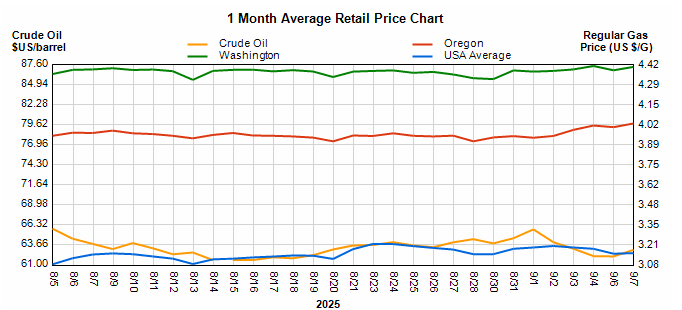
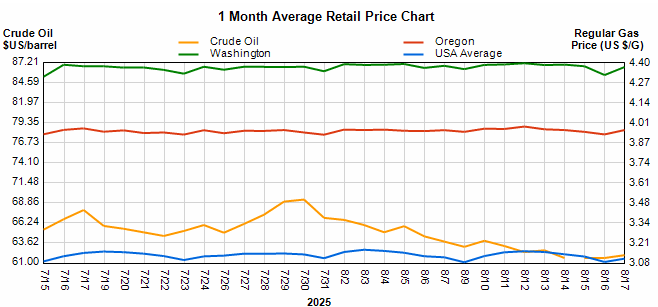
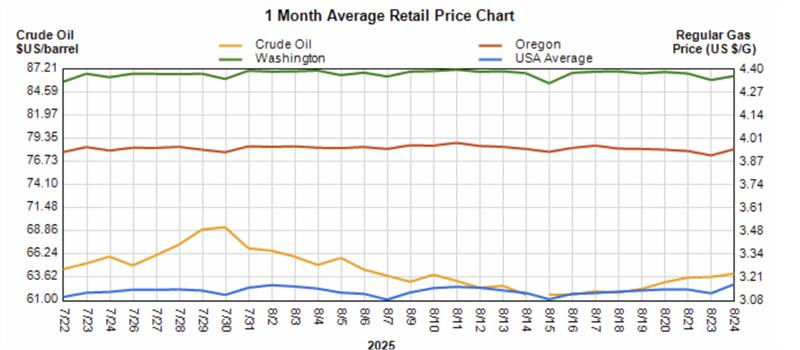
1 month average retail fuel price chart showing crude oil, Oregon, Washington, and U.S. average gas prices from July to August 2025

Did You Know That R99 Is The Same Cost As Diesel Currently?

Call to set up R99 Mobile Fueling Onsite Service in Portland at the same cost of retail diesel. Dyed untaxed R99 is also available. Give us a call today to schedule your delivery.

Wholesale Price Average 8/23/25

Wholesale LowWholesale Avg
E10$2.49$2.66
B5$2.89$3.03
B20$2.90$3.01
R99$3.82$2.96

Average Retail Prices 8/23/25

NationalOregonWashington
E10$3.16$3.97$4.40
B5$3.68$4.45$5.01

Taxes

FederalState: ORLocalState: WA
Gas$0.184$0.40$0-.13$0.554
Diesel$0.244$0.40$0-.13$0.584

Portland Retail Fuel Price Variance

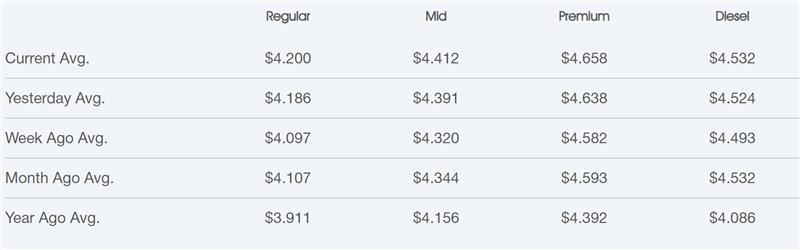
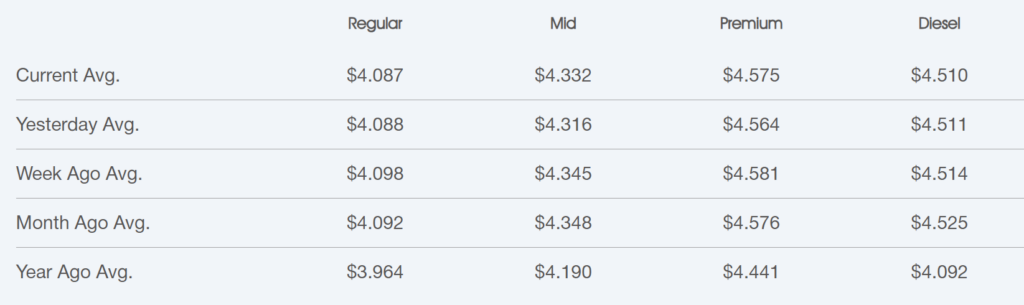
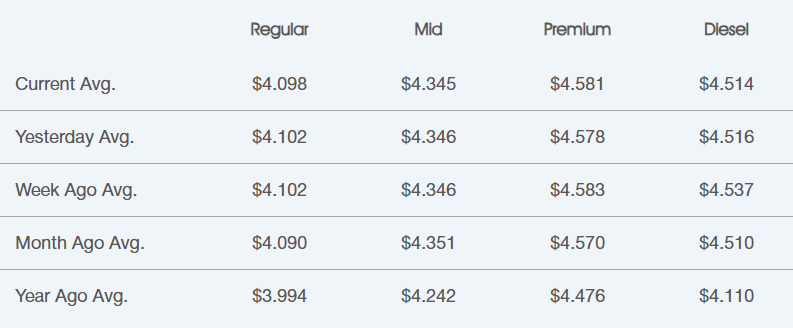
Oregon average fuel price variance table for Regular, Mid, Premium, and Diesel in August 2025

Fuel Market News

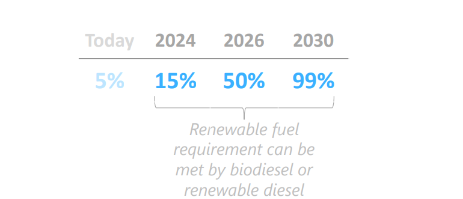
Gas prices dipped slightly, and diesel prices saw significant price jumps this past week. Rack averages in Portland were down $0.03/gal while diesel prices were up over $0.10/gal on B5, B20, and R99. Renewable diesel prices dipped significantly this month, with prices as low as $2.50/gal. The Portland market’s need for Renewable Diesel will continue to be high in demand as the 2026 RFS deadline approaches, with diesel blends increasing to B50 blends. Questions of supply remain unclear, with Neste pulling out of the market in early 2025. Much remains unknown about the future supply of diesel in Oregon. Demand will be very high, and supply will need to be strong to support this. Where the supply comes from remains unknown for most. The winter blend of gas and diesel will soon be back on the market as we roll into September next week. This may create an initial increase in prices, with pricing dips following into October/November. Oil prices have remained slightly below $65/barrel. OPEC+ has announced a production boost headed into September, which may lead to crude oil prices below $60/barrel into the fall/winter. 

fuel-market-report-star-oilco-5-18-24

Important Note: Per the City Of Portland, “Distributors in the City of Portland are required to meet the minimum biofuel content requirements for all fuel they distribute beginning on May 15, 2024. All diesel fuel distributed to retail stations, non-retail dealers, or wholesale purchaser-consumers must include a minimum of 15% biofuel content, from either renewable diesel or biodiesel. This requirement increases to 50% on May 15, 2026, and 99% on May 15, 2030”.

Crude oil is trading just below $65, at a current price of $64.72/barrel. This is $1.38/barrel higher than it was last week. 


Crude oil is the main ingredient for gasoline and diesel. Per AAA, on average about 50% of what you pay at the pump is the price of crude oil, breaking down as 25% refining, 11% distribution & marketing, and 14% taxes—a helpful breakdown for consumers wondering why they are paying the prices that they pay. Crude Oil is currently trading at $64.72/barrel compared to $63.34/barrel last week and $69 a year ago. 

It’s essential to recognize that fuel prices result from a complex interplay of the factors mentioned above and other regional factors. Additionally, prices may vary by specific regions within Oregon and Washington. For the most precise and up-to-date information on fuel prices and the causes for these price changes within your area, use the links below for AAA & GasBuddy.

If you have any questions, feel free to contact Star Oilco and speak to one of our fuel market advisors to discuss how the market can impact your business.

Set up your R99 Mobile Fueling Onsite Service in Portland Today Including Dyed Untaxed R99.

Give Us A Call Today

For other news in the fuel market:

● https://gasprices.aaa.com/?state=OR

● https://www.gasbuddy.com/charts

Join the Fuel Market Report newsletter for your weekly fill of updates!

Person looking through binoculars in an autumn forest with vibrant fall colors reflected in both lenses, symbolizing focus on Oregon’s diesel and CO2 credit market conditions.
Oregon Diesel Market Forecast Fall 2025 1024 1024 Star Oilco

Oregon Diesel Market Forecast Fall 2025

What market forces are impacting the Oregon diesel outlook?

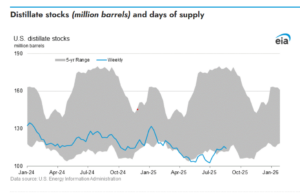
The US market is short diesel in storage while the Oregon market is short CO2 credits causing a unique market condition as we head into fall.

Diesel prices in the Pacific Northwest have not been following National trends for diesel.  The west coast is paying a premium compared to other nearby states.  Diesel in Oregon is significantly higher than the national average.  More to the point, the carbon credits associated with biodiesel and renewable diesel in Oregon are trading at recent record high prices. Higher than California’s CO2 credit prices. What’s going on?

Well for once it isn’t the price of crude oil causing this, or the amount of biofuels. Its all about todays Oregon diesel and carbon markets.  The story starts a few weeks before Memorial day.

Memorial day is often cited as the kick off to the driving season.  It also is when we usually see construction and trucking pick up with the summer weather.  A few weeks before Memorial day the Olympic pipeline went down unexpectedly.  The Olympic pipeline serves Portland and Eugene with their diesel and gasoline fuels from the refineries in northwest Washington state.

That pipeline had an unexpected outage.  Those happen for plenty of reasons usually safety checks or repairs. When the pipeline went down the market was notified it would probably be a week and open again the Monday before memorial day.  That Monday, the Monday before one of the bigger fuel weekends of the year, came and notice went out the pipeline would still be down for another week.

At that moment supply was already short for gas and diesel. Especially diesel.  The Portland and Eugene market saw diesel like a dollar cheaper in states like Idaho, Utah and others. So guess where diesel started flowing from? Markets responded as the bigger players on the ground in Oregon started moving diesel from those states.  Your local truck stops, gas stations, and cardlocks didn’t run out of fuel in several parts of Oregon because of these efforts.

In a US diesel market that was already tight for diesel supply, Portland, Oregon had an event that made it even tighter demanding diesel from around the region. Markets responded sending higher price offers to bring diesel into Oregon. Source is US EIA.

Oregon does not have any petroleum refineries or even biofuel plants.  It can only be supplied by pipeline, barge, rail or truck from outside the state.  When the pipeline came back online quite a bit of outside diesel had flowed into the state from nontraditional sources by rail and truck.

The people who moved that diesel are regulated in Oregon with two programs for CO2 emissions.  One is called the Clean Fuels Program which requires anyone importing diesel into Oregon to come up with a CO2 reductions by either blending low carbon biofuels or buying CO2 credits from others that use those fuels in the state.  Oregon also has a Cap and Invest program which only allows so much fossil fuel to be sold inside Oregon in a calendar year.  Oregon caps the total market for fossil fuels sold at retail stations as part of it’s carbon reducing strategy.

Guess what happens when a bunch of suppliers start bringing in gas and diesel to meet the market need?  They have to come up with Carbon credits and allowances to meet those carbon reduction programs for liquid fuels.  When unexpected volumes of diesel get imported into Oregon the CO2 market dynamics change.

For diesel, they need to start blending biofuels such as renewable diesel and biodiesel.  So since that Memorial Day pipeline outage the people who imported diesel from other states need CO2 credits under Oregon Clean Fuels Program as well as to ensure they done sell to many additional gallons of fossil fuel diesel to exceed the allowance of Oregon’s cap and invest regime.

Therefore CO2 credits are high, people are trying to blend more biofuels to catch up to the unexpected volumes of diesel they moved into Oregon.  Prices are higher than the rest of the US for diesel as a hangover to the supply disruption.

Upside for the first summer in a few years there is plenty of Renewable Diesel in the Portland, Oregon market as the CO2 credit prices are higher than California and the diesel prices are also high to help.  In the last month we have seen a huge amount of Renewable Diesel show up into the terminals in Portland.  So hopefully we will see lower prices heading into fall as all this works itself out.  As we pass by Labor Day the market cost of diesel should normalize and return to a much more affordable price.

The one downside of high diesel prices is that it makes Renewable Diesel the same price as fossil diesel.  If you want to try it, now is a good time where you can get it affordably and field test it for results with your fleet.  Want to see how it performs in reducing truck regens, EGR services, and see if fuel economy improves with a cleaner burning synthetic diesel running in your fleet.  This fall is a good time to experiment with it.

If you want to try Renewable Diesel in your fleet.  Star Oilco has it immediately available.  Please reach out to give it a try at either our Cardlock locations, with Mobile Onsite Refueling in your yard, or a Loaner Bulk Tank trial of the fuel in a few trucks.

Star Oilco has Renewable Diesel seven days a week for your fleet: Mobile Onsite Fueling, Cardlock, and Bulk Delivery.
Call us at 503-283-1256 or email at OrderDesk@StarOilco.net.

Renewable Diesel in Oregon

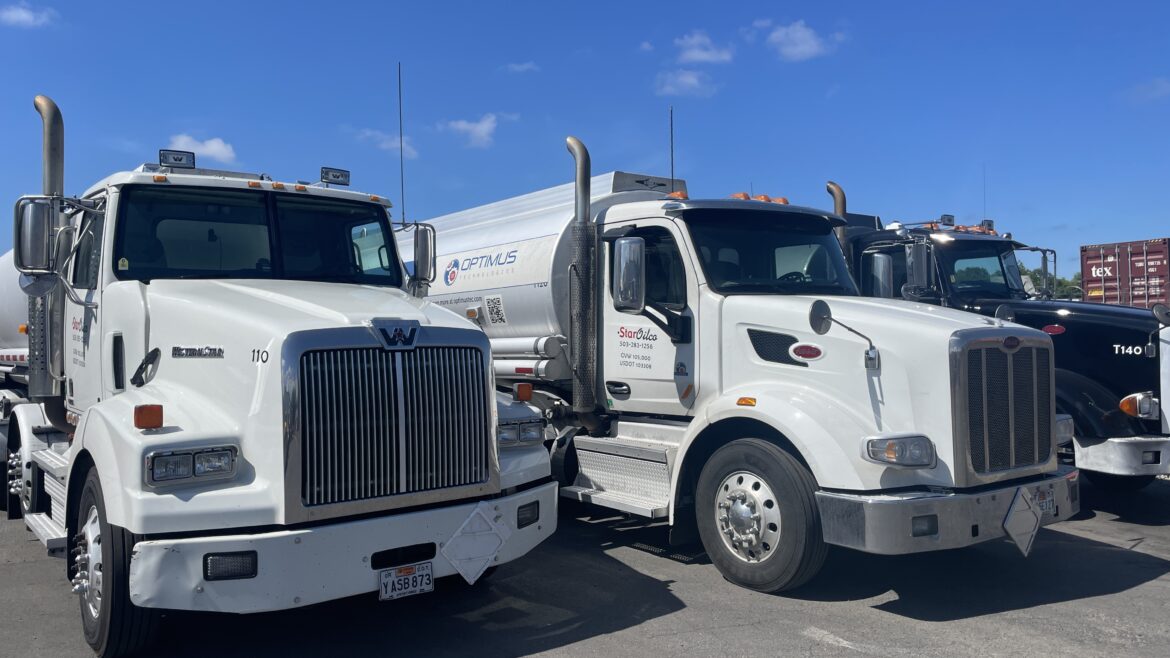
Star Oilco fuel trucks staged for mobile on-site fueling
On-Site Mobile Fueling Benefits -Truck Fleets 1024 768 Star Oilco

On-Site Mobile Fueling Benefits -Truck Fleets

For companies that operate truck fleets, managing fuel consumption is a critical aspect of their operations. Refueling logistics and costs can pose significant challenges. A fuel delivery truck service is also known as fleet fueling, mobile fueling or wet hosing. By incorporating a fleet fueling service that fills their trucks every morning, companies will reap numerous benefits and eliminate additional costs. Through this approach of fleet fueling, efficiency will be improved. Costs are reduced and operations are streamlined. Ultimately, this improves profitability and sustainability for the company and the environment. 

Enhanced Operational Efficiency 

Having a fuel delivery truck fill a company’s truck fleet each morning can significantly enhance operational efficiency. Instead of requiring drivers to waste valuable time searching for gas stations and waiting in queues, the fleet is primed and ready for their daily routes. This allows for optimized productivity as drivers can focus on their core responsibilities through wet hose fueling.

Furthermore, with a centralized refueling system, companies can eliminate the risk of trucks running low on fuel during the day. This minimizes unforeseen delays, ensuring timely deliveries and improving customer satisfaction. The streamlined refueling process also reduces administrative burdens, eliminating drivers to track fuel expenses and submit reimbursement forms.  

Cost Savings and Budget Predictability

Implementing a fuel delivery truck service offers substantial cost savings for companies with truck fleets. By purchasing fuel in bulk, companies can negotiate favorable pricing terms with the fuel supplier. It allows companies to secure discounts or fixed rates. Fuel costs predictability allows for better budget planning, avoiding fluctuating fuel prices.

By eliminating the need for drivers to refuel at public gas stations, the company can prevent unauthorized fuel purchases, fuel theft, and the potential for inaccurate expense reporting. The fuel delivery service ensures that fuel consumption is closely monitored, minimizing fuel misuse.  

In addition, having a dedicated fuel delivery truck also reduces the wear and tear on company trucks caused by constant stops at gas stations. This reduces maintenance and repair costs in the long run. With regular fuel top-ups in the morning, trucks operate at optimal fuel levels, improving engine performance and extending their lifespan.  

Environmental Sustainability

By consolidating fuel delivery through a dedicated truck, companies can contribute to environmental sustainability. Bulk fuel delivery reduces the number of individual fuel stops to gas stations, resulting in reduced carbon emissions. The streamlined fleet fueling process also minimizes fuel spills and or possible leakage from conventional methods. This solution preserves air and soil quality. 

Furthermore, adopting a fuel delivery service encourages alternative and cleaner fuels. Companies can explore options like biodiesel or electric vehicles, and the fuel delivery truck can be equipped to accommodate these eco-friendly fuel sources. By transitioning to greener fuels, companies can reduce their carbon footprint and align with environmental regulations and customer preferences.  

For companies with truck fleets, integrating a fuel delivery truck service offers numerous advantages. Moreover, the streamlined refueling process through fleet fueling or mobile fueling enhances operational efficiency. Your truck fleets will benefit from fleet fueling by eliminating your employees wasting time on the clock with refueling stops. You will also benefit from the minimized administrative burdens. Cost savings are achieved through bulk purchasing, predictable budgeting, and reduced maintenance expenses. This approach contributes to environmental sustainability by reducing carbon emissions and promoting cleaner fuel alternatives.  

By optimizing fuel management and leveraging the many benefits of fuel delivery, companies can drive their fleet operations to new levels of productivity, cost-effectiveness, and environmental responsibility. Embracing this innovative solution not only benefits the company itself but also enhances customer satisfaction and positions the company as a leader in sustainable business practices. 

Two semi-trucks driving on a highway with trees in the background
Fuel Market Report: August 10th-16th, 2025 1024 683 Star Oilco

Fuel Market Report: August 10th-16th, 2025

Fuel Market Report by Star Oilco Banner
1 Month Average Retail Gasoline and Crude Oil Price Chart – Oregon, Washington, and U.S. Trends (July–August 2025)

Wholesale Price Average 8/16/25

Wholesale LowWholesale Avg
E10$2.51$2.69
B5$2.83$2.94
B20$2.81$3.02
R99$3.64$2.79

Average Retail Prices 8/16/25

NationalOregonWashington
E10$3.14$3.98$4.41
B5$3.69$4.47$5.01

Taxes

FederalState: ORLocalState: WA
Gas$0.184$0.40$0-.13$0.554
Diesel$0.244$0.40$0-.13$0.584

Oregon Fuel Price Variance

Oregon average fuel price variance chart on Regular, Mid, Premium, and Diesel (August 2025)

Fuel Market News

Diesel prices are down significantly and gas prices have hovered around the same price range for the wholesale rack average market. These prices have had little impact at the street pump price level so drivers are not seeing as much of a difference as distributors. Diesel prices have dropped over $0.20/gal since the beginning of August while gas prices have hovered around the $3.90/$4.00 range. Gas prices should remain around this level in coming weeks with a slight uptick in late September when the winter blend of fuel begins to hit the market and then a further downtick in gas prices both wholesale and retail. Drivers can expect to see lower gas prices October 1st than today. The summer was a very mild one for hurricanes as the South experience next to no distributions in production due to natural disasters. This could change this week with Hurricane Erin reaching a category 4 and headed to the east coast and Florida region.

fuel-market-report-star-oilco-5-18-24

Important Note: Per the City Of Portland, “Distributors in the City of Portland are required to meet the minimum biofuel content requirements for all fuel they distribute beginning on May 15, 2024. All diesel fuel distributed to retail stations, non-retail dealers, or wholesale purchaser-consumers must include a minimum of 15% biofuel content, from either renewable diesel or biodiesel. This requirement increases to 50% on May 15, 2026, and 99% on May 15, 2030”.

Crude oil is trading below $70, at a current price of $63.34/barrel. This is $1.80/barrel lower than it was last week. 


Crude oil is the main ingredient for gasoline and diesel. Per AAA, on average about 50% of what you pay at the pump is the price of crude oil, breaking down as 25% refining, 11% distribution & marketing, and 14% taxes—a helpful breakdown for consumers wondering why they are paying the prices that they pay. Crude Oil is currently trading at $63.34/barrel compared to $65.14/barrel last week and $69 a year ago.

It’s essential to recognize that fuel prices result from a complex interplay of the factors mentioned above and other regional factors. Additionally, prices may vary by specific regions within Oregon and Washington. For the most precise and up-to-date information on fuel prices and the causes for these price changes within your area, use the links below for AAA & GasBuddy.

If you have any questions, feel free to contact Star Oilco and speak to one of our fuel market advisors to discuss how the market can impact your business.

For other news in the fuel market:

● https://gasprices.aaa.com/?state=OR

● https://www.gasbuddy.com/charts

Join the Fuel Market Report newsletter for your weekly fill of updates!

Two semi-trucks driving on a highway with trees in the background
Fuel Market Report: July 13th-19th, 2025 1024 683 Star Oilco

Fuel Market Report: July 13th-19th, 2025

Fuel Market Report by Star Oilco Banner
Regional gasoline price trends for Oregon and Washington compared with national gas and crude oil prices

Wholesale Price Average 7/19/25

Wholesale LowWholesale Avg
E10$2.46$2.57
B5$3.19$3.27
B20$3.28$3.32
R99$3.17$3.22

Average Retail Prices 7/19/25

NationalOregonWashington
E10$3.14$4.98$4.39
B5$3.72$4.51$5.03

Taxes

FederalState: ORLocalState: WA
Gas$0.184$0.40$0-.13$0.554
Diesel$0.244$0.40$0-.13$0.584

Oregon Fuel Price Variance

Oregon average fuel prices for regular, midgrade, premium gasoline and diesel with price comparisons

Fuel Market News

Fuel prices trickled down this week with both gas and diesel prices dropping. Although the drops were very marginal, with gas prices down $0.02/gal and diesel prices down less than $0.05/gal. Rack averages in Portland saw a steeper drop-off while retail street prices hardly budged. Fuel prices should remain steady in the coming weeks as political climates in the Middle East have toned down and hurricane season has been very quiet for the southern states. Historically, fuel prices have been higher around this time of year with summer travel and increased demand for fuel. Yet surprisingly, fuel prices were at the exact same level in Portland a year ago today. Iran has agreed to new nuclear talks amid the tensions in the Middle East. On July 22nd Britan, France, Germany and Iran will hold talks to re-engage this discussion.

fuel-market-report-star-oilco-5-18-24

Important Note: Per the City Of Portland, “Distributors in the City of Portland are required to meet the minimum biofuel content requirements for all fuel they distribute beginning on May 15, 2024. All diesel fuel distributed to retail stations, non-retail dealers, or wholesale purchaser-consumers must include a minimum of 15% biofuel content, from either renewable diesel or biodiesel. This requirement increases to 50% on May 15, 2026, and 99% on May 15, 2030”.

Reasons For Price Variance

Oil Prices Below $70

OPEC+ Production Cuts

Crude oil is trading just below $70, at a current price of $67.10/barrel. This is $0.49/barrel higher than it was last week.


Crude oil is the main ingredient for gasoline and diesel. Per AAA, on average about 50% of what you pay at the pump is the price of crude oil, breaking down as 25% refining, 11% distribution & marketing, and 14% taxes—a helpful breakdown for consumers wondering why they are paying the prices that they pay. Crude Oil is currently trading at $67.10/barrel compared to $66.61/barrel last week and $69 a year ago.

It’s essential to recognize that fuel prices result from a complex interplay of the factors mentioned above and other regional factors. Additionally, prices may vary by specific regions within Oregon and Washington. For the most precise and up-to-date information on fuel prices and the causes for these price changes within your area, use the links below for AAA & GasBuddy.

If you have any questions, feel free to contact Star Oilco and speak to one of our fuel market advisors to discuss how the market can impact your business.

For other news in the fuel market:

● https://gasprices.aaa.com/?state=OR

● https://www.gasbuddy.com/charts

Join the Fuel Market Report newsletter for your weekly fill of updates!

Two semi-trucks driving on a highway with trees in the background
Fuel Market Report: July 6th-12th, 2025 1024 683 Star Oilco

Fuel Market Report: July 6th-12th, 2025

Fuel Market Report by Star Oilco Banner
Pacific Northwest gas prices compared with U.S. average gasoline and crude oil price trends

Wholesale Price Average 7/12/25

Wholesale LowWholesale Avg
E10$2.45$2.58
B5$3.23$3.31
B20$3.25$3.35
R99$3.29$3.36

Average Retail Prices 7/12/25

NationalOregonWashington
E10$3.15$4.00$4.40
B5$3.70$4.50$5.00

Taxes

FederalState: ORLocalState: WA
Gas$0.184$0.40$0-.13$0.554
Diesel$0.244$0.40$0-.13$0.584

Oregon Fuel Price Variance

Oregon gasoline and diesel prices for regular, midgrade and premium gas with previous fuel price averages

Fuel Market News

Fuel prices trickled up this week, with street retail prices dropping slightly and rack averages going up about $0.05/gal. Portland rack averages for gas jumped $0.07/gal, while B5, B20 & R99 diesel averages moved up less than $0.03/gal. AAA analysts predict prices at the pump will continue to fall as tensions calm in the Middle East and no hurricanes are expected to hit the Golf Coast in the coming weeks. According to the EIA, “Gasoline production dipped last week, averaging 9.6 million barrels per day, compared to 10.1 million barrels the previous week”. Although this dip may not seem extreme, it is surprising coming off a record-setting 4th of July with traveling trends reaching all-time highs. With inventories relatively steady, we should see prices at the pump hover around their current price with some slight dips into August.

Oregonians may be in store for higher diesel prices this year with the end of Blenders Tax Credits, the introduction of the Producers Tax Credit & the Oregon Climate Protection Program going into 2025. For more on this report, visit the link below.

2025 Fuel Market Outlook: Oregon

fuel-market-report-star-oilco-5-18-24

Important Note: Per the City Of Portland, “Distributors in the City of Portland are required to meet the minimum biofuel content requirements for all fuel they distribute beginning on May 15, 2024. All diesel fuel distributed to retail stations, non-retail dealers, or wholesale purchaser-consumers must include a minimum of 15% biofuel content, from either renewable diesel or biodiesel. This requirement increases to 50% on May 15, 2026, and 99% on May 15, 2030”.

Reasons For Price Variance

Oil Prices Below $70

OPEC+ Production Cuts

Crude oil is trading just below $70, at a current price of $66.61/barrel. This is $1.39/barrel lower than it was last week.


Crude oil is the main ingredient for gasoline and diesel. Per AAA, on average about 50% of what you pay at the pump is the price of crude oil, breaking down as 25% refining, 11% distribution & marketing, and 14% taxes—a helpful breakdown for consumers wondering why they are paying the prices that they pay. Crude Oil is currently trading at $66.61/barrel compared to $68.00/barrel last week and $70 a year ago.

It’s essential to recognize that fuel prices result from a complex interplay of the factors mentioned above and other regional factors. Additionally, prices may vary by specific regions within Oregon and Washington. For the most precise and up-to-date information on fuel prices and the causes for these price changes within your area, use the links below for AAA & GasBuddy.

If you have any questions, feel free to contact Star Oilco and speak to one of our fuel market advisors to discuss how the market can impact your business.

For other news in the fuel market:

● https://gasprices.aaa.com/?state=OR

● https://www.gasbuddy.com/charts

Join the Fuel Market Report newsletter for your weekly fill of updates!

Two semi-trucks driving on a highway with trees in the background
Fuel Market Report: June 29th – July 5th, 2025 1024 683 Star Oilco

Fuel Market Report: June 29th – July 5th, 2025

Fuel Market Report by Star Oilco Banner
1-month average retail fuel price trends in Oregon, Washington, and the USA alongside crude oil prices for June 29th through July 5th

Wholesale Price Average 7/5/25

Wholesale LowWholesale Avg
E10$2.42$2.51
B5$3.22$3.29
B20$3.19$3.33
R99$3.28$3.35

Average Retail Prices 7/5/25

NationalOregonWashington
E10$3.14$4.02$4.41
B5$3.68$4.47$4.95

Taxes

FederalState: ORLocalState: WA
Gas$0.184$0.40$0-.13$0.554
Diesel$0.244$0.40$0-.13$0.584

Oregon Fuel Price Variance

Chart of average gas prices over time for Regular, Mid, Premium, and Diesel in July 2025.

Fuel Market News

The past week brought a mix of pricing fluctuation, with gas prices down and diesel prices up. Rack averages in Portland dipped $0.05/gal for gasoline and jumped $0.02/gal for diesel. Smaller price fluctuations than weeks past, as the market is still balancing the heightened political climate in the Middle East, with much remaining uncertain for the weeks ahead. Crude oil is hovering just below $70/barrel at a current rate of $68.00/WTI Crude, and is expected to remain at this level in the weeks ahead. Retail fuel prices are still high in Oregon and Washington, with most retail stations in Portland averaging around $4.15/gal. The 4th of July brought an increase of 1.7 million drivers traveling, which is up 2.4% from last year.

Oregonians may be in store for higher diesel prices this year with the end of Blenders Tax Credits, the introduction of the Producers Tax Credit & the Oregon Climate Protection Program going into 2025. For more on this report, visit the link below.

2025 Fuel Market Outlook: Oregon

fuel-market-report-star-oilco-5-18-24

Important Note: Per the City Of Portland, “Distributors in the City of Portland are required to meet the minimum biofuel content requirements for all fuel they distribute beginning on May 15, 2024. All diesel fuel distributed to retail stations, non-retail dealers, or wholesale purchaser-consumers must include a minimum of 15% biofuel content, from either renewable diesel or biodiesel. This requirement increases to 50% on May 15, 2026, and 99% on May 15, 2030”.

Reasons For Price Variance

Oil Prices Below $70

OPEC+ Production Cuts

Crude oil is trading below $70, at a current price of $68.00/barrel. This is $3.09/barrel higher than it was last week. 


Crude oil is the main ingredient for gasoline and diesel. Per AAA, on average about 50% of what you pay at the pump is the price of crude oil, breaking down as 25% refining, 11% distribution & marketing, and 14% taxes—a helpful breakdown for consumers wondering why they are paying the prices that they pay. Crude Oil is currently trading at $68.00/barrel compared to $64.91/barrel last week and $72 a year ago. 

It’s essential to recognize that fuel prices result from a complex interplay of the factors mentioned above and other regional factors. Additionally, prices may vary by specific regions within Oregon and Washington. For the most precise and up-to-date information on fuel prices and the causes for these price changes within your area, use the links below for AAA & GasBuddy.

If you have any questions, feel free to contact Star Oilco and speak to one of our fuel market advisors to discuss how the market can impact your business.

For other news in the fuel market:

● https://gasprices.aaa.com/?state=OR

● https://www.gasbuddy.com/charts

Join the Fuel Market Report newsletter for your weekly fill of updates!

Two semi-trucks driving on a highway with trees in the background
Fuel Market Report: June 22nd-28th, 2025 1024 683 Star Oilco

Fuel Market Report: June 22nd-28th, 2025

Fuel Market Report by Star Oilco Banner
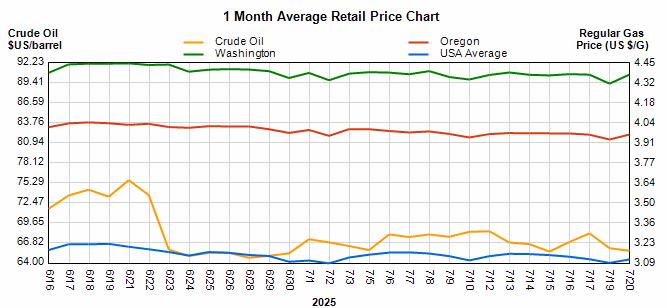
1-month average retail fuel price trends in Oregon, Washington, and the USA alongside crude oil prices for June 22nd through June 28th

Wholesale Price Average 6/28/25

Wholesale LowWholesale Avg
E10$2.43$2.56
B5$3.16$3.27
B20$3.27$3.32
R99$3.13$3.27

Average Retail Prices 6/28/25

NationalOregonWashington
E10$3.19$4.05$4.43
B5$3.69$4.46$4.92

Taxes

FederalState: ORLocalState: WA
Gas$0.184$0.40$0-.13$0.554
Diesel$0.244$0.40$0-.13$0.584

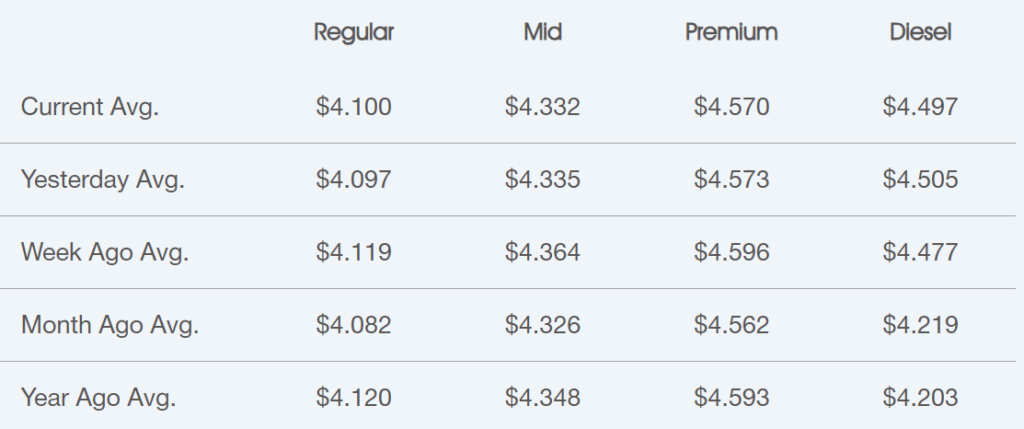
Oregon Fuel Price Variance

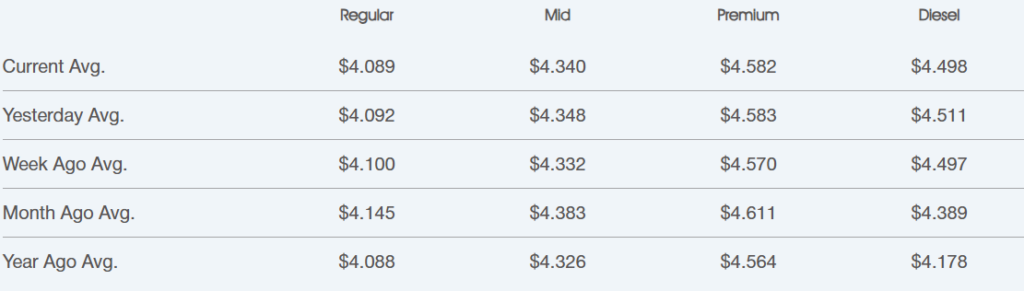
Current average fuel prices for regular, mid-grade, premium gasoline, and diesel in June 2025.

Fuel Market News

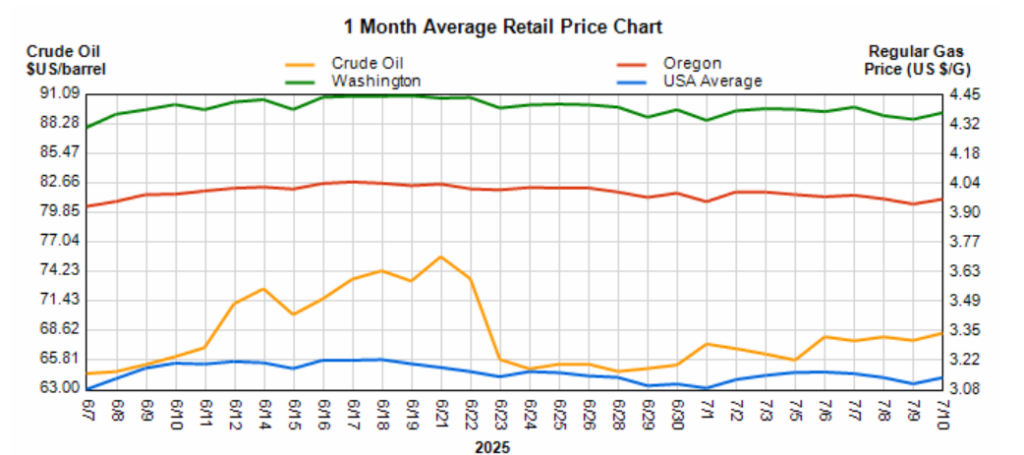
The past week brought downward price fluctuations as oil prices dipped and rack averages dropped. Rack averages in Portland were $0.10/gal lower than the week prior across the board for both gas and diesel. The retail street price did not see these dips, as the Oregon retail average remained high around $4.15 and closer to $4.20 in the greater Portland area. After the heightened tensions and missile strikes on Iran, many analysts expected the market to skyrocket for crude oil prices, while the opposite occurred. Crude oil prices peaked at $74/barrel on June 20th and have since dropped below $65 as of the 30th.

Oregonians may be in store for higher diesel prices this year with the end of Blenders Tax Credits, the introduction of the Producers Tax Credit & the Oregon Climate Protection Program going into 2025. For more on this report, visit the link below.

2025 Fuel Market Outlook: Oregon

fuel-market-report-star-oilco-5-18-24

Important Note: Per the City Of Portland, “Distributors in the City of Portland are required to meet the minimum biofuel content requirements for all fuel they distribute beginning on May 15, 2024. All diesel fuel distributed to retail stations, non-retail dealers, or wholesale purchaser-consumers must include a minimum of 15% biofuel content, from either renewable diesel or biodiesel. This requirement increases to 50% on May 15, 2026, and 99% on May 15, 2030”.

Crude oil is trading below $65, at a current price of $64.91/barrel. This is $3.85/barrel lower than it was last week.


Crude oil is the main ingredient for gasoline and diesel. Per AAA, on average about 50% of what you pay at the pump is the price of crude oil, breaking down as 25% refining, 11% distribution & marketing, and 14% taxes—a helpful breakdown for consumers wondering why they are paying the prices that they pay. Crude Oil is currently trading at $64.91/barrel compared to $68.76/barrel last week and $74 a year ago.

It’s essential to recognize that fuel prices result from a complex interplay of the factors mentioned above and other regional factors. Additionally, prices may vary by specific regions within Oregon and Washington. For the most precise and up-to-date information on fuel prices and the causes for these price changes within your area, use the links below for AAA & GasBuddy.

If you have any questions, feel free to contact Star Oilco and speak to one of our fuel market advisors to discuss how the market can impact your business.
For other news in the fuel market:

● https://gasprices.aaa.com/?state=OR

● https://www.gasbuddy.com/charts

Join the Fuel Market Report newsletter for your weekly fill of updates!