
Posts Tagged :

Biological Growth

Close-up of a diesel fuel droplet creating ripples in a golden liquid
What is the benefit of Premium Diesel versus normal diesel? 1024 769 Star Oilco

What is the benefit of Premium Diesel versus normal diesel?

Premium Diesel delivered in Oregon and Washington with every gallon of Star Oilco diesel.

Are you clogging filters, seeing corrosion, suffering repeated DPF regens, or fighting biological growth in your tank?

Premium Diesel improves engine performance and reduces DPF regens.

Premium Diesel with routine tank maintenance is the solution to your problem.

Premium diesel provides real benefits to the long term maintenance cost of any diesel fleet.

Hydrotex PowerKleen Premium Diesel has a higher cetane, an aggressive detergent for cleaning injectors and tanks, pushes water out of the fuel keeping it dry while traveling down your fuel rail, as well as stabilizes the fuel to ensure it does not begin to grow algae or other biological problems in your tank.

Hydrotex PowerKleen Premium Diesel has plenty of benefit for a very small additional cost.  The most profound and not highlighted is the effect on long term storage of tanks and what your bulk storage tank bottoms look like long term. Namely that the corrosion inhibitors, moisture demulsifiers and stability benefits of Premium Diesel will pay back dividends for your entire fleet.  As time passes the bottom of your tank begins to age and collect anything that might fall out of solution.  Premium diesel will significantly reduce these danger particles that can get into your fleet’s fuel system.  Premium diesel not only improves the active daily performance of your fleet, it also prevents the long term problems that build up in fuel storage.

A first hand extreme example.  Recently we have seen where a customers sprinklers put a huge quantity of water in their storage tank and the additive kept that fuel bright, clean and not growing fuel algae.  Upon sending the sample to the lab of course water content was higher than you want, but that fuel was in great shape considering this extreme failure of fuel quality assurance. Controlling and preventing for the unforeseen is worth the effort.  What might have been a disaster costing tens of thousands in down equipment was an oddity we were able to fix for them in a few hours.  All because additive fuel kept that fuel within specification even in the most extreme of scenarios.


To read more about Hydrotex PowerKleen Premium Diesel and more in depth research on the benefits of premium diesel:  Hydrotex PowerKleen Premium Diesel Brochure.

Backup Generator Fuel Portland

If you have a commercial fleet and want to have Star Oilco sample and test your fuel for quality assurance please do not hesitate to ask. We are here to help.

Tank Testing Form

  • This field is for validation purposes and should be left unchanged.
Aerial view of a truck driving on a highway through a forest
BioGuard Plus 6 Stabilize Your Diesel Tank 1024 463 Star Oilco

BioGuard Plus 6 Stabilize Your Diesel Tank

Spring is just around the corner.

Have you stabilized the diesel in your generator?

Water and temperature changes can contribute to growth in your tanks.

Prepare your diesel fuel, heating oil, kerosene, or boiler fuel storage and make sure it works when you need it.

With the Fire last fall and the recent power outages many generators have recently been filled. If you haven’t added stabilizers and a biocide to your fuel you may not be ready for the next emergency.

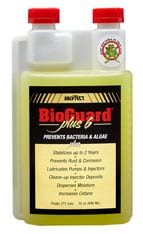
Kill bacteria, bugs, and yeasts growing in your diesel fuel with Valvtect BioGuard Plus 6

Valvtect BioGuard Plus 6

Use this diesel fuel microbiocide every spring and winter to guarantee your tank is not providing a habitat to fuel system-spoiling microbes.

Water in diesel is a fact of life these days. Biological growth spoiling your fuel quality does not have to be. Ultralow sulfur diesel and biodiesel have water in them. Over time, water entrained in your diesel fuel can fall out of solution. Add to that the condensation that will naturally develop in your fuel tank and you have an environment for humbug to grow in your heating oil, diesel, or boiler fuel storage tank.

When it is raining, your tank is likely breathing in the water. With the rainy season, be aware that water is everywhere unless you work to seal it out of your fuel storage system.

If your tank does not have a desiccant breather on it, your fuel tank can collect condensation. As air moves in and out of the tank with temperature changes, moisture will collect on the wall of the tank. Yeasts, bacteria, fungi, and algae can grow in the water that collects on the bottom of the tank. Make sure your tank is not a habitat for growing bugs every spring and winter.

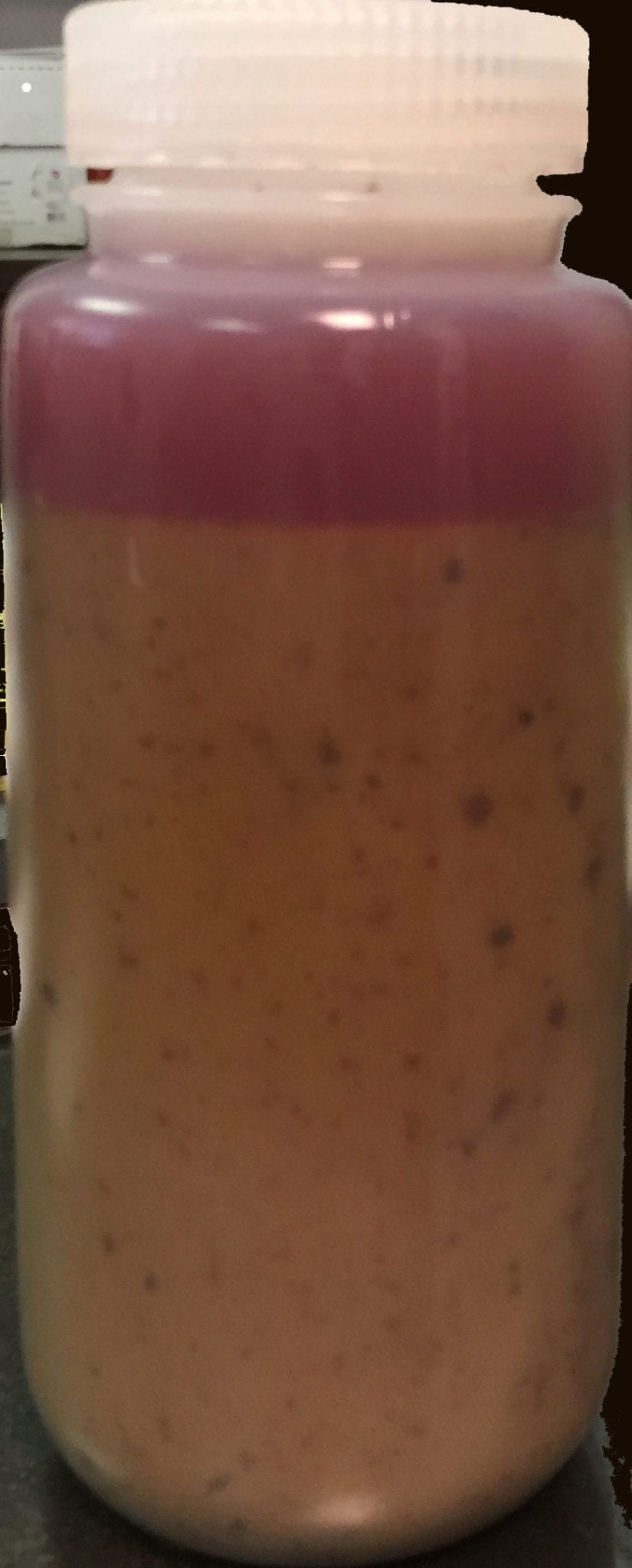
Microbiological growth in diesel fuel, also known as “humbug” in fuel, can start growing and, if unchecked, will wreak havoc with your fleet. Once it starts in your fuel tank, it will spread throughout your fleet. If you see a random need to spin filters between services or odd fuel-related maintenance issues, you likely have bugs growing in your fuel tanks.

Star Oilco recommends BioGuard Plus 6 as a regular biocide for routine maintenance.  

BioGuard Plus 6 is the only EPA-certified biocide product that contains both a biocide as well as a fuel stabilizer with detergent. This detergent stabilizer acts as an aggressive tank cleaner (NOTE: BioGuard available without Plus 6).

When using Valvtect BioGuard, treat first with a kill, performed in your bulk diesel storage. That will spread and kill the growing bugs in your fleet. Maintenance will clean up any remaining bacteria. If you do not have a known or visible problem, a kill twice a year is a great way to guarantee bacteria does not appear and you can treat the individual tanks of your fleet.

Product Specifications:

ValvTect BioGuard™ PLUS 6Valvtect BioGuard Plus 6

BioGuard® Plus 6™ is the ONLY EPA registered diesel additive that combines a biocide with a multi-functional diesel additive to prevent bacteria, algae and all other major diesel related problems.

BioGuard Plus 6 is the perfect solution for ultra low sulfur diesel and biodiesel problems; such as bacteria, algae, excess water, sludge, filter plugging, injector wear & deposits, poor fuel economy and unstable fuel.

Only BioGuard Plus 6 prevents bacteria and algae growth, plus:

  • Stabilizes fuel for up to 2 years
  • Prevents rust and corrosion
  • Lubricates pumps and injectors
  • Cleans-up injector deposits
  • Disperses moisture
  • Increases cetane

ValvTect BioGuard Plus 6
“It’s ALL Your Diesel Fuel Needs!”

32 oz Bottle treats 375 Gallons
1 Gallon Bottle treats 1500 Gallons
Also available in 2.5 Gallon Plastic Bottles, 55 Gallon Drums and 300 Gallon Totes


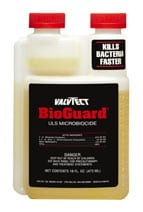
BioGuard ULS Fuel Microbiocide

BioGuard is an EPA registered dual soluble (fuel & water) microbiocide that effectively kills bacteria and fungi that grow in diesel fuel, heating oil and gasoline. BioGuard also prevents bacteria caused filter plugging and bacteria caused corrosion of the fuel system.

BioGuard typically works in 2-3 hours versus 24-36 hours needed by other biocide products. BioGuard has also been found to be up to twice as effective as other biocides.

BioGuard can be used in all diesel and gasoline bulk tanks and vehicle tanks, including marine, farm, truck fleet, home heat, generators, and railroad storage tanks.

  • Kills bacteria and other biocontamination quickly
  • Twice as effective as other biocides
  • Breaks up sludge and slime
  • Prevents bacteria plugged filters
  • Prevents bacteria caused corrosion
  • Bottle contains easy measuring spout

16 oz. container treats 460 gallons of diesel fuel at the initial kill treat rate.
16 oz. container treats 920 gallons of diesel fuel at the maintenance treat rate.

Learn more about Valvtect BioGuard Plus 6.

If you have any questions about routine tank maintenance or to order Valvtect BioGuard products, please don’t hesitate to contact Star Oilco directly by email, message, or phone.  If you would like to learn more about checking your tank for growth this is a great checklist. 

Contact Form

  • This field is for validation purposes and should be left unchanged.
Close-up abstract image of diesel fuel with suspended droplets and fluid motion
About Diesel Fuel 1024 512 Star Oilco

About Diesel Fuel

Bulk Diesel Fuel Frequently Asked Questions

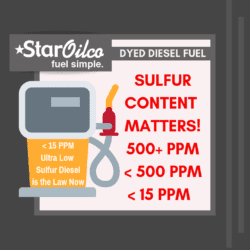
Ultra Low Sulfur Diesel is 15 PPMDyed Off-Road Diesel

Where your diesel comes from and what you need to know about ASTM Diesel Standards and ISO cleanliness code.

Where do Pacific Northwest vendors get their fuel?

In the Pacific Northwest, diesel is fungible. Everyone buys their fuel from each other in some way or another.  

This means that every refiner is typically expecting to mix their diesel and gasoline products. The real difference is in the care a vendor takes to filter the fuel, additize and continuously check their fuel quality. If you are buying at the absolute lowest price possible, know that there is an incentive to skip any added value of quality assurance.

Through its Pacific Operations unit, Kinder Morgan operates approximately 3,000 miles of refined products pipeline that serves Arizona, California, Nevada, New Mexico, Oregon, Washington and Texas. With roots dating back to 1956, it is the largest products pipeline in the Western U.S., transporting more than one million barrels per day of gasoline, jet fuel and diesel fuel to our customers. The company-owned terminals also provide additional services, such as liquid petroleum product storage and loading facilities for delivery trucks.

Diesel Fuels

In the United States, diesel fuel is controlled according the American Society for Testing and Materials Standard D975-97.  This standard describes a limited number of properties that diesel fuels must meet.  It should be noted that the requirements are all performance- based.  They do not mandate the composition of the fuel, only the specific performance related requirements demanded of a fuel for a diesel engine.  The requirements of D975 are described below. 

ASTM Specifications for Diesel Fuel Oils (D975)*

* You can go to the source of ASTM HERE if you have an interest in really getting in depth.

Diesel fuel is characterized in the United States by the ASTM standard D975.  This standard identifies five grades of diesel fuel. We are only going to talk about the two most popular commercially diesel fuel used — No 1 and No. 2 diesel. The ASTM D975 standard is made up of a series of different tests that check the characteristic ranges of a fuel to confirm it is adequate to operate in your equipment. In simple terms, they are checking for specific gravity, the vapor point (when it turns into a gas), the flash point (when it catches fire), the dirt content, water content (how much microscopic entrained water), and a host of other requirements diesel must meet in order to be legal to be sold for use in your engine.

Grade No. 1-D and Ultra-Low Sulfur 1-D: This is a light distillate fuel for applications requiring a higher volatility fuel to accommodate rapidly fluctuating loads and speeds, as in light trucks and buses. The specification for this grade of diesel fuel overlaps with kerosene and jet fuel, and all three are commonly produced from the same base stock. One major use for No. 1-D diesel fuel is to blend with No. 2-D during winter to provide improved cold flow properties.  Ultra Ultra-Low sulfur fuel is required for on-highway use with sulfur level < 0.05%. 

Grade No. 2-D and Ultra-Low Sulfur 2-D:  This is a middle- or mid-grade distillate fuel for applications that do not require a high volatility fuel. Typical applications include high-speed engines that operate for sustained periods at high load. Ultra-Low sulfur fuel is required for on-highway use with sulfur level < 0.05%.

RecologyDealing with Dirty Fuel and Today’s Tier 4 Engines

Water and dirt are the biggest concerns for fuel quality. Why? Because no matter how perfect fuel is refined, these two elements can find their way into fuel and crash its performance. Water and dirt often build up in tanks just from the temperature change between night and day, causing a bulk fuel tank to breathe. Condensation and dust can also find their way into a bulk storage tank. If not addressed, they build up and will cause mechanical failures.

Dirty fuel will cause premature parts failure in equipment of any age. But newer equipment has far tighter tolerances than what we saw in previous decades. Today’s new and improved Tier 4 rail injector engines are more efficient, they burn cleaner, and run better, they are more powerful than ever before. But there are things that make fuel quality more important than ever. Because of the extremely high pressures (upwards of 35,000psi at the injector tip), the possibility of damage from dirty wet fuel is more prevalent than ever. This damage is much more pronounced in newer equipment with High Pressure Common Rail (HPCR) fuel systems. Hard particulate is commonly referred to as “dirt,” but is in fact made up of a wide variety of materials found at job sites (coal, iron, salt, etc.), generated by fuel tanks and lines (rust, corrosion, etc.) and inside engines (carbonaceous materials and wear particles).

Frequent diesel fuel filter changes — as well as the expensive, and time consuming, task of cleaning diesel fuel tanks — have become acceptable periodic maintenance, instead of a warning signal, for diesel engine failure. Diesel fuel filter elements should last a thousand hours or more, and injectors should endure 15,000 hours. However, since diesel fuel is inherently unstable, solids begin to form and the accumulating tank sludge will eventually clog your diesel fuel filters, ruin your injectors and cause diesel engines to smoke.

Symptoms

  • Clogged and slimy filters
  • Dark, hazy fuel
  • Floating debris in tanks
  • Sludge build up in tanks
  • Loss of power and RPM
  • Excessive smoke
  • Corroded, pitted injectors
  • Foul odor

The solids that form as the result of the inherent instability of the diesel fuel and the debris formed in the natural process of fuel degradation will accumulate in the bottom of your fuel tank. The sludge will form a coating or “bio-film” on the walls and baffles of the fuel tank, plug your fuel filters, adversely impact combustion efficiency, produce dark smoke from the exhaust, form acids that degrade injectors and fuel pumps, and impact performance. Eventually, fouled diesel fuel will clog fuel lines and ruin your equipment.

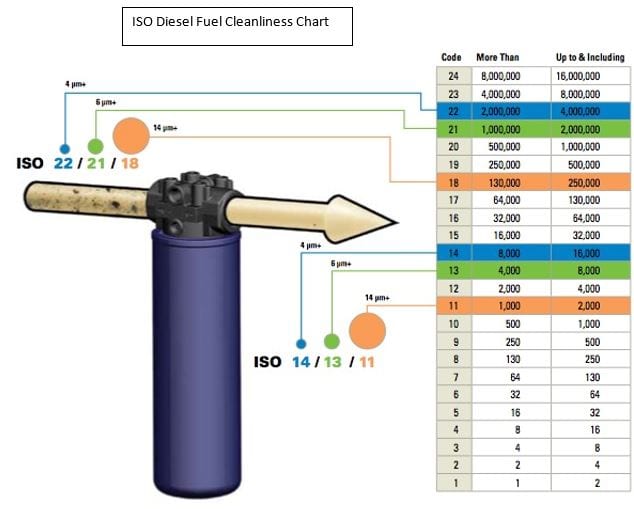
The Bigger Picture: ISO (International Standardization Organization)ISO Chart 1

In today’s world, the definition of what constitutes clean or dirty fuel is critically important and, as such, fuel cleanliness levels are now measured and reported according to the ISO Cleanliness Code 4406:1999. The International Organization for Standardization (ISO) created the cleanliness code to quantify particulate contamination levels per milliliter of fluid at three sizes: 4μ, 6μ, 14μ. Microns.

Fuel Cleanliness vs. Engine Technology

Fuel cleanliness levels using the ISO4406:1999 method were officially documented as a global standard only as recently as 1998 with the development of the Worldwide Fuels Charter (WWFC). Since its inception, the charter has established a minimum cleanliness level for each of the diesel fuels under various available categories around the world.

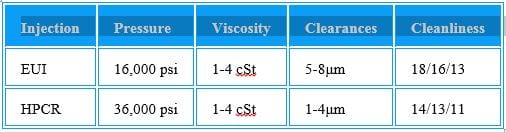
Most mainstream engine OEM’s now subscribe to these standards. Interestingly (and somewhat troubling to note), however, is that fuel cleanliness levels as specified by engine OEM’s and the WWFC have not changed since their inception in 1998, despite the enormous advances in fuel injection technology. This relationship is best represented in the previous table that identifies the advances in fuel injection systems and clearly highlights how OEM’s and the WWFC have not responded to reduce fuel cleanliness in accordance with advancements in technology.

Diesel Fuel Injection – Advancing Technologies & Cleanliness Levels

ISO Chart 4This table  identifies that, over time, fuel injector critical clearances have halved and fuel pressures have doubled, yet the level of fuel cleanliness being specified has not changed in accordance with such advancements. In fact, the same cleanliness levels specified in 2000 are still being used today despite these magnificent technological design advancements by engine manufacturers worldwide.

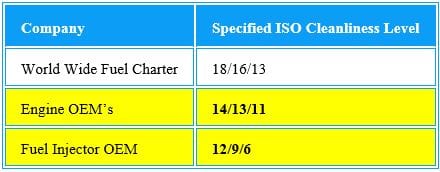
Leading fuel injector manufacturers around the world have clearly identified and communicated that they require ULSD fuels with ISO fuel cleanliness levels as low as ISO12/9/6 to maintain ultimate performance and reliability. It is here where we see an enormous mismatch in what the fuel injection OEM desires as a fuel cleanliness level, to what the engine OEM’s and the WWFC are advising the industry. The following table identifies the discrepancies in fuel cleanliness levels.

Diesel Cleanliness Levels

 ISO Chart 3                        


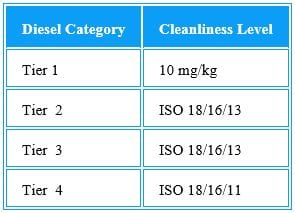
WWFC Diesel Category Fuel Cleanliness Standards                                                                                                      ISO Chart 5


Damage Caused by Hard Particulate

Hard particulates cause problems with moving parts in the fuel system. This can lead to starting problems, poor engine performance, idling issues and, potentially, complete engine failure. All too common, hard particulates damage engines.

The spray pattern generated by the HPCR injector is critical for proper combustion and overall fuel system performance. (1) sm-injector-with-red-light-Bosch

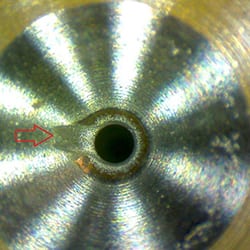
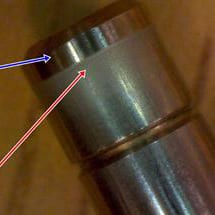
It must be extremely precise in terms of quantity, distribution and timing. Ball seat valves are sealed with balls that are only 1mm in diameter. A good seal is absolutely necessary for proper injection. Damage from erosive wear, such as shown below, will cause over fueling, leading to decreased fuel efficiency and eventually shut you down altogether.

hpcr injector damaged by hard particulate(3) high-pressure-fuel-system-wear

Pump performance can also be compromised by scoring and abrasive wear. These issues are magnified by tighter tolerances and extreme pressures in HPCR engines. In these circumstances, it is the smallest particles (1-5 microns in size) that cause the most damage, virtually sand blasting part surfaces.

Allowable Levels of Hard Particulate 

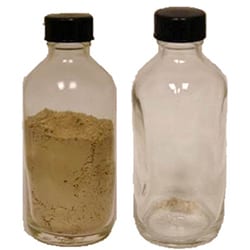
(4) dirt-in-vs-allowed-in-1000-gal-dieselIn some parts of the world, 10,000 gallons (38,000 liters) of “typical” diesel contains 1-1/2 lbs (700 grams) of hard particulate; this is 1000 times more than the 1/4 oz. (0.7 grams) per 10,000 gallons (38,000 liters) that is allowed by the cleanliness requirements of high pressure common rail fuel systems. In reality, there is no “OK” level of hard particulate. Injector manufacturers are very clear that damage caused by hard particulate reaching the engine is not a factory defect, but rather the result of dirty diesel that is not fit for use in HPCR fuel systems. At the end of the day, the end user is responsible for the fuel he puts into his equipment, and the consequences thereof.

How Dirt Enters Fuel

Dust and dirt are all around us, especially on job sites. Diesel fuel is fairly clean when it leaves the refinery but becomes contaminated each time it is transferred or stored. Below you will find some of the key contributors of fuel contamination:

Pipelines: Most pipelines are not new, and certainly not in pristine condition. Corrosion inhibitors are added at most refineries to help protect pipelines, but rust and other hard particulate is nevertheless picked up by the fuel that flows through them.

Barges and rail cars: How often are they drained and scrubbed out? What was in the last load? Where did it come from? How much of it was still in the tank when your load was picked up? How long was it in transit? Is the tank hermetically sealed? There are many opportunities for contaminants to make their way into the fuel.

Terminal tanks: Terminal tanks usually see a high rate of turnover, so there is not much time for the fuel to pick-up contamination from outside ingress. Has the tank ever received a “bad load” from a pipeline or a barge? Has larger dirt had a chance to settle on the bottom of the tank? How often has it been cleaned out? Was it just filled? Did the bottom get churned up in the process? How full was the tank when your fuel was loaded into the delivery truck? There are many variables that can affect fuel cleanliness.

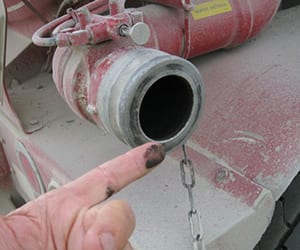
Delivery trucks: All the same issues that apply to stationary tanks also apply to tanker trucks, except that truck tanks never get a chance to settle. In addition, have you ever considered how much dirt gets into that tanker while it is delivering fuel to a customer, potentially a customer in an extremely dusty environment? As fuel flows out, air is sucked in to displace it. Is there anything protecting the inside of the tank from all the dust in the air? Generally not. Venting is typically completely unprotected, as seen in the image to the right.

Storage tanks: Onsite bulk storage tanks typically see less rapid turn-over than terminal tanks. In addition to those issues, yard and jobsite tanks can also develop serious problems with other sources of contamination, such as the ingress of dirt and water, condensation, rust, corrosion, microbial growth, glycerin fall-out and additive instability. Time and temperature become big factors affecting fuel quality.

Dispensing process: How far does your diesel need to travel between the bulk tank and the dispenser? The more pipe it runs though, the more potential there is for contamination. Are your dispenser nozzles kept clean? Are they ever dropped on the ground? Then what? What about the vehicles’ fuel tank inlets, are they clean? Think about the extremely tight tolerances in your fuel system, then take another look at housekeeping issues. You will see them through new eyes.

Onboard fuel tanks: Contamination continues even after the fuel is in the equipment. What has that tank seen in the past? Has it been left stagnant for long periods? What kind of protection is there on the equipment’s air intake vents? Heavy equipment does hard, dirty work.

Engines: Unfortunately, even if the fuel in your tank could be perfect, additional contamination is generated by the fuel system itself. Wear particles are created by mechanical friction. High heat and extreme pressure generated inside the modern engine, lead to coking and the creation of carbon products at the injector. Much of this internally-produced particulate is returned to the fuel tank, along with the unburned diesel.

The Bottom Line

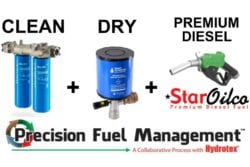
No one gets special fuel, no one has better fuel, no one has cleaner fuel. Diesel fuel vendors get the same fuel, from the same pipeline, delivered to the same terminals. We all wait in the same lines with our tank trucks to get that same fuel. So ask yourself: Given that the fuel is the same, what sets one vendor apart from all the others? Star Oilco Premium Diesel fuel is treated with Hydrotex PowerKleen® additive running through Donaldson filtration systems.

Clean, dry, premium diesel

FURTHER READING ON DIESEL FUEL:

Read about Star Oilco’s approach to Fuel Quality Assurance: Star Oilco – Precision Fuel Management

Read about dealing with biological growth in your diesel tank: Bioguard Plus 6 biocide treatment for diesel

Get Chevron’s Technical Manual to Diesel Fuel (essentially an easy to read text book on diesel): Chevron’s Fuel Technical Review

Get a white paper from Donaldson Filtration on tier 4 engines and fuel cleanliness: Donaldson on Tier 4 Engine Fuel Contamination

Read more about Donaldson Desiccant Breathers for bulk diesel tanks: Why use a Donaldson Desiccant Breather for a bulk diesel storage tank.

Close-up of clean diesel fluid stream with light reflections
Tier 4 Engines and Diesel Contaminants – Donaldson White Paper 683 1024 Star Oilco

Tier 4 Engines and Diesel Contaminants – Donaldson White Paper

Managing bulk diesel fuel storage has become more complex in recent years. Especially in Oregon and Washington the chance of water finding it’s way into your fuel tank is a real concern. If water gets in your bulk fuel biological growth or “hum bug” won’t be far behind.  Donaldson has positioned itself with real concrete solutions for for fuel quality.

With the extremely tight tolerances of today’s clean diesel engines and the expansion of sour crudes from tar sands, oil shale, and other source being hydrocracked into today’s ultra low sulfur diesel we have all seen it.  Fuel quality has stayed the same while the tolerance engine manufacturers build to have gotten tighter.

To help fleets solve the fuel quality issues fleet’s are dealing with these days Donaldson Filters has put out an intensive white paper on the what clogs filters.

Titled “Analysis and Identification of Contaminants in Diesel Fuel Filtration and Storage Systems” it goes into a level of depth of what the causes of filter spinning in your fleet is. If you are seeing clogged fuel filters this can help you diagnose and begin to problem solve for your fleet.

Usually diesel engine maintenance costs spin out of control around injector failure, DPF maintenance down time, and recurring regen cycles at the most inconvenient times blowing white smoke everywhere.  Usually this fleet management pain point revolves around dirt and water in diesel fuel.  Problems that Donaldson Filtration is the industry leader in solving.  Aggressive filtration and desicant breathers on tanks will polish your fuel beyond the low standards of petroleum standard ASTM and will exceed the ISO cleanliness standards the OEM’s made your engines to run.

This document is designed as and essential review of diesel contamination as it’s seen from the perspective of a filtration company guarding your diesel engine systems from problems.

This matters as the current generation of clean diesel technology commonly called “Tier 4” engines have a tighter specification need than industry standard diesel specification will meet in practice in the field.


The Donaldson Filters White Paper can be seen here: http://www.mycleandiesel.com/Resources/IFC10_FuelContaminants.pdf